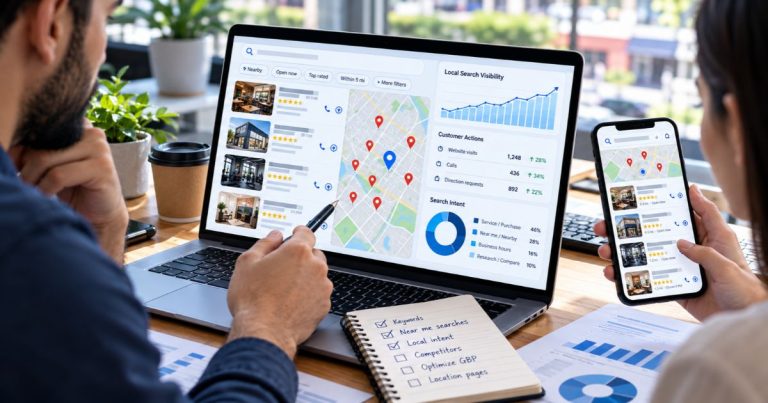
Local SEO Keywords: 11 Best Ways to Find Nearby Customers
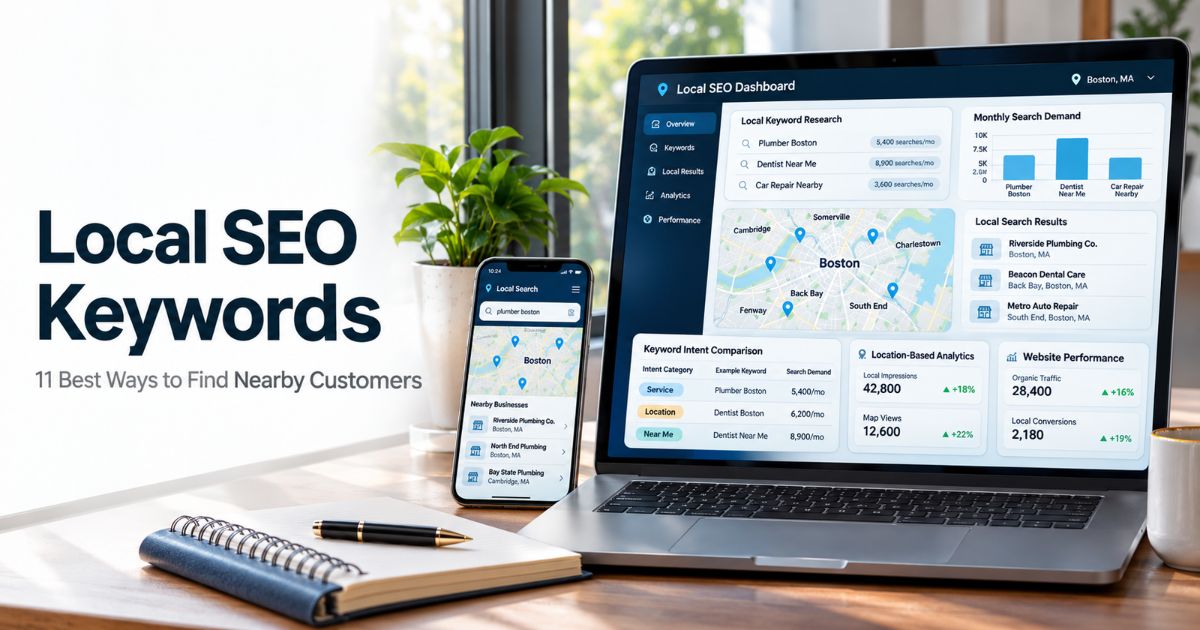
Local SEO keywords are the search phrases people use when they want a product, service, or business connected to a particular area. Some include a city or neighborhood, such as “emergency plumber in Boston.” Others, such as “dentist near me,” depend partly on where the searcher is located. Understanding that difference helps businesses create pages that answer real customer needs.
A useful local SEO keywords strategy starts with actual services and customer language, not an oversized list of phrases copied from a tool. Research should explain which areas a business truly serves, what customers want to accomplish, and whether a service page, location page, Google Business Profile, or helpful article is the right destination.
This guide covers 11 practical steps for finding, organizing, using, and measuring location-based terms. It includes a worked example, simple tables, four visual illustrations, and a checklist for implementation. For broader guidance, browse our Local SEO resource hub.
Key Takeaways
- Start with genuine services, customer questions, and places your business actually covers.
- Separate explicit location queries from searches where Google infers nearby intent.
- Look at local results and the Local Pack before deciding what type of page to create.
- Use Keyword Planner and third-party tools as directional research inputs, not guarantees of organic clicks.
- Group closely related phrases by search intent instead of building a separate page for every variation.
- Use location terms naturally in accurate service and branch information; never invent addresses or reviews.
- Measure meaningful outcomes such as qualified calls, bookings, inquiries, and location-page performance.
What Are Local SEO Keywords?
Local SEO keywords are words and phrases indicating that a searcher wants information, a product, or a service relevant to a geographic area. The area might be stated directly, inferred from device location, or implied by a query such as “open now.” A user searching for “roof repair Denver” makes the geography explicit, while “roof repair near me” asks the search experience to find suitable nearby providers.
Local SEO keywords matter because local customer intent is not identical to general informational interest. Someone searching for “how to repair a leaking pipe” may need instructions, while “emergency plumber open tonight” probably needs contact details and genuine availability. The page format should match that difference.
Google’s local results are mainly based on relevance, distance, and prominence. These factors help explain why two people typing the same short phrase in different neighborhoods may see different business listings. Optimizing local SEO keywords cannot eliminate proximity or guarantee placement in the Local Pack. Our local search intent guide explains how to interpret those results.
| Query Type | Illustrative Search | Likely User Need |
|---|---|---|
| Explicit geographic | Plumber in Boston | Providers serving Boston |
| Implicit geographic | Locksmith | Nearby locksmiths based on context |
| Proximity-based | Pizza near me | Convenient nearby options |
| Urgency or availability | Dentist open Saturday | Verified appointment availability |
| Neighborhood-specific | Brake repair South End Boston | A provider serving that neighborhood |
11 Practical Ways to Find and Use Local SEO Keywords
1. Define Your Actual Services, Locations, and Customer Goals
Before opening a research tool, write down what the business provides, which customers it can serve, and where services are genuinely available. A storefront needs a verifiable physical address; a service-area business may operate across several communities without welcoming customers at a retail counter. Do not use fictitious addresses simply to target more searches.
For local SEO keywords, create an initial matrix of core services, products, cities, neighborhoods, business attributes, and customer actions. A dental clinic might list teeth cleaning, emergency appointments, pediatric dentistry, accessibility, and Saturday hours—but only when those services or features are really offered. A home-repair business might emphasize licensed technicians, emergency coverage, and areas where travel is practical.
Define the desired next step for each group: phone call, booking, quote request, directions, or product pickup. This keeps your keyword list connected to commercial outcomes rather than vanity traffic. When several genuine branches are involved, our multi-location local SEO guide shows how to plan separate geographic experiences.
2. Collect the Words Customers Already Use
A reliable set of local SEO keywords often comes from your own customers. Review questions received by phone, email, chat, support tickets, and sales staff. Note everyday vocabulary that differs from the company’s internal labels. People may ask for “tyre fitting” where a business says “wheel service,” or ask for “same-day appliance repair” rather than a technical diagnosis.
During local SEO keywords research, capture language without collecting unnecessary personal information. Customer questions can be anonymized, and your team should follow its usual privacy practices. Use common themes, not a person’s private details, to build search ideas. Existing website-search queries and Search Console data may reveal additional terminology already associated with your business.
For example, a car workshop might collect “brake fluid change,” “car battery replacement,” “check engine light,” and “inspection before buying a used car.” Only then should it combine those concepts with real places. For an approach that connects topics to suitable URLs, read our content mapping framework.
3. Build Seed Groups With Services and Geographic Modifiers
Organize local SEO keywords into meaningful groups rather than one endless keyword export. Core service terms can be combined with cities, suburbs, neighborhoods, or legitimate service-area descriptions. Add urgency, availability, and attribute modifiers where they describe something customers can actually get.
Illustrative local SEO keywords for a plumbing company include “plumber Boston,” “emergency plumber South End,” “water heater installation Boston,” and “plumber open Sunday” if Sunday service is available. The purpose is to discover useful intent variations, not to put every combination into an article or business name.
It is fine to research “near me” searches, but you generally do not need awkward phrases such as “best plumber near me in Boston” repeated on the site. Use clear language that confirms coverage and makes an action easy. Our local landing pages guide explains how genuine coverage details make geographic pages useful.

4. Expand Ideas With Keyword Planner and Search Suggestions
When researching local SEO keywords, Google Keyword Planner can help expand seed phrases and estimate monthly search demand using selected location and language settings. Start with products or services and choose the appropriate target market; compare broader city-level phrases against narrower variants. Google designed Keyword Planner primarily for advertising research, so its forecasts should not be treated as guaranteed organic click estimates.
Use local SEO keywords suggestions from autocomplete, related searches, Google Trends, and reputable research tools as additional clues. Review their source markets, dates, definitions, and coverage limitations. Tools may group variants, show ranges rather than exact counts, or provide little information for very specific neighborhood phrases. Competition in a Google Ads report concerns advertisers and is not a direct organic ranking difficulty score.
For local SEO keywords, a “zero” or tiny reported search volume is a reason to validate the phrase, not necessarily a reason to discard it. A rare emergency request can be valuable if your business is actually able to help. Google’s Keyword Planner help guide explains the available ideas and estimates. Our keyword difficulty guide explains how third-party scores should be interpreted, and our traffic forecasting resource shows why predicted visits should remain scenarios rather than promises.
5. Inspect Search Intent and the Real Local Results
For every important local SEO keywords group, search from the target market or use a location-aware research environment. Check whether the result contains a Local Pack, ordinary service pages, directories, product listings, articles, or comparison resources. Results can vary by location, device, and time, so keep a record of when and where you inspected them.
One set of local SEO keywords may belong to an urgent-service page; another may be best served by a how-to article. “Emergency locksmith near me” suggests immediate availability and a phone number. “How to choose a locksmith” suggests advice. “Best locksmith in Boston” may invite comparison and independent reviews. Those different tasks need different page experiences.
Look beyond the first business shown. Inspect what customers can learn about hours, prices, service areas, credentials, and appointment options. Do not infer that one competing page is a universal template for success. For answer-style informational queries, our featured snippets guide discusses appropriate explanatory formats.
6. Compare Genuine Competitors Without Copying Their Pages
To research local SEO keywords competitively, identify businesses that appear for the services and locations you really target. A national information publisher may be a competitor for a how-to query, but not necessarily for a nearby appointment. Compare the business type, service availability, useful page details, geographic coverage, and customer questions addressed.
During local SEO keywords research, a competitor may reveal overlooked services or local terminology. For instance, a workshop’s competitors may discuss electric-vehicle diagnostics, weekend inspection slots, or mobile tire fitting. Investigate whether those represent genuine opportunities for your business rather than copying services you do not offer.
Use a keyword-gap report cautiously. A competitor ranking for a phrase does not mean its topic is appropriate for you, and an organic SERP is not the same as a map result. Note which page types appear in each. Our real estate local SEO guide illustrates how a specialized industry can require its own customer and neighborhood research.
7. Group Phrases by Intent and Assign One Useful Page
Grouping local SEO keywords makes content planning manageable. When searches represent the same need, one comprehensive page can often serve them naturally. When the results show genuinely different intent, separate pages may be justified. A car repair shop might handle basic brake replacement and related service questions on one service page, while an educational guide on how brakes work deserves a different destination.
With local SEO keywords, distinguish the service, intended audience, location, urgency, and next action before deciding. Do not create a new page every time an SEO tool suggests a synonym, plural form, or slightly different neighborhood phrase. Repeated city-name templates with no meaningful local facts are unhelpful to customers and may raise doorway-page concerns.
| Related Searches | Potential Page Type | Reason |
|---|---|---|
| Car tyre replacement, tire fitting prices, wheel fitting | Service page plus clear pricing details | Closely related service intent |
| Emergency plumber tonight | Emergency service page | Availability and immediate contact matter |
| How to repair a leaking tap | Educational guide | Reader may want instructions, not an appointment |
| Clinic downtown hours | Actual branch page | Specific contact and opening hours |
For local SEO keywords, store the primary group, related terms, target URL, search intent, business objective, and evidence behind each assignment. Our site architecture guide provides a model for linking service and geographic pages without creating unnecessary duplication.

8. Map Local SEO Keywords to Real Location and Service Pages
Pages targeting local SEO keywords should answer what is different or relevant about each real branch or service area. For a storefront, include its genuine address, hours, parking, accessibility details where available, staff or services, and practical contact options. For a service-area business, explain coverage boundaries, how bookings work, and any relevant travel or service limitations.
Do not assume that local SEO keywords require dozens of new URLs. A single well-maintained regional page can serve closely related neighborhoods when the service offering is the same. Dedicated city pages make more sense when a business has actual separate locations, teams, rules, or customer needs that justify distinct information.
Make the navigation clear: link the main location hub to real branches, connect service pages to the locations that offer them, and keep your internal links pointed at the intended live URLs. Our location pages for SEO guide shows what useful branch pages contain, while the content development workflow covers drafting and review.
9. Optimize On-Page Copy Without Keyword Stuffing
When using local SEO keywords on-page, place the primary topic and accurate geographic context in a helpful title, main heading, and introductory copy. Then write naturally about the actual service, coverage, and customer questions. A phrase should appear because it clarifies the page, not because a spreadsheet demands exact repetition in every paragraph or alt attribute.
For local SEO keywords, on-page quality also means practical information: accurate opening hours, genuine pricing or quote conditions, appointment steps, accessibility, credentials where relevant, and clear contact methods. Put the most important action near the top, especially on mobile. Avoid making unsupported claims about response times, service guarantees, or fabricated reviews.
Use informative images with alt text describing the visual. If an image shows a real branch entrance, describing the branch and city can be appropriate; if it shows a generic keyword chart, do not pretend it is a photograph of that branch. You can explore our content optimization articles for writing guidance and use our technical SEO audit resource when page templates or internal links need troubleshooting.
10. Keep Google Business Profile Details Aligned With the Website
For eligible businesses, Google Business Profile supports discoverability in Search and Maps. Keep the real-world business name, category, address or service area, telephone number, hours, and offered services accurate. Choose categories based on the business’s actual activity rather than adding unrelated popular terms. Do not add keywords to the business name unless they are genuinely part of the real-world name.
Local SEO keywords research can help identify which services customers ask about, but those phrases should be reflected through truthful descriptions and relevant pages. Reviews can show what customers value; they should not be manufactured or turned into unnatural keyword-stuffed responses. If multiple genuine branches have profiles, make sure each refers to an appropriate location page.
Google’s official local ranking guidance describes relevance, distance, and prominence and notes that payment cannot buy a better local ranking. Use these principles to set realistic expectations. Profile accuracy can help customers make decisions, but no particular keyword guarantees a map position.

11. Track Visibility, Calls, Bookings, and Keyword Changes
Local SEO keywords research becomes more useful when connected to outcomes. In Google Search Console, review queries, pages, clicks, impressions, and country or device filters where relevant. In GA4, review organic landing-page sessions and configured key events. For eligible Business Profiles, monitor available profile performance, calls, website interactions, and direction requests with attention to their reporting definitions.
Because local results depend partly on location, do not present one rank-tracking screenshot as a universal position. Compare consistent neighborhoods, devices, and date ranges; document competitor changes or business-hour adjustments. A term with low estimated volume might still be valuable if it reliably leads to genuine qualified inquiries.
Build a monthly review log for local SEO keywords: relevant phrase group, assigned page, search trend, actual customer action, issue found, and planned change. Avoid changing pages whenever a single day’s ranking fluctuates. Our SEO metrics guide, SEO reporting framework, recurring SEO checklist, and analytics resource hub can support consistent reviews.

Worked Example: Keyword Research for a Local Repair Shop
Consider a hypothetical repair shop that serves central Boston and nearby neighborhoods. The business offers brake checks, battery replacement, and pre-purchase vehicle inspections, with Saturday appointments but no overnight emergency service. The goal is to earn relevant bookings, not impressions from people looking for services the shop cannot deliver.
Its local SEO keywords seed list might include “car battery replacement Boston,” “brake inspection near me,” “pre-purchase car inspection South End,” and “car repair open Saturday.” Staff should check whether these phrases reflect actual questions, examine what the local search results show, and assess whether one service page or several distinct destinations offer the clearest answer.
| Illustrative Keyword Group | Customer Need | Suggested Destination | Measure |
|---|---|---|---|
| Battery replacement Boston | Book a specific service | Battery service page | Relevant inquiries and appointments |
| Brake inspection South End | Confirm nearby availability | Brake service page with true coverage details | Calls and service requests |
| Car repair open Saturday | Check weekend hours | Correct hours on business and location pages | Saturday bookings |
| How to tell if a battery is failing | Learn warning signs | Helpful educational guide | Useful engagement and next-step clicks |
The examples are not verified search-volume figures or performance predictions. If the shop later opens a second genuine branch, it can evaluate whether that location deserves a distinct page. Our local landing page examples show how to make the differences useful to customers.
Common Local Keyword Research Mistakes
- Stuffing city names: Repeating one neighborhood unnaturally cannot replace accurate service information.
- Creating doorway-like pages: Do not publish near-identical URLs for every town without distinct value.
- Trusting volume too literally: Tools provide estimates and may underrepresent narrow local phrases.
- Confusing ad competition with SEO difficulty: Paid-search advertiser competition does not directly predict organic rankings.
- Targeting unavailable services: Publish only what the business actually offers and where it serves customers.
- Ignoring mobile intent: Nearby searchers may need immediate calling, directions, or opening-hour information.
- Using one map ranking as proof: Local results vary with searcher position, time, and context.
- Measuring impressions only: Track qualified customer actions alongside search visibility.
- Inventing local credibility: Never add fake addresses, testimonials, offices, or credentials.
Local SEO Keywords Checklist Before Publishing
- Confirm services, service areas, real locations, and customer goals.
- Collect actual customer questions and commonly used wording.
- Build a seed list with relevant city, neighborhood, urgency, and service modifiers.
- Review Google Keyword Planner estimates and other suggestion sources cautiously.
- Inspect the live local search results for important query groups.
- Compare competitors with similar products, services, and coverage.
- Group related phrases by intent rather than minor wording differences.
- Assign each useful group to an appropriate existing or planned page.
- Write helpful titles, headings, and descriptions without repetition.
- Keep Google Business Profile facts accurate and consistent with the website.
- Link relevant service and location pages through ordinary navigation.
- Track search results, inquiries, calls, and bookings over comparable periods.
Frequently Asked Questions
What are local SEO keywords?
Local SEO keywords are phrases people use when looking for nearby services, products, or business information. They may mention a city or neighborhood explicitly, or imply local intent through wording such as “near me” or “open now.”
How do I find good local search terms?
Start with real customer questions, your services and coverage, search suggestions, keyword tools, and local result inspection. Prioritize phrases aligned with genuine customer needs rather than relying only on reported volume.
Do I need to use “near me” in my page title?
No. A clear title describing your service and real location is usually more readable. Google can interpret local intent using the searcher’s context, so repeating “near me” is not a substitute for useful business information.
Is Google Keyword Planner accurate for neighborhoods?
It is helpful for directional estimates and keyword ideas but can provide limited detail for very narrow areas or infrequent phrases. Validate its output with customer language and local search results.
Should every city have its own service page?
Not necessarily. Create distinct pages when there is meaningful area-specific information, operational capability, and a clear customer need. Do not generate numerous near-identical pages simply by replacing city names.
How are local organic results different from the Local Pack?
Local organic results reflect Google’s web ranking systems, while the Local Pack includes business listings influenced mainly by relevance, distance, and prominence. Both can matter to customers, but they are not identical reporting channels.
Can a keyword guarantee a Google Maps position?
No. Accurate profile information and suitable website content can help users understand a business, but rankings vary by relevance, distance, prominence, competition, and the search context.
How should I measure results?
Review relevant Google Search Console query and page trends, onsite engagement, eligible Business Profile interactions, and actual qualified calls or bookings. Document the market and date range used for comparisons.
How often should I update the keyword list?
Monthly or quarterly reviews can be practical, with earlier changes when services, hours, areas, or customer questions change. Update pages based on evidence rather than day-to-day ranking noise.
Conclusion
Local SEO keywords are most useful when they reflect real products, actual service locations, and the questions nearby customers ask. Research starts with people, expands through tools and live search observations, and ends with pages that genuinely help users find and contact the right business.
Build a manageable local SEO keywords map, avoid repetitive city templates, keep business details current, and evaluate performance through both search data and meaningful customer actions. Regular reviews will make the strategy more reliable than chasing every new phrase or treating a tool score as a ranking promise. For more practical search guidance, visit the Online SEO Blogs homepage.