
SEO Content Development: 9 Proven Steps for Success
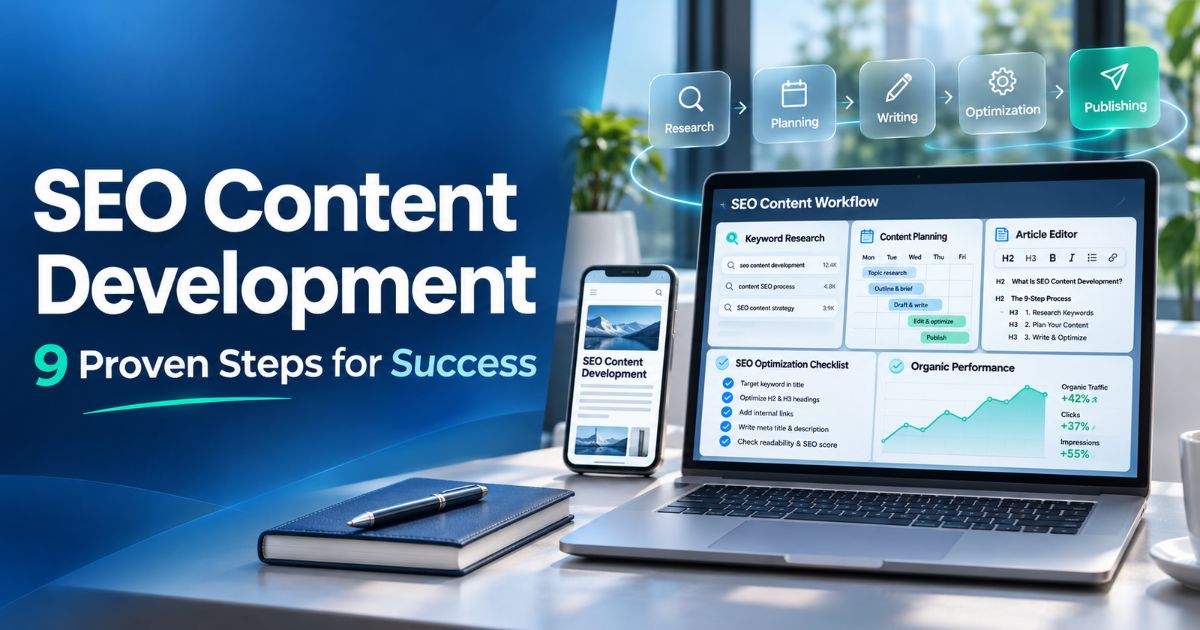
SEO content development is the process of researching an audience, planning useful pages, creating accurate material, optimizing its presentation, publishing it correctly, and measuring what happens afterward. It is more than putting a target keyword into an article. A strong workflow gives every page a clear reader, purpose, and next action.
Effective SEO content development connects editorial judgment with search data. Keyword tools can reveal possible demand, but customer questions, search intent, firsthand expertise, and quality checks determine whether a page deserves to exist. The work continues after publication because products, user needs, and search results change.
This guide follows nine practical steps from initial research to post-publication improvements, including templates, quality-control checks, and a realistic example. For additional context, explore our Content SEO & Marketing guides and practical SEO improvement strategies.
Key Takeaways
- Start with a specific customer problem and a business purpose, not a keyword list alone.
- Inspect existing pages before commissioning another article with overlapping search intent.
- Choose a suitable format and use original information, examples, evidence, and editorial expertise.
- Structure content with clear headings, helpful internal links, accurate visuals, and appropriate metadata.
- Validate factual claims, link destinations, image descriptions, accessibility, and page indexability before publishing.
- Measure relevant clicks, engaged visits, leads, or sales without promising a ranking outcome.
- Refresh a page when evidence or user needs change, rather than changing dates for appearances.
What Is SEO Content Development?
SEO content development is an organized editorial workflow designed to help people find and use content that addresses their needs. It covers audience research, search-intent analysis, content mapping, drafting, verification, on-page improvements, publishing, distribution, and measurement. The goal is helpful information that is discoverable and easy to navigate.
Unlike simply writing to meet a keyword quota, this approach considers what the searcher needs at each stage. A person asking “what is a CRM?” needs a definition. Someone comparing two products needs criteria, limitations, and fair alternatives. A customer ready to purchase may need a product page rather than another long tutorial.
Google’s people-first guidance asks whether a page provides original value and a satisfying answer for its intended audience. It does not prescribe one ideal article length or fixed keyword density. Our content mapping guide explains how page purpose connects to search intent and the buyer journey.
9 Proven Steps in SEO Content Development
1. Define the Goal, Audience, and Content Brief
Begin SEO content development with an outcome you can explain. A publishing project might aim to answer recurring support questions, support product comparisons, attract qualified inquiries, or provide an accessible reference for existing customers. Define which audience benefits and what they should be able to do after reading.
Use real evidence from customer interviews, support tickets, CRM notes, internal site search, sales objections, and existing analytics. SEO content development should also identify which facts need expert review before anyone writes the page. Distinguish a topic’s business relevance from its popularity. A broad query with large estimated volume may not help your audience, while a specific question with limited searches could resolve an important purchase objection.
A useful brief records the audience, main question, intent, page format, primary topic, intended URL, author or subject specialist, evidence sources, relevant internal pages, visual needs, and next action. Assign an owner and a realistic editorial review process; do not invent credentials or author identities to create a false impression of expertise.
For SEO content development, document success before drafting. An educational article may be judged by qualified engagement and progress to deeper guides, while a service page might prioritize requests for consultation. See our SEO metrics reference for useful distinctions between impressions, clicks, sessions, and conversions.
2. Research Queries and Inspect Live Search Intent
SEO content development research blends keyword estimates with observations of real search results. Build a shortlist using customer language, Search Console queries, and relevant keyword tools. Record the country, language, topic, estimated demand, date, and which existing page—if any—already serves the need.
Search for your main question and note whether results favor how-to articles, comparison pages, documentation, product listings, forums, or location-specific results. Identify common questions and important missing details. A keyword difficulty score can help prioritize research, but it is a proprietary estimate, not an official Google probability of success.
In SEO content development, related search phrases often belong on one strong page rather than separate near-identical articles. Group variations by their underlying task and select one clear primary topic. Our keyword difficulty guide explains the limits of tool scores, while our international keyword research guide shows why language and market context matter.
Record findings in a small research table: query cluster, audience problem, intent, preferred page type, competing formats, important facts to verify, and business relevance. Avoid treating search-engine result features as permanent; what appears can change across devices, locations, and dates.
3. Audit Existing Pages and Map Topic Coverage
Before commissioning a new page, review the content already available on your site. In SEO content development, this inventory prevents duplicate intent, wasted editorial effort, and confusing site navigation. Search your CMS and inspect Search Console performance for related URLs.
Classify each relevant asset as keep, improve, consolidate, reposition, or create. A dated guide may need corrections and examples instead of a competing replacement. Two articles answering the same customer question may be clearer as one comprehensive resource, with a redirect plan if a URL is retired.
For SEO content development, map supporting content to its logical next steps. For example, a beginner’s research guide may point to a technical checklist, while a comparison page links to detailed evaluations. Use descriptive anchor text that tells readers what they will find. Our site architecture resource covers crawlable pathways and the recurring SEO tasks checklist can help schedule inventory reviews.
SEO content development benefits from a single tracking sheet with page URL, intended audience, main topic, content stage, owner, review date, existing links, and recommended action. This reduces the risk that different writers create overlapping pieces independently.
| Existing Page Status | Meaning | Practical Action |
|---|---|---|
| Keep | Useful and current | Maintain and link where relevant |
| Improve | Right intent, weak or outdated details | Verify facts and expand useful sections |
| Consolidate | Several pages answer the same need | Choose a stronger destination and plan redirects |
| Reposition | Useful material for a different intent | Change structure or target audience |
| Create | Clear audience need remains unanswered | Approve a new brief and URL |
4. Design an Answer-First Outline and Choose the Right Format
An SEO content development outline should mirror the reader’s questions, not simply a list of repeated keywords. Start with the main answer, then arrange supporting explanations, methods, limitations, and examples in a logical order. Make headings specific enough that a reader can scan the page and find the relevant section.
In SEO content development, choose the format for the task: steps for a procedure, a table for a meaningful comparison, a diagram for a process, or a brief definition followed by useful context. Some questions are better answered with a calculator, checklist, video, or product documentation instead of a blog post. A well-chosen format supports understanding without promising special search appearances.
For SEO content development, keep the opening clear about what the page covers and avoid long introductions that delay the answer. Add a small table of contents on substantial pages where it genuinely helps navigation. See our featured snippets formatting guide for practical answer structures, while remembering that no format guarantees a featured result.
Include planned images only where they explain a point. A photograph of a review meeting may support an editorial workflow section, while a visual about nofollow attributes belongs with link checks rather than an unrelated writing section. Each visual should have concise alt text describing what it shows.

5. Draft Original, Accurate, People-First Content
The writing stage of SEO content development is where a useful outline becomes an actual resource. Explain the subject in natural language, define unfamiliar terms, and support important claims with evidence. Use examples drawn from real experience when available, and clearly label hypothetical scenarios so readers do not mistake them for observed results.
Google recommends content that is helpful, reliable, original, and written primarily for people rather than for manipulating rankings. That means a page should add something beyond a rewording of competing results: useful observations, working instructions, transparent comparisons, informed analysis, or clear corrections to common misunderstandings.
During SEO content development, writers should distinguish verifiable facts from judgment or forecast. For a software article, confirm current features and limitations; for a statistical claim, name the source and date; for a case study, disclose the actual sample and method. Avoid presenting unverified survey percentages or invented success stories as proof.
Use accessible paragraphs and varied transitions. Headings, bullets, and tables should organize information rather than artificially inflate length. Google does not require a universal minimum word count; cover the topic as fully as the reader needs. For a wider editorial framework, see the content strategy library and review the LLMO checklist for adjacent clarity considerations in AI-powered discovery.
AI tools can help brainstorm, reorganize material, or identify possible gaps, but they do not substitute for fact-checking and editorial responsibility. Check generated claims and citations, remove unsupported material, and ensure the finished page reflects the publisher’s real expertise and standards.
6. Optimize Titles, Headings, Images, and Internal Links
On-page SEO content development helps search engines and readers understand the finished page. Write a descriptive SEO title, a meaningful main heading, a concise meta description, and a stable URL. Put the primary topic naturally near the beginning of the article without repeating it in every sentence.
During SEO content development, use the terms your audience would recognize in headings and body copy, but prioritize clarity over density targets. Google can understand related wording without exact repetition. See its official SEO Starter Guide for further advice on useful titles, links, and images. Keywords inserted mechanically into tables, image alt attributes, or every heading can make the page less useful rather than more relevant.
For SEO content development, link internally to genuinely related guides so people can explore next steps. A descriptive link to our traffic forecasting guide makes sense when discussing projections, whereas an unrelated backlink article may not. Check that each URL resolves, links are crawlable, and anchors describe their destinations.
Images should be clear, relevant, properly sized, and accompanied by short descriptive alternatives if informative. Avoid writing keyword-stuffed alt text that misrepresents the image. Our technical SEO guides cover additional page-level controls that may affect discoverability.
7. Verify Facts, Editorial Standards, and Link Relationships
Before publication, SEO content development needs a real quality-control stage. Proofread spelling, grammar, titles, headings, examples, and table labels. Confirm any quoted statistics, current product facts, date-sensitive claims, and the availability of external references. A second reader or subject specialist can catch gaps the original writer misses.
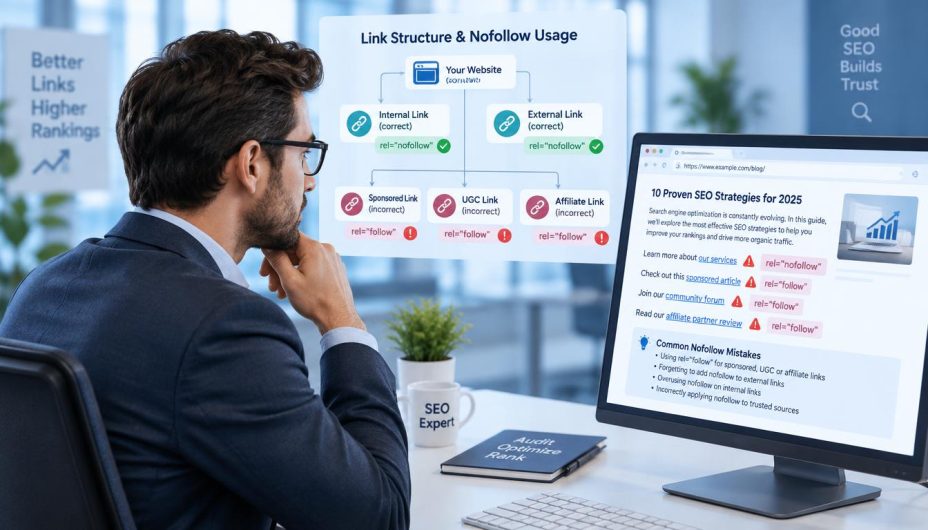
Check every link for relevance and destination accuracy. Ordinary editorial citations generally do not require rel="nofollow". Google prefers rel="sponsored" for commercial or affiliate placements and recommends rel="ugc" for suitable user-submitted links. These attributes describe relationships; none is a shortcut to rankings.
Link checks are one part of SEO content development, not the central topic of every article. A nofollow link can still be clicked by a human, and it is not an indexing-control tool. For a dedicated explanation, read our nofollow links and SEO guide. For editorial outreach processes, see our link prospecting resource.
The original imagery in this article includes link-attribute diagrams. Keep those visuals next to the editorial-link review rather than claiming that they show the whole content workflow. If possible, replace them later with diagrams specifically about research, writing, editing, and publishing.

Record reviewer approval and any outstanding issue. A repeatable checklist should flag broken links, unverified claims, misleading visuals, copied paragraphs, absent author context, and inaccessible interactions. Read the official Google people-first content guidance as a reference for evaluating originality, usefulness, and trust.
8. Publish With Technical and Distribution Checks
The publishing stage of SEO content development involves more than pressing the WordPress button. Preview desktop and mobile layouts, confirm the permalink, image sizes, table readability, call-to-action functionality, and whether the page should be indexable. Check that the content does not accidentally contain robots directives, broken canonical references, or placeholder text.
For SEO content development, retain a straightforward release checklist covering the final title, meta description, category, tags, featured image, accessible image descriptions, relevant internal links, approved outbound references, and a named reviewer. Keep the post date accurate and document significant changes when revisions are made.
After SEO content development moves into publication, ensure the URL can be discovered through relevant site navigation. Sitemaps may help search engines find URLs but do not guarantee crawling or indexing. Our XML sitemap guide explains what to include, and our technical audit resource offers a way to record deployment problems.
Distribution is another SEO content development responsibility: bring the page to interested people through appropriate newsletters, community participation, or independent editorial coverage. Do not spam irrelevant forums with identical links or buy ranking-credit placements. The objective is readers who genuinely benefit, not artificial referral numbers.

9. Track Outcomes, Refresh Content, and Document Learning
SEO content development does not finish at publication. Use Search Console to observe relevant search queries, impressions, clicks, and page performance, while GA4 and business systems can show onsite activity and outcomes where configured. Compare similar time periods and distinguish search demand from changes in the page itself.
For SEO content development, choose metrics based on the page’s job. An introductory resource may be judged by useful engaged visits and navigation to deeper content; a comparison page might lead to trials; a service page may support qualified inquiries. A higher ranking for an irrelevant query is not automatically a business success.
Our SEO reporting framework explains how to connect observations to decisions. Our analytics and SEO tools library provides supporting measurement concepts. Avoid attributing every click change to an algorithm update without investigating seasonality, technical issues, competition, and tracking changes.
Use SEO content development reviews to update genuinely stale facts, add missing answers, correct examples, remove confusing sections, and consolidate duplicate intent. Do not change the publication date merely to appear fresh. Maintain a log describing what changed, why, and what results you observed afterward.
Example: A Practical Editorial Workflow for One Guide
Consider a hypothetical small business preparing a guide on choosing a business scheduling tool. The audience is an operations manager comparing options, not a beginner looking for a general definition. The research team identifies real questions about integrations, pricing, data exports, and appointment reminders.
In this SEO content development example, the editor audits existing software articles, assigns one comparison page to the primary query group, and asks a product specialist to verify technical claims. The writer builds an answer-first outline and a comparison table with clearly stated criteria. The editor then checks all claims and sources, adds contextual internal links, and publishes a mobile-friendly page.
After launch, the team observes relevant impressions, qualified sessions, and demo requests rather than declaring success from a keyword-density score. The details are illustrative; there are no promised traffic or conversion percentages.
| Stage | Output | Owner | Approval Check |
|---|---|---|---|
| Research | Audience questions and intent notes | Strategist | Evidence and business relevance |
| Planning | Content map and outline | Editor | Distinct purpose and useful structure |
| Writing | Original draft and examples | Writer or expert | Accuracy and completeness |
| Optimization | Metadata, links, and visuals | SEO specialist | Clarity, accessibility, and relevance |
| Publishing | Accessible live page | Publisher | Working URL and correct settings |
| Review | Performance notes and update log | Analyst and editor | Actions supported by observed results |
Common SEO Content Development Mistakes
- Starting with a large keyword list: Connect research to real customers and relevant business needs first.
- Producing overlapping posts: Audit existing URLs before creating a near-duplicate page.
- Writing from search snippets alone: Add original reasoning, examples, testing, and reliable evidence.
- Stuffing an exact phrase: Use terminology naturally; there is no Google-mandated density percentage.
- Adding irrelevant images: Select visuals that explain the adjacent section and describe them accurately.
- Misusing link attributes: Do not mark all editorial references nofollow by default.
- Ignoring technical publishing checks: Verify indexability, navigation, media, and functional calls to action.
- Making unsupported ranking promises: Publishing useful content improves the work but guarantees no search position.
- Updating dates without improvements: Revise when information or reader needs change meaningfully.
SEO Content Development Pre-Publish Checklist
- Confirm the target audience, reader problem, and intended business purpose.
- Check live search intent and relevant competitor page formats.
- Review existing posts for duplicates and consolidation opportunities.
- Approve a content brief with a named owner and fact sources.
- Place a direct answer early and use descriptive H2/H3 headings.
- Use accurate original examples and clearly label hypothetical numbers.
- Proofread claims, grammar, comparisons, dates, and terminology.
- Keep metadata and primary topic natural and accurate.
- Check the relevance, accuracy, and reachability of every link.
- Describe informative images accurately and test mobile readability.
- Confirm canonical preferences, crawl access, and appropriate indexing settings.
- Publish with the correct category, featured image, and call to action.
- Record performance baselines and plan a useful review date.
Frequently Asked Questions
What is SEO content development?
SEO content development is a repeatable process that combines audience research, content planning, original writing, on-page SEO, quality assurance, publishing, and ongoing performance review. Its purpose is useful content that people can discover and trust.
How is content development different from content writing?
Writing is one production stage. Development also includes deciding what to create, researching the audience, checking existing coverage, verifying claims, optimizing page structure, publishing correctly, and measuring outcomes.
Does every article need a fixed keyword density?
No. Google does not prescribe an exact density target. Use the main phrase naturally and make the article genuinely helpful. An editorial target can be useful for internal checking but must not justify keyword stuffing.
How long should an SEO article be?
There is no universal preferred length. Write enough to answer the searcher’s question accurately with useful context, examples, and necessary qualifications, without repeating sections solely to increase word count.
Can AI tools write SEO content?
AI tools can assist with brainstorming and drafting, but the publisher remains responsible for accuracy, originality, citations, and any required disclosures. Mass-producing low-value material to manipulate rankings is not a sound publishing strategy.
What should a content brief include?
Include audience, intent, primary question, page type, existing relevant URLs, article structure, sources to verify, visual requirements, author or reviewer, desired next action, and how success will be assessed.
Are internal links important before publication?
Yes. Useful internal links help readers navigate related topics and can help search engines discover pages. Make anchor text descriptive and link to the actual preferred URL.
How do I measure content performance?
Use appropriate Search Console, analytics, and business metrics based on the page’s goal. Compare equivalent periods and connect important findings to practical editorial or technical decisions.
When should an article be updated?
Update it when products, facts, customer needs, search intent, links, or measured outcomes reveal something worth improving. A calendar can schedule reviews, but it is not a reason to rewrite an otherwise accurate article.
Conclusion
SEO content development works best when each step supports a real person. Research the question, check existing coverage, choose the right page, write a clear answer, verify the details, optimize presentation, and publish through a dependable review process.
Then measure relevant outcomes and make improvements where evidence supports them. Sustainable SEO content development is not a shortcut to guaranteed rankings; it is a disciplined approach to useful, trustworthy content. For ongoing guidance, explore the Online SEO Blogs article library.