
SEO Metrics: 12 Essential KPIs for Organic Growth
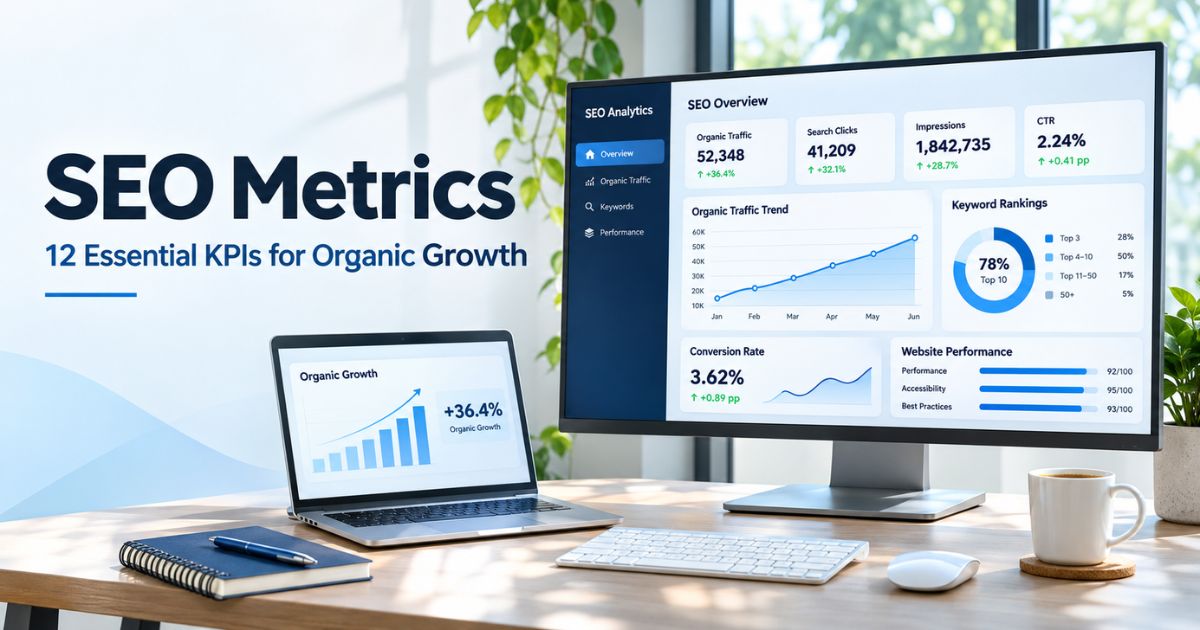
SEO metrics tell you whether organic search is helping the right people discover your website and take useful actions. Rankings alone cannot answer that question. A page might gain impressions without gaining clicks, or attract more visitors without producing a single qualified lead.
This guide explains 12 essential measurements for organic growth, where to find them in Google Search Console and Google Analytics 4 (GA4), how to interpret the numbers, and which mistakes to avoid. For the broader strategy behind measurement, read our practical SEO improvement guide.
Key Takeaways
- Choose SEO metrics that connect search visibility with business outcomes, rather than reporting every available number.
- Search Console shows Google Search clicks, impressions, CTR, and average position; GA4 measures onsite activity and configured outcomes.
- Compare similar date ranges, pages, countries, devices, and query groups before explaining an increase or decline.
- Use organic sessions and engagement as supporting context, not proof of revenue or lead quality by themselves.
- Check indexability and Core Web Vitals when technical problems could affect important pages.
- Review SEO metrics monthly and assign practical follow-up actions based on the evidence.
What Are SEO Metrics and Why Do They Matter?
SEO metrics are measurements used to evaluate search discovery, website visits, content performance, technical accessibility, and business results associated with organic search. Some are outcomes, such as qualified leads; others are diagnostic indicators, such as impressions or indexing errors.
Good reporting answers three questions: Are more relevant people discovering the website? Are they engaging with the right pages? Are their visits supporting meaningful goals? An effective dashboard should make those answers clearer, not hide them beneath dozens of unexplained charts.
Keep the distinction between tools clear. Search Console measures activity in Google’s search results, while GA4 records sessions and events on your website according to your analytics configuration. Their totals will not always match because they measure different things. For a detailed reporting framework, see our SEO reporting guide and the SEO Tools & Analytics library.
12 Essential SEO Metrics to Track for Organic Growth
1. Organic Search Clicks
Among the most direct SEO metrics, clicks show how often a searcher selected a link to your website from Google Search results, under Search Console’s counting rules. It is a direct measure of visits initiated from that search surface, although a click and an analytics session are not identical events.
Open Google Search Console > Performance > Search results, choose a stable time range, and examine total clicks alongside individual pages and queries. If clicks decline, check whether the loss is concentrated in a few URLs, a specific device, or one country before changing sitewide content.
Among SEO metrics, clicks are an accessible starting point, but they do not explain whether visitors find your pages helpful or convert. Combine them with landing-page and outcome data.
2. Search Impressions
For discovery-focused SEO metrics, an impression represents an eligible appearance of your site’s content in Google Search, subject to result-type rules. Rising impressions may indicate broader query coverage, but they can also come from searches with little relevance to your audience.
Compare impressions for high-intent and informational queries separately. If a page gets more impressions but no additional clicks, inspect the search terms, result layout, and relevance of the page’s title and description. Do not assume every impression occurred in a standard blue-link result.
The official Google Search Console Performance documentation explains the available metrics and dimensions.
3. Organic Click-Through Rate (CTR)
For actionable SEO metrics, CTR = (clicks / impressions) × 100. If a page records 120 clicks from 4,000 impressions, its CTR is 3%. This is an illustrative calculation, not a performance benchmark.
CTR should be analyzed by page, query, device, and search appearance. A low rate is not always a title problem: it can reflect rankings, mixed user intent, zero-click answers, or different result formats. Look for pages where impressions are meaningful and the snippet may not accurately represent the answer.
Use SEO metrics such as CTR to identify review candidates, then check the actual search results before rewriting titles. For page-to-query alignment, our content mapping guide explains how intent connects to content decisions.

4. Average Search Position
Among ranking-oriented SEO metrics, average position is the average position of your site’s highest-positioned result for the relevant impressions, based on Google’s reporting rules. It is not a permanent ranking for one keyword and should not be interpreted as the exact position every user sees.
Review its trend together with clicks and impressions. A change in the mix of queries can shift the average even if valuable pages remain stable. Segment branded and non-branded searches where possible, and review priority page groups instead of celebrating a single sitewide number.
SEO metrics become more useful when you ask which pages and search intents changed, rather than treating every movement in average position as a success or failure. Our keywords and SEO guide provides context for that distinction.
5. Organic Search Sessions
For onsite SEO metrics, GA4 organic search sessions indicate visits attributed to an organic search channel under the chosen reporting dimension and attribution rules. Use them to understand the volume of onsite visits, but avoid comparing them directly with Search Console clicks as if both systems should produce the same count.
Look at session trends by landing page, device, and relevant geography. Review consent changes, tracking deployments, and channel definitions when results shift sharply. A tracking problem can resemble a traffic problem, so verify measurement before drawing conclusions.
For teams creating recurring reports, our technical SEO audit presentation guide can help separate tracking issues from actual changes in website performance.
6. Engagement Rate and Engaged Sessions
Engagement-focused SEO metrics include engagement rate, the proportion of sessions GA4 classifies as engaged according to its definition. Engaged sessions can indicate that visitors spent meaningful time, viewed multiple pages, or completed a key event, depending on the event and session conditions.
Consider engagement rate alongside the page’s purpose. A visitor who quickly finds a phone number may have had a successful experience without browsing numerous pages. Conversely, a long session does not necessarily indicate satisfaction.
Use these SEO metrics diagnostically: compare similar landing pages and traffic segments rather than applying one universal engagement threshold to a service page, guide, and product listing.
7. Organic Search Key Events
Outcome-focused SEO metrics can include GA4 key events. GA4 lets you mark important events as key events, such as completed lead forms, registrations, or purchases. Configure them around real business objectives, test that they fire correctly, and avoid counting casual interactions as meaningful outcomes without a clear reason.
A site may gain organic visits while key events stay flat. That suggests a need to inspect audience fit, landing-page relevance, form usability, or tracking quality before concluding that SEO performance improved.
For service businesses, the quality of a lead matters as much as the event count. Our B2B SEO guide provides useful context for longer conversion journeys.
8. Organic Conversion Rate
One of the most useful SEO metrics is conversion rate. It expresses the proportion of eligible sessions or users associated with a defined goal. State exactly which denominator and attribution method you are using; different reports may calculate conversion-related rates differently.
For example, if 40 of 2,000 organic search sessions include a qualifying lead action, the session-based rate in this simplified example is 2%. Do not compare it with a user-based rate without making that difference explicit.
These SEO metrics are especially useful when an article attracts traffic but fails to support its intended next step. Content relevance, trust signals, clear navigation, and sensible calls to action may be more important than adding more keywords. Our site architecture guide discusses how page relationships support user journeys.
9. Organic Revenue or Qualified Leads
To connect SEO metrics to real outcomes, ecommerce businesses should track purchases and revenue attributable to the chosen organic search reporting model. For lead-generation businesses, track qualified inquiries, booked appointments, or sales opportunities where your systems make that possible.
Revenue and lead quality are outcome measures; impressions and average position are supporting indicators. Be transparent about attribution, offline conversions, repeat customers, and incomplete tracking. A conversion that happens after someone discovers your brand through organic search is not automatically caused by that one visit.
Among SEO metrics, business outcomes deserve the most attention from decision-makers. Pair them with query and landing-page trends to identify which improvements may be worth funding.

10. Organic Landing-Page Performance
Page-level SEO metrics help reveal where gains and losses occur. A landing-page report shows where visits begin and what happens afterward. Review pages by purpose: informational guides, product categories, service pages, location pages, and comparison content can have very different goals.
Check which pages are gaining or losing search clicks, which earn engaged sessions, and which contribute to key events. A page with modest traffic may still matter if it helps generate qualified inquiries or supports another important destination through contextual links.
Google’s GA4 Landing Page report documentation describes the available report and metrics. For a topical content strategy, see our Content SEO & Marketing resources.
11. Indexability of Important URLs
Indexing-related SEO metrics protect important URLs. A page cannot earn ordinary organic visibility if it is not eligible to appear in search results. Review Google Search Console’s Page indexing report and URL Inspection tool for important pages, then investigate the actual reason for an exclusion or unexpected canonical selection.
Useful checks include accidental noindex directives, blocked resources, server errors, redirects, duplicate URLs, and missing pages. Not every excluded URL is an error: some pages should remain out of the index. The goal is to protect pages that genuinely matter to the business.
Technical SEO metrics should focus on severity and affected page value, not only the number of warnings. Our XML sitemap guide, canonical pagination guide, and Technical SEO library explain related indexing decisions.
12. Core Web Vitals
Experience-oriented SEO metrics include Core Web Vitals, which describe aspects of real-world page experience: Largest Contentful Paint (LCP) for loading, Interaction to Next Paint (INP) for responsiveness, and Cumulative Layout Shift (CLS) for visual stability.
Common good-experience thresholds are LCP at or below 2.5 seconds, INP at or below 200 milliseconds, and CLS at or below 0.1. Interpret these alongside field-data availability and the number of important URLs affected. Passing these thresholds is valuable for usability but does not guarantee higher rankings.
Use SEO metrics from technical monitoring to prioritize template-level problems rather than fixing isolated low-value URLs first. For a broader quality review, read our foundational SEO principles.

Supporting Indicators: Backlinks, Content, and Search Demand
Not every useful measure belongs on your 12-metric executive dashboard. Referring domains, editorial mentions, referral sessions, content refreshes, and branded search demand can add context when a campaign or traffic change requires investigation.
A backlink count alone does not prove why rankings changed. Review link relevance, editorial context, and referral quality. Our enterprise link-building guide covers sustainable link acquisition, while the off-page SEO hub offers related resources.
For content updates, look at queries and landing pages that lost meaningful visibility, not simply articles with a low plugin score. If a change coincides with a documented algorithm rollout, use our Google update tracker and core update analysis guide as context while checking technical and content-specific causes.
A Practical SEO Metrics Dashboard Template
You do not need a complicated reporting system to get started. A useful monthly dashboard should include the metric, current period, comparison period, absolute change, percentage change when meaningful, and a brief explanation.
| Metric Group | Primary Source | Question Answered | Typical Next Action |
|---|---|---|---|
| Clicks and impressions | Search Console | Are relevant pages being discovered and visited? | Review queries and pages that changed. |
| CTR and position | Search Console | Are snippets matching search intent? | Inspect SERPs and page relevance. |
| Organic sessions | GA4 | Are organic visitors arriving onsite? | Check landing pages and tracking. |
| Engagement | GA4 | Are visitors interacting with content? | Review audience and page purpose. |
| Key events and outcomes | GA4 / CRM | Are visits supporting business goals? | Check conversion paths and data quality. |
| Indexability | Search Console | Can priority pages appear in search? | Resolve material indexing errors. |
| Core Web Vitals | Search Console / field data | Are important templates performing well? | Prioritize affected templates. |
For teams working across countries, compare comparable markets separately. Our international SEO keyword research guide explains why the same query or keyword opportunity can differ substantially by region.
How to Interpret SEO Metrics Without Misleading Yourself
Compare equivalent periods
Compare the last 28 complete days with the previous 28 days, or the same period last year when seasonality matters. Record any changes in tracking, site structure, publishing cadence, and market conditions. Avoid drawing conclusions from incomplete or preliminary data.
Segment by purpose and audience
Look separately at brand and non-brand queries, desktop and mobile, countries, and priority page groups. For local businesses, location-specific landing pages may be more meaningful than sitewide totals; our location pages guide illustrates the importance of serving distinct local needs.
Explain uncertainty
Correlation is not proof of causation. If clicks rise after a title update, investigate the affected queries and concurrent changes before attributing the increase entirely to your edit. Similarly, a rankings decline during a Google update does not automatically mean your website has a penalty.
Connect findings to decisions
Every meaningful observation should lead to a decision: investigate, fix, test, update, monitor, or take no action. Strong SEO metrics reporting includes an owner and a follow-up date instead of endlessly collecting screenshots.

Common SEO Measurement Mistakes
- Tracking everything: Too many numbers can hide the business goal. Choose a small set of decision-relevant KPIs.
- Confusing clicks with sessions: Search Console and GA4 use different definitions and processing rules.
- Treating average position as a fixed rank: Search position varies by query and context.
- Ignoring conversion quality: More visits are not automatically better leads or revenue.
- Using one conversion-rate denominator everywhere: Define users, sessions, and attribution clearly.
- Blaming every decline on an algorithm update: Check tracking, seasonality, technical issues, and content first.
- Assuming every index exclusion is harmful: Some URLs are intentionally excluded.
- Focusing on a plugin score: On-page checks cannot replace audience and business evidence.
SEO Metrics Checklist for Monthly Reviews
- Confirm property access, date ranges, and tracking reliability.
- Review clicks, impressions, CTR, and average position trends.
- Compare important pages, queries, devices, and countries.
- Review organic sessions and engagement by landing page.
- Check key events, qualified leads, purchases, and revenue where configured.
- Inspect unexpected indexing problems affecting priority pages.
- Review Core Web Vitals for important templates and traffic groups.
- Record relevant Google updates, migrations, and major site releases.
- Assign an owner, priority, and follow-up metric for each action.
Frequently Asked Questions
What are the most important SEO metrics?
Start with organic clicks and impressions, then include onsite engagement and business outcomes such as qualified leads or purchases. Add CTR, position, indexing, and technical health when they help diagnose a specific issue.
What is the difference between Search Console and GA4?
Search Console measures visibility and clicks in Google Search. GA4 measures activity on your website according to its analytics and attribution configuration. Their counts are not expected to match exactly.
Is organic traffic enough to measure SEO success?
No. Traffic volume does not reveal whether visitors are relevant, engaged, or converting. Combine acquisition measures with page purpose and business outcomes.
How often should SEO performance be reviewed?
Weekly checks may help detect urgent incidents, while monthly reports suit routine decisions. Major migrations, releases, and confirmed search updates may require additional investigation.
Does a higher average position guarantee more clicks?
No. Query demand, search appearance, user intent, and result features affect click behavior. Compare relevant clicks, impressions, and CTR with position trends.
Should I track bounce rate?
GA4 bounce rate can be used as a complementary diagnostic, but it should not be treated as a direct Google ranking factor or a universal quality score. Interpret it according to page purpose and the engagement configuration.
What should I do when organic clicks drop?
Verify the comparison period and tracking first. Then segment affected queries, pages, countries, and devices, check indexing and technical changes, and review relevant search context before making changes.
Conclusion
The best SEO metrics are the ones that connect organic discovery to useful decisions. Search Console can show whether people see and click your pages; GA4 and business systems can help assess what happens after they arrive; technical checks explain whether important pages remain accessible and usable.
Choose a clear measurement plan, compare equivalent periods, explain uncertainty, and act on the most meaningful findings. For deeper examples, explore our SEO guides and keep improving the parts of your website that matter to real visitors.