Hreflang and Duplicate Content: 9 Best SEO Fixes

Hreflang helps Google understand which language or regional version of a webpage is intended for a particular audience. Duplicate content is a related but different issue: when several URLs contain identical or very similar main content, Google may choose one representative URL for indexing. International websites need to coordinate these signals rather than assume one annotation solves both problems.
A US product page and a UK product page might share most of their English copy yet differ in currency, shipping, support, and buying terms. A Spanish translation of that product is different again. The right approach depends on whether each URL serves a meaningful audience and how Google can access, interpret, and select it.
This guide explains nine practical fixes for hreflang and duplicate content, including localization, return links, language codes, canonical URLs, sitemaps, and technical validation. Start with the Technical SEO resource hub if you also need help with crawling, indexability, or website architecture.
Key Takeaways
- Hreflang identifies equivalent language or regional alternatives; it does not make duplicate pages unique.
- Translated main content and same-language regional copies require different editorial and canonicalization decisions.
- Use valid language codes such as
enand valid language-region combinations such asen-GB. - Each alternate should include itself and link back to the other members of the same cluster.
- HTML head annotations, HTTP headers, and XML sitemaps are supported approaches; choose one maintainable source of truth.
- Coordinate canonical URLs with localized alternatives instead of indiscriminately canonicalizing every country page to one global URL.
- Keep intended alternates accessible, return successful responses, and investigate conflicting robots or noindex rules.
- Google decides its own canonical selection and search presentation; correct annotations do not guarantee country-specific rankings.
What Is Hreflang, and How Does It Relate to Duplicate Content?
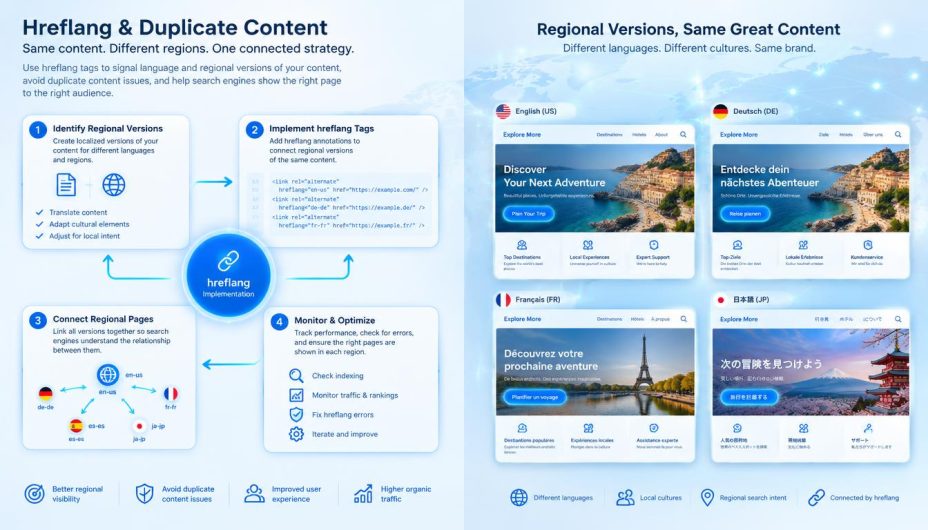
Hreflang is an alternate-language annotation that helps Google associate equivalent webpages aimed at different languages or regions. For example, an English page serving the United States might have an equivalent English page for Great Britain and a French translation for France. These pages can be declared as members of one alternate set when they fulfill the same basic purpose.
Duplicate content describes pages with the same or substantially similar material available at different URLs. Duplicate URLs are not automatically a spam violation. Search engines commonly choose a canonical representative when versions are too similar, and that selection may differ from what a publisher prefers.
The important distinction is that hreflang handles which regional or language version may be appropriate, while canonicalization handles which URL is the representative of a set of duplicates. They can work together, but neither should be treated as a replacement for helpful localized content.
A German translation of a US English page is not simply an English-language copy. Conversely, two nearly identical English pages aimed at the US and Canada may be duplicate candidates because most of their main text is unchanged. Researching actual market needs can help determine whether those pages deserve distinct content. Our international keyword research guide explains why literal translation alone may miss local intent.
9 Practical Hreflang and Duplicate Content Fixes
1. Decide Whether Separate Language or Regional Pages Are Necessary
Before implementing hreflang, map the real audience needs for each URL. Does the site need an English page and a French page? Does it operate in two countries using the same language but different currencies, regulations, service availability, or product catalogs? If a separate URL adds nothing meaningful, maintaining it can create unnecessary duplication and editorial overhead.
For multilingual sites, translated pages should preserve the user’s purpose and provide readable main content in the target language. For same-language regional sites, identify practical differences such as delivery conditions, taxes, units, contact options, availability, legal requirements, or examples. Do not manufacture minor spelling differences merely to justify dozens of country pages.
A useful page-mapping worksheet records source URL, target locale, intended audience, equivalent page, key localized changes, and indexability plan. An alternate relationship makes sense only when a visitor to either URL can reasonably accomplish a comparable task. Our content mapping guide helps assign those tasks without creating multiple pages for one search intent.
Hreflang is not needed merely because a single article mentions several countries. It becomes relevant when distinct URLs are published as language or regional alternatives. A well-chosen site structure and accurate content come first.
2. Localize the Main Content, Not Just the Navigation
A common international SEO mistake is translating only the header, footer, menu, or a few template labels while leaving the main page body unchanged. Google determines page language from visible content, not simply from a hreflang value or the HTML lang attribute. When the primary body remains untranslated, the page may be considered a duplicate.
Localization should address product terminology, service details, measurements, prices, screenshots, policies, and relevant examples. A US guide may reference dollars and US shipping arrangements; a UK guide may need pounds, different delivery areas, and local regulatory context. Whether each difference is necessary should come from customer and market research, not assumptions about a flag.
Hreflang will not compensate for poor or inaccurate translation. Ask a qualified local reviewer to check meaning, intent, and commercial facts. For the editorial side of this process, read our SEO content development workflow, which covers research, drafting, verification, and publishing.
For more editorial examples, browse the Content SEO & Marketing guides. Keep descriptions honest: if a product is unavailable in a country, that regional page should not imply that local purchasing is possible. Clear localization helps real visitors even when search engines ultimately select a different canonical.
3. Use Valid Language and Region Codes
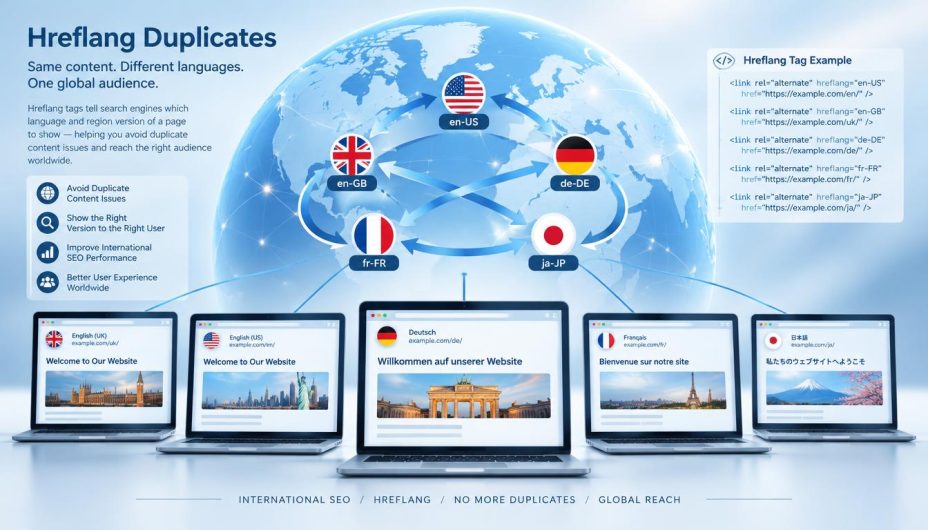
Write hreflang values in language-first order. The language is usually a two-letter ISO 639-1 code; an optional region is a supported two-letter ISO 3166-1 alpha-2 country code. Examples include en-US for US English, en-GB for UK English, fr-CA for Canadian French, and de for German without a country restriction.
Do not reverse the order as CA-fr, substitute a country code for a language, or use en-UK for the United Kingdom. Google’s supported region code is GB, not UK. Values are case-insensitive, but conventional formatting makes code review easier.
Hreflang is intended to identify alternatives, not to force Google to detect the page’s language from that tag. Ensure each page genuinely uses the declared language, especially if a content management system copies tags from the default template. The official Google documentation for localized pages explains supported values and required reciprocal references.
Avoid using a language-region combination just because it appears in a keyword tool. Each code should correspond to an intended audience and a real alternative URL. Test at least one sample page from each locale before a large rollout.
4. Build Complete, Reciprocal Alternate URL Clusters
Every page in a hreflang cluster should identify itself and the corresponding alternate URLs. If the US page points to the UK page, the UK page should point back to the US page. Missing return links are a common reason Google cannot interpret the intended relationship correctly.
For a simple two-market example, the following lines should appear in the HTML <head> of both eligible pages. They are educational examples using fictional URLs, not tags to paste into a WordPress article body:
<link rel="alternate" hreflang="en-US" href="https://example.com/us/shoes/" />
<link rel="alternate" hreflang="en-GB" href="https://example.com/uk/shoes/" />
For a third-language version, each member must include that third URL and the other alternatives. When a cluster has many locales, generate annotations from a reliable locale-URL inventory rather than typing every connection by hand. If only part of a large cluster can be maintained, prioritize accurate mutual relationships over a mass of inconsistent one-way references.
Hreflang sets can span subdomains or country domains; the URLs do not need to live within one folder. Use fully qualified HTTPS URLs, point directly to intended final pages rather than redirects, and check that the pages correspond to equivalent content. Our site architecture guide explains how URL design and crawlable navigation support international site maintenance.
5. Coordinate Canonical Tags With Regional Alternatives
Canonical selection is one of the most important technical details in an hreflang and duplicate content project. A canonical annotation expresses which URL a publisher prefers Google to treat as representative of duplicate or very similar content. An alternate-language annotation expresses an audience relationship. Mixing them up can cause the wrong regional URL to become the main indexed representative.
When a localized page is a distinct, useful, independently indexable version, it will typically declare itself as canonical. For example, the UK page may use <link rel="canonical" href="https://example.com/uk/shoes/" /> in its HTML head, while the US page refers to its own URL. Each can then identify the other with alternate-language annotations.
However, near-identical same-language regional pages may still be grouped as duplicates by Google. Google’s guidance advises choosing a canonical in the same language where possible and coordinating regional alternatives accordingly. Do not assume self-referencing tags make every lightly modified country copy eligible for separate indexing. Review whether the regional distinction genuinely matters and whether Google has chosen a different representative.
For hreflang troubleshooting, inspect the actual declared canonical and Google-selected canonical for a representative set of URLs. A canonical to a different language may undermine the intended configuration, while canonicalizing every localized page to the US version can conflict with a strategy that needs separate country URLs. Our canonical versus noindex guide clarifies those controls, and Google’s canonicalization documentation explains how Google evaluates preferred URLs.
Canonical decisions should reflect content similarity, audience purpose, and the site’s published structure. No annotation guarantees Google’s final selection.
6. Choose One Maintainable Implementation Method
Google supports three equivalent ways to communicate alternate-language relationships: HTML link elements in page headers, HTTP response headers, and XML sitemap annotations. You do not need to implement all three for extra ranking value. Using multiple methods without a shared data source can create contradictions when a product URL changes or a translation is unpublished.
| Method | Where the Annotation Lives | Practical Fit |
|---|---|---|
| HTML | Page <head> | Websites with manageable locale templates |
| HTTP header | Server response | Non-HTML documents such as PDFs |
| XML sitemap | Alternate entries in a sitemap | Large sites with centralized URL inventories |
For an XML sitemap implementation, every URL entry should include the full set of alternate references, including itself. Make sure the sitemap XML namespace and URL values are valid; generate the file through a tested process rather than copying a fragment into a post editor.
During hreflang implementation, document which system owns the tags: a CMS localization plugin, a deployment template, the server, or the sitemap generator. Keep that ownership clear so editors do not make a change in one place while a second system continues publishing old URLs. Our XML sitemap SEO guide covers sitemap validation, and the technical SEO audit framework helps organize template-level findings.

7. Keep Alternate Pages Accessible and Avoid Conflicting Signals
An hreflang cluster is difficult to maintain if its target URLs redirect unexpectedly, return 404 errors, require login, or are blocked by security rules. Test each intended variant with a crawler or HTTP inspection tool. Confirm its status, page language, canonical annotation, alternate references, and whether key content can be rendered.
Check robots.txt and noindex rules carefully. The intended pages should generally be crawlable and eligible for indexing when the goal is country-specific search visibility. If a locale is no longer active, remove its obsolete references from the remaining cluster instead of leaving a link to a discontinued page.
Hreflang is not a substitute for a crawlable site structure. Maintain visible language selection links where they help visitors, use ordinary HTML anchors for important paths, and avoid forcing visitors into an automatic country redirect that prevents them from accessing another version. Our crawl accessibility checklist covers server and robot restrictions; our Google Search Console audit guide helps inspect indexing and canonical status.
For hreflang maintenance, test mobile pages as well as desktop pages. Locale navigation should preserve page intent, not send every visitor to a translated homepage when an equivalent product or guide exists.
8. Audit Duplicate Groups and Prioritize Real User Value
Not every pair of similar regional pages is harmful. Duplicate-content auditing should identify when several URLs accidentally serve the same audience, when a translation is incomplete, or when the canonical signal conflicts with the editorial plan. A similarity threshold reported by a crawler is a diagnostic flag, not an official Google rule for removal.
Build a sample of page clusters: homepages, category pages, products, high-traffic guides, and transactional pages. Check translated main content, title and heading accuracy, currencies, local availability, links, return annotations, status codes, and Google-selected canonicals. Prioritize high-value page groups that actually create confusion or fail to reach their audience.
For duplicate-content decisions, choose from keep, localize, consolidate, redirect, or retire. Do not combine genuinely different language experiences into one page solely to eliminate a third-party duplicate score. Conversely, if two URLs have identical purpose and no meaningful regional distinction, maintaining both may offer little customer benefit. Our content pruning guide explains safe consolidation decisions, while canonical pagination guidance covers a different kind of duplicate URL challenge.
Keep an issue log containing the exact URL pair, observed similarity, intended locale, recommended action, owner, and validation date. This turns hreflang troubleshooting into a testable maintenance process rather than a guess about rankings.

9. Verify Changes and Monitor Results by Market
After deployment, recrawl representative hreflang clusters and confirm all intended annotations remain reciprocal. Inspect live HTML, response headers, or XML sitemap output according to your chosen method. Test the exact current URLs rather than assuming a CMS setting was successfully published.
Monitor country and page performance in Google Search Console and relevant landing-page outcomes in GA4. These data sources can reveal unexpected changes, but Google Search Console does not provide a dedicated comprehensive hreflang health report. Use a crawler or your own URL inventory to validate links, codes, and alternate-set membership.
An hreflang rollout may take time to be recrawled and processed. There is no guaranteed timetable for a preferred country URL to appear, and an apparent shift in rankings may involve competition, content changes, demand, or other technical issues. Our SEO metrics guide helps keep impressions, clicks, sessions, and business outcomes distinct.
For hreflang reporting, compare markets separately. An increase in UK impressions does not prove a new annotation alone caused it, and a decline in one region does not prove a duplicate-content penalty. Log implementation dates, source changes, unexpected canonical selection, and corrective actions. Our SEO reporting framework, SEO analytics reporting guide, and analytics resources provide a consistent way to communicate those findings. Use the organic traffic forecasting guide when explaining why regional projections remain uncertain.
Hreflang vs Canonical vs Noindex: What Each Signal Does
| Signal | Primary Purpose | What It Does Not Do |
|---|---|---|
hreflang | Identify equivalent language or regional alternates | Guarantee rankings or make copied content unique |
rel="canonical" | Suggest a representative URL among duplicates | Force Google to select the declared URL |
noindex | Ask a search engine not to index a page it can crawl | Identify regional alternatives or keep private data secure |
robots.txt | Control compliant crawler access to paths | Reliably remove already-known URLs from search |
These controls answer different technical questions. If a region-specific page should remain available to users and eligible for search, do not add noindex merely because a duplicate-content tool sees similar copy. Investigate actual indexing behavior and user value before changing the configuration.
Common Hreflang and Duplicate Content Mistakes
- Wrong codes: Using
en-UKinstead ofen-GB, or reversing language and region order. - Missing return links: One locale references another without a reciprocal reference.
- Wrong destinations: Alternate entries point to old redirects, broken URLs, or unrelated pages.
- Contradictory canonicals: An independently useful regional page points to another country without a reviewed strategy.
- Untranslated bodies: Only template navigation is translated, leaving the main content unchanged.
- Multiple unsynchronized methods: HTML, headers, and sitemaps publish different clusters.
- Ignoring indexability: A page intended for regional search is accidentally blocked or noindexed.
- Automatic country redirects: Users and crawlers cannot reliably access alternative versions.
- Assuming guaranteed placement: Correct annotations are useful signals, not ranking commands.
For a repeatable maintenance routine, incorporate the checks into your daily, weekly, and monthly SEO tasks. Focus on the issues that affect real audiences rather than trying to make every automated warning disappear.
Hreflang Audit Checklist Before Publishing
- Confirm each regional or language page serves a real audience and equivalent purpose.
- Review main-content translation, pricing, policies, availability, and local terminology.
- Use valid ISO language and optional region codes.
- Include every alternate and a self-reference in the cluster.
- Check that return references are present between relevant versions.
- Use full intended destination URLs with successful responses.
- Align canonical preferences with the site’s localization and duplicate-content plan.
- Select one manageable annotation method and source of truth.
- Inspect robots rules, noindex directives, server access, and rendering.
- Confirm sitemaps and internal links point to intended live URLs.
- Recrawl representative clusters after deployment.
- Monitor regional performance and document unexpected canonical selection.
Frequently Asked Questions
Does hreflang fix duplicate content?
No. Hreflang helps Google connect equivalent language and regional URLs. It does not remove duplicated text or require Google to index every alternate separately. Canonicalization and content usefulness still matter.
Should every translated page have a self-referencing canonical?
A distinct localized page intended to remain eligible for indexing will commonly have a self-referencing canonical. Very similar same-language variants require additional judgment. Review the actual duplicate group and Google’s selected canonical instead of applying a blanket rule.
Can hreflang make a website rank in another country?
It can help Google identify the appropriate localized version, but it does not guarantee an appearance or position. Relevant content, accessibility, competition, and other search systems still affect results.
Which is correct: en-GB or en-UK?
Use en-GB for English targeted to the United Kingdom. Google’s supported region code is GB; UK is not an accepted replacement in this context.
Are hreflang tags needed for a single-language website?
Not automatically. If a website has just one page for an audience, there may be no alternate URL to declare. Regional versions in the same language may benefit from annotations when the pages are genuine equivalents.
Can I implement hreflang in an XML sitemap?
Yes. Google supports alternate annotations through XML sitemaps, HTML link elements, or HTTP headers. Choose the method your team can keep accurate and consistent.
Does Google Search Console have a dedicated hreflang errors report?
No comprehensive dedicated report is provided in the current interface. Use URL Inspection and indexing reports for supporting evidence, plus a site crawler or an alternate-URL validation workflow for cluster-level issues.
What is x-default used for?
x-default identifies a fallback URL for visitors whose language or region does not match another declared alternative. A language-selection page can be a sensible fallback when it genuinely serves that purpose.
How often should international alternate URLs be audited?
Check after migrations, translations, product changes, and template releases. Regular scheduled reviews are also useful for large sites that frequently add or remove locales; the appropriate cadence depends on publishing volume and risk.
Conclusion
Hreflang and canonical tags solve different problems. One describes equivalent language or regional experiences; the other suggests which URL should represent duplicate content. Successful international SEO depends on understanding that distinction and publishing genuinely useful localized pages.
Start by mapping real audiences, implement valid codes and reciprocal alternates, align canonical decisions with content similarity, and validate every technical change. Then measure each market without claiming guaranteed rankings. For more practical guidance, explore the Online SEO Blogs homepage and its international and technical SEO resources.