Multi Location Local SEO: 10 Powerful Steps for Success

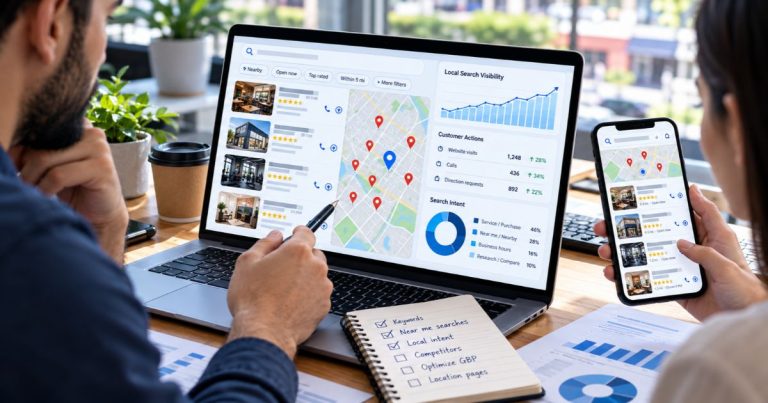
Multi location local SEO is the process of improving local search visibility for a business that operates from more than one physical location. Each branch needs accurate Google Business Profile information, a useful location page, consistent business data, local reviews, and clear internal links so customers and search engines can understand where that branch operates and what it offers.
A scalable multi location local SEO strategy treats every branch as a real local entity while keeping brand standards centralized. The goal is not to create dozens of near-duplicate city pages. It is to give each location enough accurate, unique, and useful information to earn visibility for relevant local searches.
Key Takeaways
What Multi Location Local SEO Means
Multi location local SEO combines local search optimization with scalable site architecture and operational control. A single-location business can often manage one Google Business Profile, one address, one review stream, and one primary location page. A business with five, twenty, or hundreds of branches has to keep all of those local signals accurate without creating duplicate or conflicting information.
Google says local results are mainly based on relevance, distance, and prominence. Relevance is how well a business matches what someone is searching for. Distance reflects how far the business is from the searcher. Prominence reflects how established or well-known the business appears based on information Google can understand about it.
That makes multi location local SEO a branch-by-branch discipline. A strong national brand can help overall recognition, but it does not replace accurate information for the individual location that a customer wants to visit.
If you are building your broader organic strategy at the same time, start with our practical SEO improvement guide, then use the Local SEO hub for location-focused guidance and the main SEO category for wider search strategy.
How Google Evaluates Businesses With Multiple Locations
A sound multi location local SEO plan starts by understanding what Google can and cannot evaluate about each branch.
| Local Factor | What It Means | What You Can Improve |
|---|---|---|
| Relevance | How closely the branch matches the user’s search | Accurate categories, services, content, profile details, and useful location pages |
| Distance | How far the branch is from the searcher or specified place | Provide the correct real-world address or service area; do not try to fake proximity |
| Prominence | How established and well-known the business appears | Reviews, authoritative mentions, links, citations, brand presence, and useful website content |
Google’s official local ranking guidance also recommends keeping business information complete and accurate, verifying the business, responding to reviews, and using relevant photos.
For multi location local SEO, this means every branch should be treated as its own customer-facing destination while still being connected to the wider brand.

10 Powerful Steps for Multi Location Local SEO Success
1. Build a Central Source of Truth for Every Location
The first operational step in multi location local SEO is creating one controlled location database. It can be a spreadsheet, CRM, location-management platform, or internal database, but it should contain the approved details for every branch.
Track at least:
- Official business name
- Street address
- Local phone number
- Primary and secondary categories
- Regular and special hours
- Location-page URL
- Store code or internal branch ID
- Latitude and longitude where relevant
- Opening date or closure status
- Profile ownership and manager access
This single source of truth prevents one team from changing a phone number on the website while another team leaves the old number in Business Profile, Apple Maps, Bing, or an important industry directory.
Large websites should also include location-data checks in their broader technical SEO audit process and monitor architecture issues through the Technical SEO hub.
2. Create One Eligible Google Business Profile Per Real Location
For storefront businesses, each eligible real-world branch should have its own accurate Google Business Profile. Google’s representation guidelines say businesses should create profiles for actual locations and should not create multiple profiles for the same business location unless a specific exception applies.
A multi location local SEO program should never create fake offices, virtual-office profiles, keyword-stuffed business names, or duplicate listings merely to expand map coverage.
Use Google’s Business Profile representation guidelines as the operational standard for addresses, names, service areas, and location eligibility.
For ten or more eligible locations of the same business, Google provides bulk management and verification workflows. Its bulk location management documentation explains how a business group, spreadsheet, verification process, and ongoing updates can be managed at scale.
3. Match Each Google Business Profile to the Correct Location Page
A strong multi location local SEO setup should send users from a branch profile to the page that represents that exact branch, rather than automatically sending every location to a generic homepage.
Google’s business-links guidance says multi-location action links should lead to a dedicated landing page for the specific location rather than a general landing page or another branch. This creates a clearer user journey and reduces confusion.
Use Google’s Business Profile link policies when configuring destination URLs.
Internal site architecture should make those location pages easy to reach too. Connect the homepage to a location hub, the hub to individual branches, and location pages to relevant services and supporting resources. Our SEO strategies guide provides broader internal-linking principles.
4. Build Unique and Useful Location Pages
Location pages are one of the most important website components in multi location local SEO. Each branch needs enough unique information to help a real customer choose, contact, or visit that location.
A useful location page can include:
- Official branch name
- Address and map
- Local phone number
- Opening hours and special hours
- Services available at that branch
- Real storefront and interior photos
- Parking or accessibility details
- Public transport or driving directions
- Local staff or manager details where appropriate
- Relevant local testimonials or review excerpts
- Branch-specific FAQs
- Nearby landmarks or service areas when genuinely useful
- Clear booking, contact, ordering, or appointment actions
Do not create hundreds of pages by changing only the city name. Near-duplicate location pages can become thin, unhelpful content and may resemble doorway-style publishing when they exist mainly to capture similar searches.
Our Google spam update guide explains why doorway-style and scaled low-value pages can create search risk. For content-quality planning, use the Content SEO & Marketing hub.
5. Optimize Google Business Profiles Without Keyword Stuffing
Good multi location local SEO does not depend on stuffing service keywords into profile names. Google says the Business Profile name should reflect the real-world name used consistently on the storefront, website, stationery, and other business materials.
For each profile, review:
- Real-world business name
- Accurate address or service-area setup
- Local phone number
- Correct location-page URL
- Primary category
- Useful secondary categories
- Regular and special hours
- Relevant attributes
- Services or products where supported
- Current branch photos
Google recommends choosing the fewest categories needed to describe the core business accurately. Do not turn category selection into a list of every keyword you want to rank for.
This is also where general keyword strategy needs context. Our guide on the difference between keywords and SEO explains why repeating keywords is not the same as building search relevance.
6. Add Accurate LocalBusiness Structured Data
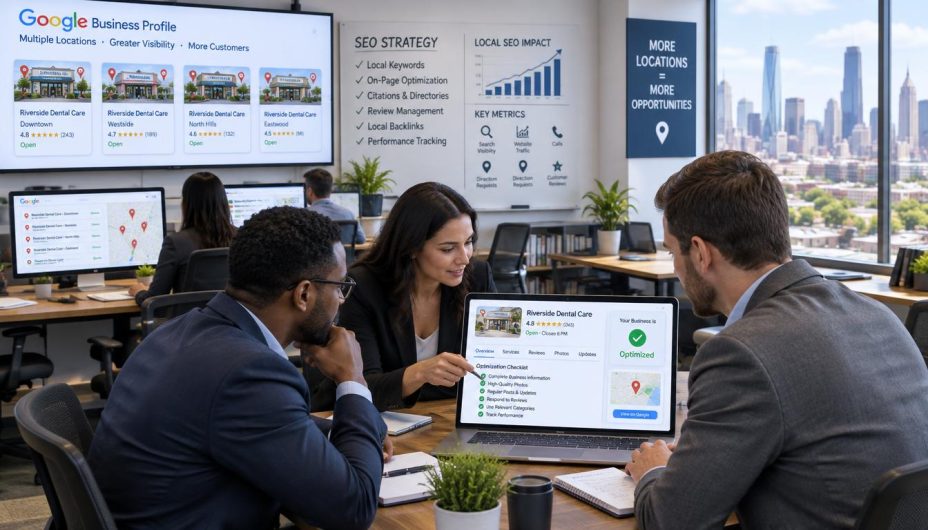
Structured data can reinforce information that is already visible on a location page. For multi location local SEO, each location page can use the most specific appropriate LocalBusiness subtype and include accurate properties that match the visible page.
Google’s current LocalBusiness structured data documentation explains that each local business location can be defined as a LocalBusiness type. Supported properties include the business name, address, geographic coordinates, opening hours, telephone number, and other relevant details.
Structured data is not a substitute for the visible page and does not guarantee a rich result. It is a machine-readable way to describe information that should already be accurate and useful to customers.
Validate markup with Google’s Rich Results Test and include structured-data checks in your technical audit workflow. The foundational SEO for AI guide is also useful for understanding why clear entities and relationships matter across modern search experiences.
7. Manage Citations and Local Mentions Consistently
Listings on trusted maps, directories, chambers, industry sites, and local organizations can help customers discover branches and reinforce consistent business information. A multi location local SEO program should prioritize sources that matter to customers instead of submitting every branch to hundreds of low-quality directories.
Start with platforms relevant to the market, such as Google, Apple Maps, Bing, major industry directories, chambers of commerce, professional associations, and reputable local resources.
Check that the branch name, address, phone, and website information match the approved location record. Exact punctuation does not need to become an obsession, but conflicting or outdated information should be corrected when it can mislead customers or search systems.
For broader authority-building, use the Off-Page SEO & Link Building hub. If a local directory or publication uses nofollow, our guide on whether nofollow links help SEO explains why referral traffic and visibility can still matter without treating the link as guaranteed ranking credit.
8. Build a Genuine Review Program for Every Branch
Reviews are important to customer decision-making and are also referenced in Google’s local ranking guidance. But multi location local SEO needs a branch-level review process rather than one generic reputation workflow.
Google allows businesses to ask customers for reviews and provides review links and QR codes. It prohibits offering incentives in exchange for reviews and prohibits attempts to manipulate review ratings or sentiment.
Use Google’s review best practices and review link and QR-code guidance when designing the process.
Operationally:
- Send the customer to the correct branch profile.
- Ask after a genuine customer interaction.
- Do not offer discounts or gifts for reviews.
- Do not suppress negative feedback.
- Respond professionally to positive and negative reviews.
- Escalate recurring service issues to the relevant branch manager.
A location with weak feedback should improve the underlying customer experience rather than trying to manufacture a better rating.

9. Build Local Internal Links Around Real Customer Needs
Internal links help users move between the brand, service, and branch layers of the site. They also help search engines understand how location pages relate to broader topics. In multi location local SEO, internal linking should reflect the actual business structure.
Useful connections can include:
- Location hub → individual branch
- Branch → relevant service
- Service → locations offering that service
- Blog article → relevant branch or local guide
- Branch → useful nearby supporting content
- Related branches → only when helpful to customers
If your business serves professional markets, compare this structure with our B2B SEO guide. For property businesses, see our local SEO for real estate agents guide. For a regulated-industry example, our cannabis SEO guide illustrates why eligibility, policy, and local context can change the strategy.
You can also use the full Online SEO Blogs library to connect location-focused content with relevant technical, content, analytics, AI-search, and off-page resources instead of creating isolated pages.
10. Measure Each Location Separately
The final step in multi location local SEO is measurement. National traffic alone can hide underperforming branches. Build reporting that lets you compare each location without losing the overall brand view.
| Metric | What It Helps You Understand |
|---|---|
| Organic clicks to location pages | Whether search visibility is producing website visits |
| Impressions by branch page | Whether a location is gaining or losing search exposure |
| Local query groups | Which services and geographic modifiers create demand |
| Calls, bookings, and leads | Whether local visibility creates meaningful business actions |
| Direction requests | Customer intent to visit a physical branch |
| Review volume and rating trends | How reputation changes by location |
| Indexing and technical health | Whether branch pages remain crawlable and indexable |
Use the SEO Tools & Analytics category for measurement workflows. If local visibility shifts suddenly, our SERP volatility guide explains how to investigate ranking changes without overreacting.
When a wider Google update is active, check the Google Algorithm Update Tracker, the Google Search Updates hub, and our Google core update guide before assuming that one branch-specific issue caused the movement.

Storefront vs. Service-Area Businesses
Multi location local SEO becomes more complex when some locations are storefronts while others are service-area operations. Google has different eligibility and address-display rules for these business models.
A storefront serves customers at the stated address. A service-area business travels to customers and generally should hide the address when customers are not served there.
Google’s service-area Business Profile guidance explains how service areas work and notes that businesses can specify supported cities, postal codes, or other areas rather than using a simple radius.
Do not create fake branch profiles simply because a company wants visibility in additional cities. For multi location local SEO, each profile must correspond to an eligible real-world operation under Google’s guidelines.
How to Scale Multi Location Local SEO Without Losing Quality
The bigger the organization becomes, the more multi location local SEO turns into an operations problem as well as an optimization problem.
Create governance rules for:
- Who can create or close a location
- Who approves profile names, categories, hours, and URLs
- Who responds to reviews
- How new branch pages are created
- How structured data is validated
- How local photos are collected
- How temporary closures and holiday hours are handled
- How duplicate profiles are escalated
- How redirects are handled after closure or relocation
- How monthly or quarterly audits are documented
For businesses with 10 or more eligible locations, bulk tools can reduce manual work, but bulk management does not remove the need for local accuracy. Google says bulk-managed profiles still need to remain accurate and actively maintained.
At the website level, connect local SEO governance with technical SEO, content standards, and analytics. Our technical audit template, content SEO resources, and SEO analytics resources can support that operating model.
Use the standards in our editorial policy when deciding whether local ranking claims, third-party statistics, or performance promises have enough evidence to publish.
How AI Search Changes Multi Location Local SEO
AI-powered search increases the value of clear business entities and consistent factual information. It does not replace the fundamentals of multi location local SEO. Search systems still need crawlable pages, accurate business information, understandable relationships, and reliable evidence.
Each branch page should clearly state the business name, address, phone, services, hours, location context, and relationship to the parent brand. This makes information easier for both traditional search systems and AI-powered experiences to interpret.
Our SEO with AI foundations guide and AI Search & SEO category cover the broader principles. Avoid inventing special “AI local ranking factors” that Google has not documented.
Common Multi Location Local SEO Mistakes
Using the Same Content on Every Location Page
Templates are useful, but multi location local SEO pages should contain branch-specific information that helps users. Replacing only the city name creates weak differentiation.
Sending Every Business Profile to the Homepage
When a dedicated branch page exists, linking the correct profile to that page creates a clearer path for customers and a stronger location-specific relationship.
Creating Fake Offices for Map Coverage
Virtual offices and ineligible locations should not be used to manufacture additional local presence. Follow Google’s eligibility and representation requirements.
Keyword Stuffing Business Names
Use the real-world business name rather than adding services, neighborhoods, or promotional phrases solely for ranking purposes.
Ignoring Duplicate or Outdated Profiles
Closures, relocations, acquisitions, and ownership changes can create duplicate records. Include duplicate-profile checks in the multi location local SEO audit process.
Incentivizing Reviews
Google prohibits incentives for reviews. A sustainable review program asks real customers for honest feedback without controlling the rating or wording.
Tracking Only National Organic Traffic
A national total can rise while important branches decline. Measure performance by location, market, landing page, and conversion action.
Multi Location Local SEO Launch Checklist
- Create an approved source-of-truth record for every branch.
- Confirm that each Business Profile represents an eligible real-world business.
- Verify names, addresses, phone numbers, categories, hours, and URLs.
- Link each profile to the correct location page.
- Create useful, indexable, branch-specific pages.
- Connect location pages through a clear location hub and internal links.
- Add accurate LocalBusiness structured data where appropriate.
- Validate structured data and indexing.
- Audit high-value citations and map platforms.
- Create a compliant branch-level review process.
- Add real branch photos.
- Monitor duplicate or outdated profiles.
- Track local organic traffic and customer actions by branch.
- Document updates, ownership, and audit dates.
Use this checklist as the operational baseline for multi location local SEO, then adapt it to the company’s business model, country, industry, and number of branches.
Frequently Asked Questions
What is multi location local SEO?
Multi location local SEO is the process of improving local visibility for a business with several eligible locations by optimizing each branch’s Business Profile, location page, business data, reviews, local mentions, and website relationships.
Does every physical location need its own Google Business Profile?
Each eligible customer-facing location can generally have its own profile, but the location must meet Google’s Business Profile rules. Do not create duplicate profiles or fake offices simply to target additional areas.
Does every branch need a separate location page?
For most multi-location websites, a dedicated page is useful because it can provide branch-specific services, hours, contact information, directions, staff, photos, FAQs, and conversion actions. The page should provide genuine local value rather than duplicate another location page.
How many locations are needed for Google bulk verification?
Google’s current documentation says eligible businesses with 10 or more locations of the same business can use its bulk verification process, subject to its requirements and quality guidelines.
What are the main local ranking factors?
Google says local results are mainly based on relevance, distance, and prominence. Complete business information, reviews, links, and other evidence can contribute to how Google understands these factors.
Should all location pages use the same template?
A shared template can keep branding and usability consistent, but the important content should reflect the real branch. Multi location local SEO works better when each page contains unique services, photos, staff details, directions, FAQs, and local information where applicable.
Can businesses offer discounts for Google reviews?
No. Google’s policies prohibit offering incentives such as discounts, free goods, or services in exchange for reviews, rating changes, or removal of negative reviews.
Should a service-area business create a profile in every city it serves?
No. Profiles must follow Google’s service-area and eligibility rules. Businesses should not create fake offices or profiles solely to target additional cities. Separate profiles are appropriate only when distinct eligible locations meet Google’s requirements.
Conclusion
Multi location local SEO succeeds when centralized brand control and local accuracy work together. Every branch should have the correct profile, a useful location page, accurate business details, genuine reviews, strong internal connections, and measurement that shows whether local visibility is producing real customer actions.
The most scalable multi location local SEO strategy is not a collection of city-name templates. It is a structured system for maintaining real locations, real customer information, real local evidence, and useful website experiences.
Continue with the Local SEO resource hub, compare industry-specific tactics in our real estate local SEO guide, explore the Online SEO Blogs homepage, and use the full article library for technical SEO, content strategy, AI search, Google updates, analytics, and off-page guidance that supports a complete local search program.