
Local Search Intent: 9 Powerful Ways to Win Nearby Customers
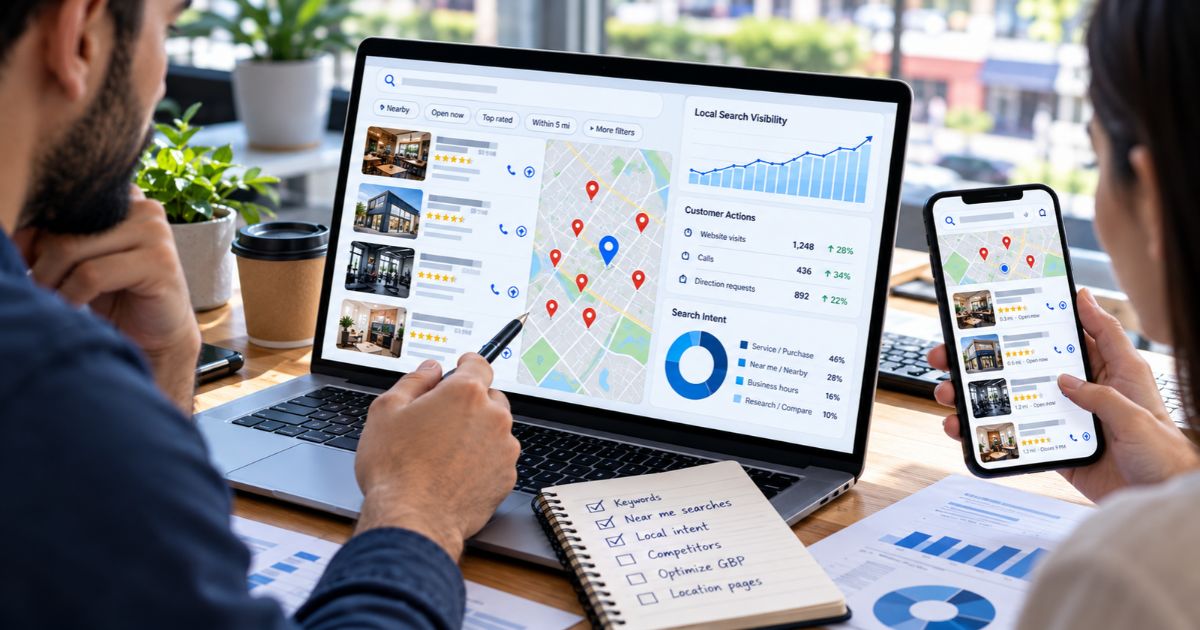
Local search intent describes what a person wants when a search has a geographic or nearby-business need. Someone searching “how to fix a leaking faucet” may want information, while someone searching “emergency plumber near me” is much closer to contacting a local service provider.
To match local search intent, identify what the searcher is trying to accomplish, inspect the types of results Google shows, and send each query to the most useful page type—such as a service page, location page, Google Business Profile, local guide, or contact page.
Key Takeaways
What Local Search Intent Means
Local search intent is the purpose behind a search where location influences what the user considers useful.
The user does not always type a location. A query such as “coffee shop,” “dentist,” or “car repair” may still produce nearby results because location can be important to satisfying the request.
Google’s official local-ranking guidance explains that local results are mainly based on relevance, distance, and prominence. Relevance reflects how well a business matches the search, while distance considers how far the business is from the searcher or location used in the query.
You can review Google’s local ranking guidance for its current explanation.
Understanding local search intent therefore requires more than adding a city name to a keyword. You need to understand the customer’s problem, expected distance, urgency, preferred page type, and likely next action.
For broader fundamentals, start with our practical SEO strategies guide, then explore the Local SEO resource hub.
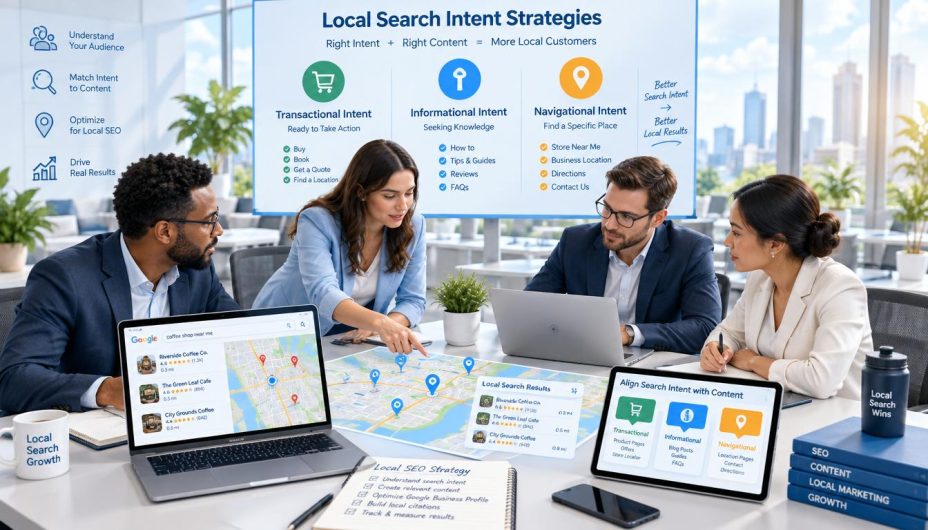
Four Common Types of Local Search Intent
Local search intent can be grouped into familiar search-intent types, but the geographic context changes what a useful result looks like.
| Intent | Example Query | Likely Need | Useful Page Type |
|---|---|---|---|
| Informational | how to unclog a drain | Advice or instructions | Guide or article |
| Navigational | Costco Lahore hours | Specific business information | Business/location page or profile |
| Commercial investigation | best dentist near me | Compare providers before choosing | Location/service page with trust signals |
| Transactional | emergency plumber near me | Contact or book a service quickly | High-intent service/location page |
The important point is that local search intent changes what information should appear first.
An informational visitor may need a detailed explanation. A person searching for an emergency service may need a phone number, availability, service area, price context, and booking action immediately.
Our article on keywords versus SEO explains why understanding intent is more useful than simply repeating a keyword phrase.
How to Identify Local Search Intent in a Query
Some local search intent is obvious because the searcher explicitly includes a location or nearby modifier.
Explicit local signals
Common examples include:
- near me
- in Chicago
- downtown Toronto
- open now
- 24-hour dentist
- plumber in Brooklyn
- restaurant near airport
- SEO agency Lahore
These terms make the geographic requirement clear.
Implicit local signals
Other queries may not mention a place but still have strong local search intent.
Examples include:
- coffee shop
- dentist
- car wash
- pharmacy
- pizza delivery
- emergency electrician
Google explains that when a customer does not explicitly share a location in the search, its local systems can use what they know about the customer’s location when determining distance.
This means your keyword research should not depend only on phrases containing a city or “near me.”
9 Powerful Ways to Match Local Search Intent
1. Inspect the Current Search Results
The fastest way to understand local search intent is to examine what Google currently shows for the query.
Look for:
- Local Pack or map results
- Business Profile listings
- Service pages
- Location pages
- Directories
- Review sites
- Informational articles
- Videos
- Forums or discussions
- Shopping or product results
If the results are dominated by nearby businesses and map listings, Google is interpreting the query differently from a search dominated by tutorials and informational articles.
Do not blindly copy competitors. Use the results to understand what type of answer seems to satisfy the query.
If rankings change substantially over time, our Google Algorithm Update Tracker and Google Search Updates hub can help separate confirmed updates from ordinary ranking changes.
2. Determine the Searcher’s Next Likely Action
Ask what someone expressing this local search intent is likely to do next.
Possible actions include:
- Learn how to solve a problem
- Compare businesses
- Check opening hours
- Read reviews
- Call a company
- Request directions
- Book an appointment
- Request a quote
- Visit a physical location
This prevents a common mistake: creating content for the keyword instead of creating the page the customer actually needs.
3. Match the Query to the Right Page Type
A good local search intent strategy gives each type of search a logical destination.
| Query | Better Destination |
|---|---|
| how often should an AC be serviced | Informational guide |
| AC repair in Dallas | Local service page |
| ABC HVAC Dallas hours | Location page / Business Profile |
| best AC company near me | Strong service/location page with reviews and trust information |
| emergency AC repair near me | High-intent emergency service page |
Do not send every query to the homepage simply because the homepage has the strongest authority.
The page that best satisfies local search intent should normally be the page you optimize for that search.
For a broader example of geographic page planning, see our local SEO guide for real estate agents.
4. Create Useful Service and Location Pages
When local search intent is commercial or transactional, users usually need concrete information before choosing a business.
A useful local service page can include:
- Service description
- Areas served
- Availability
- Contact or booking options
- What the service includes
- Real photos
- Relevant reviews
- FAQs
- Pricing context where appropriate
- Accurate business details
For multi-location brands, each real branch should have enough unique information to help nearby customers. Review our Local SEO resources and broader SEO article library when planning supporting pages.
Avoid thin city pages that simply replace one place name with another. Google’s spam policies can apply to doorway-style pages created primarily to rank for similar queries without providing meaningful independent value.
Our Google spam update guide provides additional context on doorway pages and scaled low-value content.
5. Align Google Business Profile With Local Search Intent
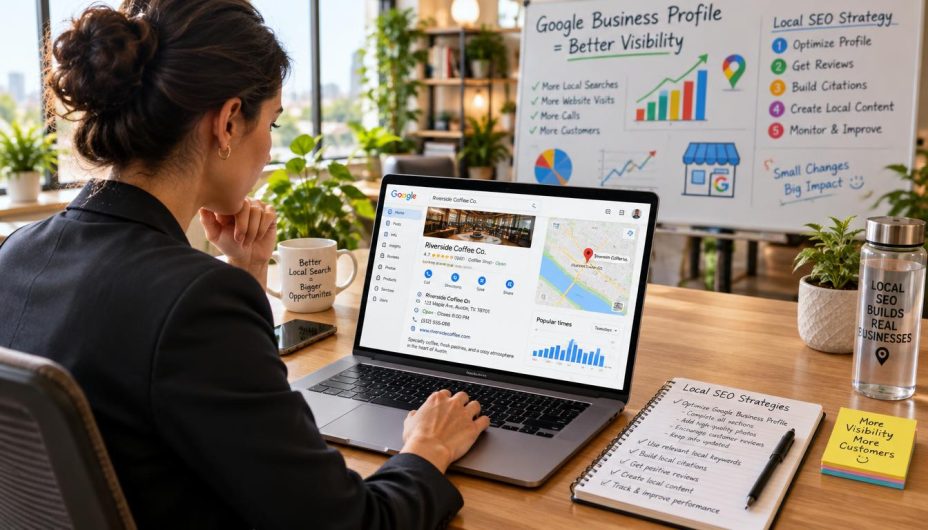
Google Business Profile is an important part of many local search intent journeys because customers may want to confirm a business’s address, hours, category, phone number, photos, reviews, and services without first visiting the website.
Google recommends keeping Business Profile information complete and accurate.
Review:
- Real-world business name
- Address or service area
- Primary category
- Relevant secondary categories
- Phone number
- Website URL
- Regular hours
- Special hours
- Services
- Attributes
- Photos
- Reviews and responses
Google’s Business Profile representation guidelines say the profile should accurately reflect how the business exists in the real world. Google also recommends using as few categories as necessary to describe the core business rather than treating categories as keywords.
For businesses serving several real locations, consistent profile-to-page relationships become even more important. Our broader local SEO coverage explains how branch structure and customer intent should work together.
6. Use Local Keywords Naturally
Keyword research helps reveal how people express local search intent, but keywords should guide content rather than dominate it.
Useful patterns can include:
- service + city
- service + neighborhood
- service + near me
- service + open now
- best + service + location
- service + reviews
- emergency + service + location
- business name + hours
Do not force every variant into the copy. Google can understand relationships between words and concepts without exact-match repetition in every heading.
Our keywords and SEO comparison explains why keywords are only one component of a wider optimization strategy.
For content planning, browse the Content SEO & Marketing category.
7. Add Accurate LocalBusiness Structured Data
Structured data can make business details easier for search systems to interpret, but it does not create local search intent and does not guarantee better rankings.
Google’s LocalBusiness structured data documentation supports properties such as:
- Business name
- Address
- Telephone
- Opening hours
- Geographic coordinates
- URL
- Business type
The markup should match information users can see on the page.
If you are auditing schema, indexability, internal architecture, or crawling at the same time, use our technical SEO audit guide and the Technical SEO hub.
8. Build Local Authority and Useful Referral Visibility
A business can strengthen the ecosystem around its local search intent pages through genuine local relationships and mentions.
Useful sources can include:
- Local chambers
- Professional associations
- Community organizations
- Relevant directories
- Local publications
- Industry resources
- Partnership websites
The goal is not to collect as many links as possible. Prioritize sources that real customers use and trust.
Our Off-Page SEO & Link Building hub covers broader authority-building principles.
Industry context also matters. Compare the local challenges discussed in our B2B SEO guide and cannabis SEO guide, where audience, regulation, and customer journeys can change how search strategy is applied.
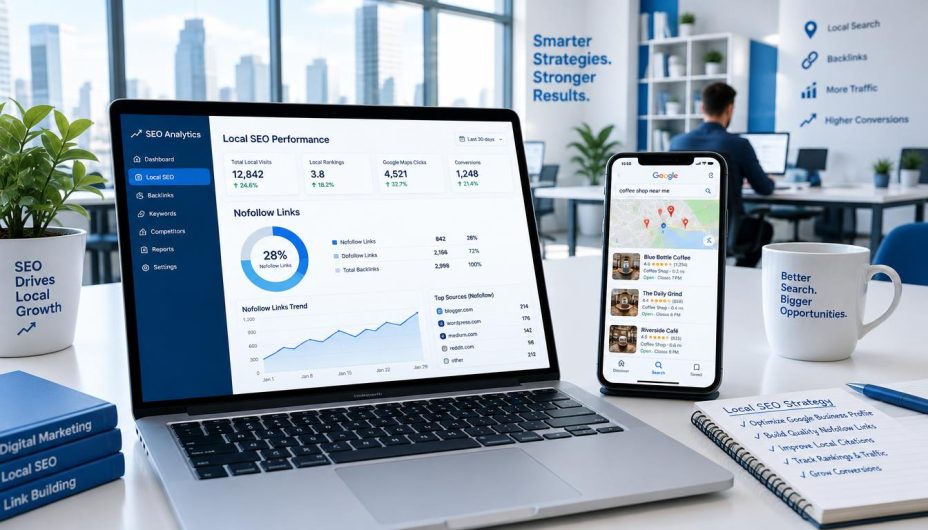
9. Measure Whether the Page Actually Satisfies the Search
The final test of local search intent is not whether the keyword appears in a ranking tool. It is whether relevant searchers reach the page and take useful actions.
Google Search Console’s Performance report provides clicks, impressions, CTR, average position, queries, pages, countries, devices, and other dimensions that can help you understand search performance.
Review:
- Queries generating impressions
- Queries generating clicks
- Landing pages
- CTR
- Device differences
- Geographic differences where available
- Calls
- Forms
- Bookings
- Directions
- Qualified leads
If a page ranks for a strong local search intent query but generates few customer actions, investigate the page experience.
The problem may be:
- Wrong page type
- Unclear service information
- Missing location details
- Incorrect hours
- Weak trust signals
- Poor mobile usability
- Slow page experience
- Weak call-to-action
- Mismatch between query and service offered
For measurement workflows, use the SEO Tools & Analytics hub.
How Local Search Intent Changes by Business Type
The same local search intent framework does not produce identical tactics for every industry.
Restaurants and retail stores
Customers may care heavily about distance, hours, ratings, inventory, directions, photos, and whether the business is open now.
Emergency service businesses
Plumbers, locksmiths, electricians, towing companies, and similar services often need fast contact options, availability, clear service areas, and strong mobile usability.
Professional services
Law firms, accountants, consultants, dentists, and other professionals may face more research-oriented local search intent. Visitors may compare experience, services, reviews, location, credentials, and consultation options before contacting the provider.
Real estate
Location context is particularly important. Neighborhood expertise, market information, property type, and local experience may all contribute to usefulness. See our local SEO for real estate agents guide for a vertical-specific example.
Local Search Intent and AI Search
AI-powered search does not remove the need to understand local search intent. Clear entities, accurate location information, crawlable pages, and useful answers remain fundamental.
A local business page should make important relationships explicit:
- Who is the business?
- Where is it located?
- What does it offer?
- Who does it serve?
- When is it available?
- How can customers contact it?
- How is the branch related to the main brand?
Our foundational SEO with AI guide and AI Search & SEO hub cover these principles in more detail.
Do not invent special “AI local ranking factors.” Focus on information quality, accessibility, consistency, and the customer’s actual need.
Common Local Search Intent Mistakes
Optimizing only for “near me” keywords
Local search intent exists even when the query contains no explicit location phrase.
Sending every local query to the homepage
A service or location page may satisfy the search much better than a general homepage.
Creating duplicate city pages
Location pages should contain useful local information, not just city-name substitutions.
Stuffing Google Business Profile names
Google requires businesses to use their real-world business name rather than adding unnecessary keywords, locations, phone numbers, or promotional language.
Choosing categories like keywords
Business Profile categories should accurately describe the business. Google’s guidelines recommend using the fewest categories necessary to describe the core business.
Assuming structured data guarantees rankings
Schema helps describe information but does not guarantee rankings, Local Pack placement, or leads.
Ignoring changing search results
Local search intent can evolve as customer behavior, competition, Google features, and search demand change.
If rankings fluctuate substantially, use our Google core update guide and algorithm update tracker before assuming every movement requires a content rewrite.
Local Search Intent Optimization Checklist
- Define the primary customer need behind the query.
- Check whether location is explicit or implicit.
- Inspect the current result types.
- Identify the likely next customer action.
- Choose the correct page type.
- Write useful service and location information.
- Keep Business Profile information accurate.
- Use the real-world business name.
- Select accurate categories.
- Add useful photos and review responses.
- Use LocalBusiness structured data where appropriate.
- Connect relevant pages through internal links.
- Build genuine local mentions and relationships.
- Measure Search Console queries and landing pages.
- Measure calls, bookings, directions, and qualified leads.
- Update content when customer needs genuinely change.
This checklist keeps local search intent tied to customer usefulness rather than reducing local SEO to keyword placement.
Frequently Asked Questions
What is local search intent?
Local search intent is the need behind a search where geographic proximity or a specific local business matters. The searcher may want information, directions, opening hours, comparisons, a nearby service, or an immediate transaction.
How can I identify local search intent?
Look for explicit location phrases such as “near me,” city names, neighborhoods, “open now,” and other geographic modifiers. Also inspect the search results because Google may show local results even when the query does not explicitly include a place.
What pages work best for local searches?
The best page depends on the intent. Informational searches may need guides, while high-intent service queries often need service or location pages. Navigational searches may be satisfied by accurate location pages and Business Profile information.
Does Google Business Profile help satisfy local search intent?
Yes. Business Profile can provide customers with important local information such as location, hours, phone number, categories, photos, services, reviews, and website links.
Should I create a page for every city I want to rank in?
No. Create location or service-area pages only when they represent real services and provide useful, distinct information. Avoid mass-producing near-duplicate city pages simply to target geographic keywords.
Does structured data improve local rankings?
LocalBusiness structured data can help search engines understand business information, but it does not guarantee higher rankings, Local Pack placement, or additional leads.
How should I measure local search intent performance?
Use Search Console to review queries, clicks, impressions, CTR, and landing pages, then combine that data with business outcomes such as calls, forms, appointments, directions, bookings, and qualified leads.
Conclusion
Local search intent is ultimately about understanding what a nearby customer needs and giving that person the right information at the right stage of the decision process.
A strong local search intent strategy connects queries with suitable guides, service pages, location pages, Google Business Profiles, business information, structured data, reviews, and clear conversion actions.
Do not reduce local search intent to city keywords or “near me” phrases. Inspect the results, understand the likely customer action, build useful local pages, maintain accurate business information, and measure whether those pages generate real engagement.
Continue with the Local SEO hub, our local SEO for real estate guide, the main SEO category, and the Online SEO Blogs homepage for broader search strategy, technical SEO, AI search, analytics, Google updates, and content optimization guidance.