Brand Visibility in AI Answer Engines: 9 Proven Ways
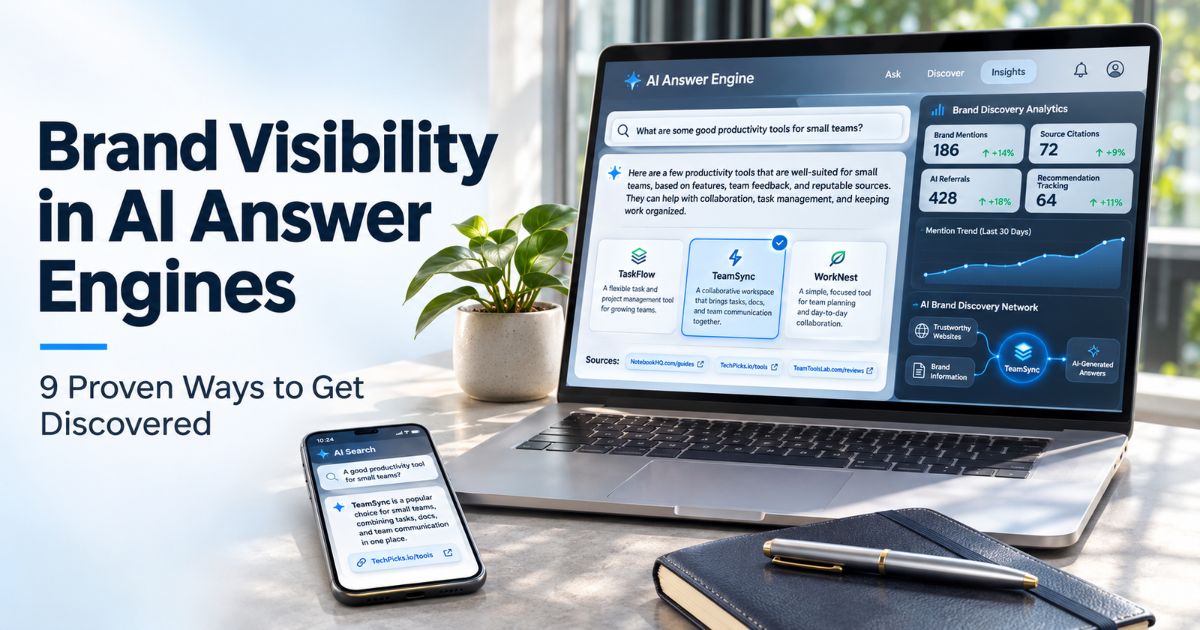
Brand visibility in AI answer engines means the observable presence of a company, product, or publisher when an AI-powered service responds to relevant questions. People may encounter a business through a name mention, a shortlist recommendation, a cited source, or a link they can open. These outcomes are different, and none can be guaranteed by adding a special keyword or markup tag.
Improving brand visibility takes more than traditional rankings. Your public information must be accurate, accessible, useful, and supported by real evidence. You also need a way to check answers without treating one conversation as a universal measure of how a system behaves. This guide walks through nine practical actions for teams using ChatGPT Search, Google AI Overviews or AI Mode, and other AI-assisted discovery experiences.
The methods for better brand visibility build on ordinary search foundations rather than replacing them. For wider context, see our AI Search & SEO resources and foundational SEO with AI guide.
Key Takeaways
- Measure mentions, recommendations, owned-site citations, third-party citations, referral visits, and conversions separately.
- Choose questions real customers ask, including non-branded questions that test discoverability.
- Maintain useful, crawlable public pages and distinguish OpenAI’s search crawler from its training crawler.
- Publish consistent product, organization, author, pricing, and service details that readers can verify.
- Make content worth citing by adding original research, firsthand examples, and clearly explained limitations.
- Use schema to describe genuine visible information, not as a promise of a citation or AI recommendation.
- Avoid manufactured brand mentions, fake reviews, mass-produced pages, and unsupported visibility statistics.
- Review results across a stable prompt sample and connect findings to real customer outcomes.
What Does Brand Visibility Mean in AI Answer Engines?
Brand visibility describes whether an audience encounters recognizable, relevant information about a business in an AI-generated answer. An answer might mention your company without a link, cite a document from your website, reference an independent publisher discussing your product, or recommend your service alongside competitors. A brand may appear in one of those ways but not the others.
These experiences are not equivalent to a fixed ranking position. Questions can be phrased differently; sources can change; some products use live search while other responses rely on different context. Geographic availability, personalization, and conversation history may also affect the result. A citation is not automatically an endorsement, and brand visibility is not automatically a qualified lead.
| Observation | What to Record | What It Does Not Prove |
|---|---|---|
| Brand mention | The company or product is named | That the answer recommends the brand |
| Recommendation | The brand is suggested for a particular need | That it is the best choice for every user |
| Owned-site citation | A link points to the brand’s own page | That all claims were verified by the reader |
| Third-party citation | An independent source discusses the brand | That the cited source is necessarily accurate |
| Referral visit | A person follows a measurable link | That the visit became a customer |
For a more detailed framework on observing these outcomes, explore our competitor visibility in LLMs guide. It explains why an AI response should be documented, not mistaken for a stable search-result position.
9 Practical Ways to Improve Brand Visibility in AI Answers
1. Define Customer Questions and a Repeatable Prompt Set
The first step in strengthening brand visibility is to identify real customer situations. A consumer looking for inexpensive travel insurance asks different questions from a procurement director comparing compliance software. List the products, services, locations, budgets, constraints, and problems that genuinely relate to your organization.
Build a representative set of prompts, including neutral questions that do not contain your company name. Examples include “Which tools help small clinics manage appointments?”, “What should I ask before hiring a technical SEO agency?”, and “Compare appointment scheduling services for a team of six.” Include branded questions separately to assess whether public facts about an already-known business are correct.
For brand visibility testing, record exact wording, date, platform, product mode, language, country where relevant, and whether the experience used live search. A workable initial sample might contain 20 carefully chosen questions, but that is an illustrative research design, not an industry standard. Build categories for discovery, comparison, problem solving, and purchase intent.
Do not create a different landing page for every small prompt variation. Instead, match each question cluster to a genuinely useful resource. Our content mapping framework explains how to align a customer’s intent with the most appropriate destination.

2. Establish a Baseline for Mentions, Citations, and Recommendations
Before you attempt to improve brand visibility, record where the business appears now. Run your documented prompts, save the responses, and label the outcome using a consistent definition. Distinguish a passing name mention from a clear recommendation. Open any cited sources to check whether they genuinely support the claims made.
For brand visibility measurement, do not combine unrelated indicators into one unexplained proprietary score. A business might be frequently named by an AI service but seldom linked. Another might be linked as a source but not recommended as a vendor. Those cases suggest different editorial and commercial opportunities.
A hypothetical baseline could show 9 mentions in 30 eligible answers. That is a 30% observed mention rate for this specific prompt sample, not an estimate of how frequently all AI users see the company. The same answer can mention several brands, so separate brands’ percentages do not need to total 100%.
Review the factual quality of citations as well as their frequency. A third-party article may mention an outdated price, an unavailable product, or a former office address. Make a correction log and identify what can be improved on the source page. Our ChatGPT monitoring for product pages guide offers a more product-focused testing approach.
3. Check Crawl Access and the Differences Between AI Platforms
Technical access is foundational to brand visibility in systems that retrieve web information. Important public pages should return sensible server responses, expose readable text, and be reachable through ordinary internal links. Review robots.txt, CDN settings, hosting firewalls, JavaScript rendering, canonical URLs, and accidental noindex directives.
For Google AI Overviews and AI Mode, Google’s documented guidance says a supporting page must be indexed and eligible to appear with a snippet in ordinary Search. There is no separate requirement for a special AI-only schema file. Google recommends the same basic practices: useful content, crawl access, internal linking, good page experience, and consistency between structured data and visible text. See its official documentation on AI features and websites.
OpenAI publishes different web agents for different tasks. OAI-SearchBot supports discovery for ChatGPT search features, while GPTBot is associated with potential model-training use. ChatGPT-User can fetch pages for certain user-initiated requests; it is not the general automatic search crawler. Publishers can set search and training crawl policies independently. Read the official OpenAI crawler documentation before editing access rules.
For brand visibility work, avoid copying an example robots.txt file into production without checking the current configuration. A rule may already allow the intended crawler, while a WAF could still block it. Conversely, a domain may deliberately limit a crawler for policy reasons. A change in eligibility never guarantees an answer, citation, or recommendation.
Use our crawl accessibility checklist, XML sitemap guide, and Google Search Console audit to organize the technical review. Keep discovery, crawling, indexing, and answer selection as separate concepts.

4. Publish Consistent, Verifiable Brand and Product Information
Conflicting facts create problems for customers and make brand visibility research harder. Maintain a clear About page and current product or service pages that explain exactly what your organization offers, where it operates, and what customers can expect. Use the correct legal or trading name, recognizable product names, and accurate contact information.
For brand visibility, list practical details a purchaser would need: pricing conditions, limitations, supported markets, delivery availability, refunds where relevant, integration requirements, credentials, and service boundaries. A company should not invent branches, review ratings, professional qualifications, or partner relationships to appear more established.
Check that important facts agree across your website, official profiles, product documentation, and maintained directories. When a genuine change occurs, update the authoritative pages and request corrections to material inaccuracies on third-party sites. Do not pretend every platform uses a universal, published formula for brand trust; focus on accuracy that can be independently checked.
Useful trust pages include real author biographies, editorial standards, and a corrections process. For an example of transparent publishing practices, see the Online SEO Blogs editorial policy. If your services vary by country or language, use our international keyword research guide to plan meaningful regional differences instead of bulk-translating identical sales claims.
5. Create Original Answers and Evidence Worth Referencing
The most sustainable form of brand visibility comes from having information worth finding. Create pages that answer relevant questions accurately, acknowledge constraints, and supply original evidence where available. Examples include real product testing, documented workflows, comparison criteria, first-hand case studies, original research, and explanations contributed by credible subject specialists.
For brand visibility improvement, avoid writing broad promotional paragraphs that make unsupported claims such as “the number-one solution” or “guaranteed results.” Explain how a product works, which users benefit, what trade-offs exist, and when another choice may fit better. If a result is hypothetical, label it as an example rather than a verified customer outcome.
Organize pages around customer tasks. A procurement question deserves transparent feature and pricing comparisons; a troubleshooting question benefits from numbered instructions and known limitations. Provide source dates where facts may become outdated, and maintain helpful diagrams or demonstrations when text alone is insufficient.
Clear writing can support brand visibility without following an artificial AI paragraph formula. Google says there is no special requirement to divide content into tiny AI chunks or publish an llms.txt file for its generative Search features. Its guidance favors original, people-first information over mass-produced summaries. Our SEO content development workflow and answer-first content guide offer practical editorial techniques.

6. Make Important Pages Easy to Navigate and Understand
Readers who arrive from an AI answer may not know your business. Good brand visibility should lead to a page that quickly explains the subject and the next step. Link useful supporting pages through ordinary navigation, descriptive anchors, and appropriate category or product relationships.
Use one clear main page purpose, explanatory headings, short paragraphs, and comparison tables when they genuinely help. Keep important facts available as text rather than embedding the only explanation inside an image. Check mobile layouts, link destinations, and essential forms. Helpful alt attributes should describe images rather than repeat a keyword regardless of the picture.
For brand visibility, a consistent site structure also reduces confusion among similar products and overlapping articles. Link a category overview to the relevant product details, and use comparison pages to explain genuine differences. Avoid publishing numerous near-identical pages that simply substitute one product or city name for another.
Structured data such as Organization, Product, or Article can describe real facts where the page qualifies, but it must match the visible content and applicable search-engine requirements. It does not force an AI system to cite or recommend the business. Our site architecture resource explains crawlable linking, and our content pruning guide helps identify pages that should be improved or consolidated.
7. Earn Independent Mentions and Treat Link Attributes Correctly
Independent public evidence can make brand visibility more useful to customers. Relevant editorial coverage, expert interviews, professional associations, reputable review platforms, and genuinely helpful community answers can give readers another perspective on your offer. They also create opportunities to identify and correct outdated descriptions.
Do not buy fake reviews, manufacture brand mentions, or post repetitive comments to influence AI answers. There is no reliable universal number of citations, backlinks, or mentions that guarantees inclusion in ChatGPT or Google AI features. When collaborating with a publisher, respect its editorial independence and clearly disclose any compensation.
Nofollow, sponsored, and UGC are link attributes used for different link relationships, particularly in Google Search. An independently chosen editorial citation normally does not need a special value. Paid or affiliate placements should be appropriately qualified, generally using rel="sponsored", while rel="ugc" is intended for appropriate user-generated links. These are not special controls for AI recommendations.
For brand visibility measurement, a nofollow citation may still send relevant human visitors, but it does not guarantee a ranking benefit. Focus on the source’s relevance, the accuracy of its discussion, and genuine referral quality. Our link prospecting guide and off-page SEO resource library explain how to evaluate legitimate outreach opportunities.
8. Match the Brand Experience to Markets, Formats, and Customer Actions
Useful brand visibility depends on the situation in which a customer meets your information. A shop may need accurate hours, location details, availability, and service areas. A software company may need integrations, data-handling disclosures, support levels, and specific use cases. A publisher may need clear authorship, topic expertise, and references that remain accessible.
Update useful business and product information in official profiles when relevant, and make sure landing pages reflect actual offers. For international services, verify local language, currency, shipping and eligibility details rather than assuming every customer can buy the same product under the same conditions.
Images, diagrams, video demonstrations, and accessible product specifications can improve the reader’s understanding of a topic. Choose media for genuine explanatory value and provide descriptive text alternatives. The presence of a particular file format does not guarantee a citation, but clearer brand visibility materials support customers who do arrive.
For brand visibility across markets, review the questions each audience asks rather than translating one keyword list mechanically. Our content SEO resource hub provides guidance for useful content structure, and our LLMO checklist connects technical access, content quality, and measurement without promising special AI rankings.
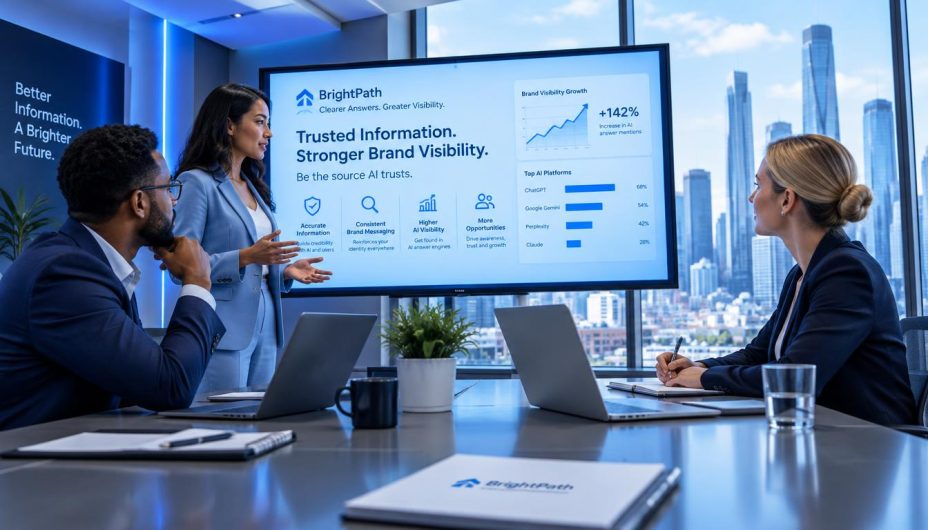
9. Track AI Mentions, Referral Visits, and Business Outcomes Separately
The final step in a brand visibility program is ongoing measurement. Keep a stable prompt panel, document any changes to the tests, and evaluate responses under comparable conditions. Record whether the brand appeared, whether it was recommended, which sources were cited, and whether a source actually supported the statement.
For brand visibility, referral traffic is another layer, not a substitute for prompt observation. Use site analytics to review identifiable visits from AI services, then examine engaged sessions, qualified form submissions, purchases, or other real outcomes. Some traffic will have incomplete attribution, and a change in branded search volume does not by itself prove that AI answers caused the change.
Use a short brand visibility status report: what changed, which audience or prompt group was affected, what evidence supports the finding, what remains uncertain, and who owns the next action. For example, an incorrect specification cited from a product page suggests a factual correction; missing referrals from a successful mention may require checking whether the answer actually included a clickable link.
To connect brand visibility testing with regular business reporting, review our SEO metrics guide and SEO reporting framework. Both help keep search exposure, website visits, and conversions distinct instead of inventing a combined success percentage.
Simple AI Brand Visibility Measurement Template
This example is an illustrative worksheet, not data from a real business. A consistent record helps you compare AI responses without mistaking an anecdote for a market-wide result. Brand visibility should be analyzed by prompt type and platform before making a claim about performance.
| Field | Illustrative Entry | Why It Matters |
|---|---|---|
| Prompt | Which booking tools support small clinics? | Defines the customer need |
| Platform and date | AI search experience, date recorded | Preserves test conditions |
| Brand mention | Yes / No | Tracks naming in answers |
| Recommendation | Yes / No / Ambiguous | Separates endorsement from reference |
| Owned-site citation | Exact source URL if present | Checks whether your page is cited |
| Source accuracy | Supported / Outdated / Unclear | Identifies corrections |
| Referral or outcome | Recorded separately in analytics | Tests real business value |
A brand visibility comparison should use the same prompt categories and scoring rules over time. If you add easier questions that mention your company in the prompt, the mention rate may rise without any improvement in broader discovery. Report sample size, date, and exclusions beside each percentage.
What AI Answer Engine Optimization Does Not Guarantee
There is no verified universal formula that guarantees brand visibility through a certain keyword density, a fixed number of backlinks, 100-word paragraphs, special markup, or a list of publisher mentions. AI answers can vary by prompt, source availability, product features, and context. An effective strategy aims to make information useful and accurate while measuring observed results honestly.
Be skeptical of unsupported claims that generative search has eliminated a precise percentage of all organic traffic or that every AI answer contains the same number of recommended brands. Broad forecasts may describe a scenario, not an established outcome for your company. Use dated, attributable research if you choose to report statistics, and label assumptions clearly.
Likewise, changes in brand visibility should not automatically be attributed to a single page edit or new backlink. Seasonality, competing content, changes in the AI product, and variation in the prompt set may affect observations. Build a repeatable review process before asserting cause and effect.
Common Mistakes to Avoid
- Measuring only branded prompts: A brand name in the question makes mentions more likely and weakens discovery testing.
- Confusing citations with recommendations: A citation can support factual context without endorsing a vendor.
- Using unsupported statistics: Do not treat forecasts or promotional research claims as universal facts.
- Ignoring crawler rules: Verify access for the specific search system your business wants to be eligible for.
- Inventing trust signals: Fake reviews, offices, awards, and credentials damage the accuracy of public information.
- Misusing link attributes: Nofollow and sponsored values are not guaranteed AI citation signals.
- Over-optimizing for AI formats: Forced content chunks and AI-only schema cannot substitute for helpful material.
- Reporting unstable scores: Explain the sample, prompt setup, platform, and observation date.
- Ignoring conversions: Being named in an answer and acquiring a qualified customer are separate outcomes.
Practical Brand Visibility Checklist Before Publishing
- Define the real product, audience, geography, and customer questions.
- Build a representative set of neutral and branded prompts.
- Record mentions, recommendations, citations, and source accuracy separately.
- Confirm public pages are available to the search crawlers your policy permits.
- Check that company descriptions, product details, and support information are current.
- Publish accurate, original explanations and clear comparisons.
- Give important pages descriptive headings, working links, and accessible media.
- Keep structured data consistent with visible page facts.
- Seek legitimate editorial references instead of manufactured mentions.
- Review differences between language and regional offerings.
- Measure identifiable AI referrals and actual qualified customer actions.
- Assign owners to corrections and record follow-up results.
Frequently Asked Questions
What is brand visibility in AI answer engines?
It means the observable presence of a business or product in AI-generated answers, including mentions, recommendations, and citations. It is not the same as a fixed organic search ranking or a guaranteed visitor.
How can a small business improve its chances of being discovered?
Start with accessible public pages, accurate services and contact information, real customer questions, useful original explanations, and legitimate references. Document what appears in repeatable tests rather than purchasing a promised AI placement.
Does ChatGPT Search use the same crawler as model training?
No. OpenAI documents OAI-SearchBot for search discovery and GPTBot for potential model-training use. Publishers can configure their access rules independently, and allowing a crawler does not guarantee inclusion.
Is special schema required for Google AI Overviews or AI Mode?
No. Google’s official guidance says its generative Search features have no extra special schema requirement. Valid structured data remains useful where it accurately describes visible content and meets normal feature rules.
Can I guarantee that an AI system cites my website?
No. You can improve public information and technical eligibility, but you cannot force an AI product to choose your page as a source or recommend your brand.
Are citations, mentions, and referrals the same thing?
No. A mention names the brand, a citation identifies a source, and a referral is a visit caused by a clickable link. Measure them separately and verify whether cited material actually supports the associated statement.
Do nofollow backlinks ensure better AI visibility?
No. A nofollow link may deliver useful referral traffic or a relevant editorial mention, but there is no documented universal rule that it makes a brand appear in AI-generated recommendations.
What is the best way to monitor competitors in AI answers?
Use the same relevant non-branded prompts, dates, markets, and scoring definitions for each brand. Record whether the response mentions, recommends, or cites each competitor, then report sample limits.
How often should AI visibility be reviewed?
Use a cadence suited to your business and publishing volume. Monthly or quarterly prompt reviews can provide a practical starting point, with additional checks after important product, policy, or website changes.
Conclusion
Brand visibility in AI answer engines grows from being genuinely useful and easy to understand, not from a guaranteed optimization trick. Build an accurate public identity, maintain access to important pages, answer customer questions with original evidence, and earn legitimate references that help people evaluate your business.
Then review mentions, citations, recommendations, referrals, and customer outcomes under consistent conditions. Treat variations as observations and document what is still uncertain. To continue building a strong foundation for brand visibility, explore our recurring SEO checklist and the Online SEO Blogs homepage.