AI Search Visibility Metrics: 11 Best KPIs to Track
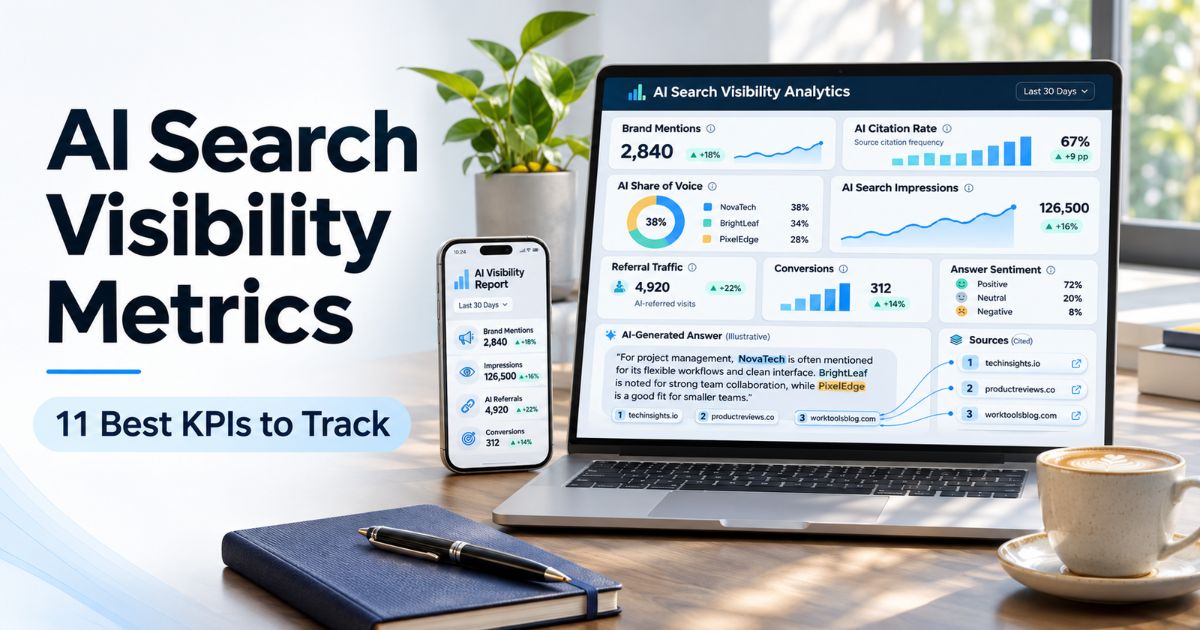
AI search visibility metrics help marketers understand whether a brand, product, or webpage appears when people ask AI-powered search services relevant questions. A company may be named in an answer, cited as a source, recommended among competitors, or visited after someone follows a link. Each outcome means something different, so one combined “AI ranking” score can be misleading.
Useful AI search visibility metrics combine repeatable answer observations with official platform reports, website analytics, and real business outcomes. They complement traditional SEO clicks and rankings rather than replacing them. This guide explains 11 measurable KPIs, formulas, data limitations, and a practical reporting template for teams monitoring Google AI experiences, ChatGPT Search, and other answer engines.
Start with your audience and business questions rather than an expensive dashboard. For the wider context, review our AI Search & SEO guides and organic search metrics overview.
Key Takeaways
- Measure mentions, citations, recommendations, brand comparisons, referral visits, and conversions as distinct outcomes.
- Keep a stable set of relevant prompts, with recorded platform, date, market, and search mode, before comparing results.
- Use a clear denominator for every percentage; a small prompt sample is not a market-wide audience estimate.
- Google introduced dedicated Generative AI performance reports in Search Console in 2026, showing impressions and useful dimensions.
- Connect identifiable ChatGPT referrals to landing-page engagement and qualified outcomes, allowing for incomplete attribution.
- Verify cited sources and answer accuracy instead of treating every brand mention as a positive recommendation.
- Turn findings into specific corrections, original content improvements, and technical checks without promising AI inclusion.
What Are AI Search Visibility Metrics?
AI search visibility metrics are measurements of how a brand or website is represented in AI-powered discovery experiences. Some are observed directly by testing questions: whether an answer names a brand, suggests it, or links to a page. Others come from platforms, such as Google’s Generative AI impressions report or your website’s identifiable visits from AI search referrals.
When comparing AI search visibility metrics, these categories should not be conflated. A citation to an independent article mentioning your company is not a link to your own website. A brand can be included in a comparison without being recommended. A user can encounter an answer and search for your brand later, but analytics generally cannot prove that the later search was caused by a specific unseen response.
For AI search visibility metrics to support a decision, define which product, topic, market, and customer intent the measurement covers. A local repair company and a global software vendor need different prompt panels and commercial outcomes. Our content mapping framework helps group real customer questions into useful page types, while the LLM competitor audit guide gives a complementary research process.
11 Best AI Search Visibility KPIs to Track
1. Brand Mention Rate
Brand mention rate is the proportion of eligible AI responses that explicitly name your organization or product. In a documented prompt panel, divide responses naming the brand by the number of valid responses reviewed, then multiply by 100. For example, 12 brand mentions in 40 eligible responses produce a 30% observed mention rate. The numbers are illustrative, not a verified market benchmark.
Among AI search visibility metrics, mention rate is a useful first signal because it can be collected even when an answer contains no clickable sources. However, do not count variations of one brand name as several separate appearances in the same response. Separate prompts that already contain the brand name from neutral discovery questions; prompted brand recall and unprompted discovery are different measurements.
To make AI search visibility metrics comparable, record the exact answer text, platform, date, search availability, country where relevant, and classification rules. If you want product-specific examples, see our ChatGPT product-page monitoring guide. A higher mention rate may be worth investigating, but it cannot independently prove broader public awareness.
2. Owned-Website Citation Rate
A citation is an answer’s reference to a supporting source. Owned-site citation rate measures how many eligible tested answers contain at least one link to your own website. Use (responses citing an owned URL / eligible tested responses) × 100. Decide in advance whether responses without any citation feature are excluded or retained in the denominator, and disclose that choice.
For AI search visibility metrics, distinguish an owned citation from an external publication that merely mentions your company. If an answer cites your product documentation, record the exact URL, source context, and whether the claim is genuinely supported. Count responses containing one or more owned citations rather than inflating the rate when an answer repeats the same link.
Citations do not always signal an endorsement. A source may be used to explain a limitation, an error, or a comparison. Our ChatGPT Search visibility guide explains the difference between discovery, brand mentions, and source linking.

3. Answer Inclusion and Recommendation Rate
Answer inclusion records whether your brand appears as a relevant option, product, or provider in an AI-generated response. Recommendation rate is narrower: it counts answers that actively suggest your brand for the user’s stated need. Define a coding rule before testing, such as mentioned, listed as an option, recommended, or not present.
AI search visibility metrics should not treat a neutral comparison as a positive endorsement. A response such as “Company A offers feature X but lacks feature Y” includes the brand without necessarily recommending it. Likewise, a named business that does not serve the user’s country should not be scored as a successful local recommendation.
For trustworthy AI search visibility metrics, use the same prompt set and labeling rules each month. A second reviewer can evaluate ambiguous responses, and disagreements should be documented rather than hidden. This KPI is especially valuable when customers ask for shortlists or purchasing advice.
4. AI Share of Voice Against Relevant Competitors
AI share of voice compares your observed mention frequency with selected competitors in the same research sample. One method calculates your brand mentions / all mentions of tracked brands × 100. Another reports the percentage of eligible answers containing each brand separately. Those methods have different denominators and should never be mixed into one chart.
For AI search visibility metrics, compare brands with similar products, price ranges, and geographic reach. A global household name may appear in nearly every broad query but be irrelevant to the niche service your business provides. Normalize by prompt category, such as education, comparison, recommendation, and purchase readiness.
For AI search visibility metrics, answers may name multiple brands, so individual presence rates can total more than 100%. If your reporting uses a share of all tracked-brand mentions, explain how duplicate appearances and multiple mentions in one response are counted. Our competitor visibility methodology helps turn this exercise into a reproducible audit.
5. Answer Placement and Context
Some teams record where a brand appears within an answer: first recommendation, middle of a shortlist, supporting example, or passing mention. This is an exploratory observation, not a Google-style ranking position. Answers can be conversational, reorganized, personalized, or accompanied by different visual cards, so there is no universal position scale across platforms.
Among AI search visibility metrics, placement is useful only if the interface and question type are comparable. Record whether the answer is a ranked list at all, then capture the placement and surrounding wording. A brand appearing first in a list of examples is not automatically the best option or the most trusted source.
For AI search visibility metrics quality control, save representative screenshots or response text according to the platform’s terms and your privacy policy. Avoid interpreting a one-position movement in a small sample as confirmed growth. Compare broader distributions and highlight notable examples rather than declaring a fixed “AI rank.”
6. Brand Sentiment and Factual Accuracy
Brand perception is more than positive or negative language. Review whether an answer accurately describes pricing, service areas, product specifications, eligibility, supported integrations, or limitations. For sentiment, apply consistent labels such as positive, neutral, negative, or mixed, based on the exact words used in the answer.
For AI search visibility metrics, factual accuracy deserves its own score. A practical calculation is verified correct claims / checked material claims × 100. Decide which claims are material, inspect the cited source, and use current first-party documentation where possible. An answer that sounds flattering but misstates your service coverage should not be counted as a success.
When reviewing AI search visibility metrics, flag incorrect information and identify the probable source where evidence allows. Improving your content development process and updating outdated pages may help make public information clearer, but correcting a page does not guarantee that every AI response changes immediately.

7. Google Generative AI Impressions
Google introduced dedicated Generative AI performance reporting in Search Console in June 2026 and stated that the reports were rolled out worldwide by August 31, 2026. The views include impressions of your URLs in AI features on Search, including AI Overviews and AI Mode, and generative AI experiences in Discover. The reported dimensions include pages, countries, dates, and devices for Search, subject to the applicable report.
This is an important improvement for AI search visibility metrics: it provides official platform-side evidence of content appearances instead of relying only on manual prompts or estimated tracking-tool scores. Use the Generative AI report to find which URLs are shown, which countries matter, and whether the trend changes over comparable periods. Google states that this visibility is also included in its overall performance reporting, so do not simply add the two totals together.
For AI search visibility metrics, do not label the dedicated impressions count as unique people, clicks, referrals, or conversions. It reports visibility according to Google’s defined counting rules, and it cannot establish whether a user noticed the result or remembered the brand. Read Google’s official announcement of Generative AI performance reports for the rollout and available dimensions.
For a broader technical review, consult our Search Console audit checklist and SEO analytics reporting guide.
8. AI Referral Traffic and Landing Pages
AI referral traffic measures visits attributed to users who follow links from AI-powered services to your website. Use GA4 or another trusted analytics system to examine session source, referral information, landing page, device, and geography. For ChatGPT, OpenAI says search referral URLs include utm_source=chatgpt.com, which can help with identification.
AI search visibility metrics must distinguish referral traffic from prompt observations. A mention without a click produces no directly observed visit, while a user might find your brand in an answer and arrive later through a branded Google query. Referral attribution can also be incomplete because of browser settings, tracking limitations, consent choices, or navigation paths.
When compiling AI search visibility metrics, check the official OpenAI publishers FAQ for its description of crawler access and ChatGPT referral tagging. Use exact source definitions in your analytics, and review landing-page trends alongside traditional SEO reporting practices.
9. Engagement Quality of AI-Referred Visitors
A traffic source can deliver more visits without delivering more valuable engagement. For sessions identified as AI referrals, examine engaged sessions, engagement rate, relevant page interactions, and whether people continue to useful supporting pages. Define success by the landing page’s purpose; someone who quickly obtains a phone number may not need to read five more pages.
For AI search visibility metrics, keep GA4 engaged-session definitions and event settings consistent over time. Avoid comparing ChatGPT referrals from one month with all organic search traffic from a different country or content category. Segment product pages, service pages, and educational posts where enough data exists.
In AI search visibility metrics reporting, some visits may be incorrectly grouped as direct or another source, so label the traffic that is identifiable rather than claiming complete AI-driven acquisition. Our SEO KPI reference explains why traffic volume and genuine engagement should be considered together.
10. AI-Referred Leads, Conversions, and Revenue
Business outcomes are the most decision-oriented of the AI search visibility metrics. Track useful actions from identifiable AI-referred sessions: demo requests, booked calls, paid orders, qualified form submissions, newsletter registrations, or other relevant key events. Confirm event tracking works and avoid treating every minor click as a qualified lead.
An illustrative calculation: if 250 identifiable AI-referred sessions produce 10 validated inquiries, the session-to-inquiry rate is 4%. If three inquiries become customers, that is a separate lead-to-customer rate of 30%. These example figures are arithmetic only, not typical industry performance or a prediction of revenue.
For AI search visibility metrics, revenue reporting should note attribution limits, purchase lag, refunds, and margin where relevant. A person can touch several channels before buying, and it is rarely possible to prove that an unseen answer alone caused a sale. Our traffic forecasting guide explains how to separate estimates from observed outcomes.
11. Stability, Coverage, and Change Over Time
One snapshot is a weak basis for decisions because AI responses can vary. Track stability across repeated runs of the same prompt under defined conditions and coverage across customer topic groups. A simple stability measure can be the share of repeated tests that still mention your brand, but make the repeat count and test dates explicit.
For AI search visibility metrics, compare the same core sample over time. If you replace half the prompts with branded questions, an increased mention rate may say more about your test design than your brand’s discovery. Add new prompts to a separately labeled exploratory set, then evaluate them before integrating them into the main baseline.
To interpret AI search visibility metrics, review content changes, major product launches, platform updates, and competitor activity alongside the observed results. A drop should trigger investigation rather than an automatic rewrite. Use our LLMO checklist to review accessibility and content clarity, and our foundational SEO with AI resource to keep the analysis grounded in useful website practices.
A Practical AI Search Visibility Metrics Dashboard Template
Organize AI search visibility metrics into three distinct data layers: observed answers, official platform reports, and website/business analytics. This keeps a manually sampled mention rate from appearing to have the same coverage as a first-party impression count. Use a consistent reporting period and store raw examples so another reviewer can audit the conclusions.
| KPI | Suggested Source | How to Calculate or Review | Important Limitation |
|---|---|---|---|
| Brand mention rate | Documented prompt tests | Answers mentioning brand / eligible answers | Prompt sample, not total audience |
| Owned-site citation rate | Recorded answers and links | Answers linking to owned URLs / eligible answers | Citation does not equal endorsement |
| Recommendation rate | Manual classification | Answers recommending brand / eligible answers | Requires consistent coding |
| AI share of voice | Comparable brand prompt panel | Your mentions / tracked-brand mentions | Depends on competitor set |
| Answer placement | Saved answer context | Placement distribution in comparable formats | Not a universal fixed rank |
| Sentiment and accuracy | Expert source review | Documented labels and verified claims | Reviewer interpretation |
| Generative AI impressions | Google Search Console | Reported impressions by page, country, date | Not clicks or unique users |
| AI referral sessions | GA4 or web analytics | Sessions with identifiable AI sources | Incomplete attribution |
| Referral engagement | GA4 | Engaged sessions and useful events | Depends on event settings |
| Qualified conversions | GA4 and CRM | Validated leads or sales from identified visits | Multi-channel purchase paths |
| Visibility stability | Repeated matched tests | Consistency across a fixed prompt panel | Platform and prompt variability |
When presenting AI search visibility metrics to stakeholders, place the sample size directly beside each rate. If an answer was tested five times, do not quietly report all five runs as five independent people. Identify the platform, country, and mode for each result. A small, transparent dashboard is more useful than an unexplained composite “AI visibility score.”
How to Build a Repeatable Prompt Testing Baseline
Choose a manageable core set of questions aligned with the buyer journey. Include informational discovery, category comparisons, brand-neutral recommendations, and high-intent product or service decisions. A panel of 20 to 40 prompts can be an operational starting point for a small team, but it is not a statistically representative sample of all users.
For AI search visibility metrics, collect the following fields consistently:
- Exact prompt wording and the business problem it represents
- Platform, product mode, and whether web search was used
- Observation date, language, geography, and relevant account context
- Whether the brand was mentioned, compared, or actively recommended
- Source links, owned-domain citations, and independent citations
- Sentiment label, notable factual claims, and verification outcome
- Competing brands named and their role in the response
- Reviewer, evidence location, and any change to the testing methodology
For AI search visibility metrics, keep neutral prompts and prompts containing your brand in separate categories. Rotate new exploratory questions without changing the historical core panel. If responses are highly variable, repeat tests and report the distribution instead of cherry-picking the best screenshot. The purpose of AI search visibility metrics is honest monitoring, not manufacturing a favorable result.
How Links and Source Citations Fit Into the Analysis
Within AI search visibility metrics, source citations deserve context, but do not turn this article into a general guide about nofollow links. A link inside an AI response is evidence of a particular source reference. An ordinary editorial backlink from another website is a different object, and a referral session happens only when someone actually visits your site.
Attributes such as rel="nofollow", rel="sponsored", and rel="ugc" identify link relationships in systems such as Google Search. They are not published switches that guarantee inclusion in an AI answer. A nofollow link may still be useful to a reader, but it should not be counted as an AI citation unless it was actually cited in a tested answer.
For AI search visibility metrics, report independent editorial mentions separately from platform-generated citations. Consider whether a source is accurate, current, relevant, and useful to customers. For ethical outreach and link evaluation, review our content quality resources.

Worked Example: Reporting Visibility for a Software Company
To illustrate AI search visibility metrics, imagine a fictional scheduling software company testing 40 neutral questions about appointment booking. In this illustrative month, its name appears in 14 eligible responses, its website is cited in six, and it is actively recommended in nine. The observed mention rate is 35%, owned citation rate is 15%, and recommendation rate is 22.5%. These percentages describe this exact test sample only.
The company’s dashboard also shows Google Generative AI impressions for several product-guidance pages and 120 identifiable referral sessions from AI sources. Six sessions lead to qualified demo requests. Because these signals come from different reporting systems, the team does not combine them into a single exposure or conversion rate.
One cited product comparison misstates a plan limitation. The team verifies the current policy, corrects its public documentation, and contacts the independent publisher if an external page is outdated. A subsequent review repeats the same prompts and checks identifiable referrals. This is the kind of action that AI search visibility metrics should support: correcting a real customer-information problem rather than promising a fixed recommendation position.
Turn Findings Into Monthly Decisions
For every important movement in AI search visibility metrics, ask what changed, where it happened, how confident the evidence is, and what a reader needs. A mention decline in one small prompt category may require more observations; an inaccurate product price can justify an immediate correction; a technical access problem on a critical public page requires a different investigation.
For AI search visibility metrics, use the following simple process:
- Validate tracking settings and compare the same market, prompts, and period.
- Identify which metric changed, and avoid mixing sampled rates with official impressions.
- Read actual answer contexts and verify material cited claims.
- Check the relevant pages, crawl access, factual details, and internal navigation.
- Assign an action owner, due date, and a measurable follow-up observation.
- Retest and report whether the outcome improved, stayed uncertain, or worsened.
For website-level technical checks, our crawl accessibility guide and site architecture guide provide useful background. They help diagnose accessibility and discovery problems, but fixing either cannot force an AI platform to choose your source.

Common Measurement Mistakes to Avoid
- Reporting one answer as market share: A single AI response cannot represent an entire audience.
- Using mismatched denominators: A percentage of cited answers differs from a percentage of all prompts.
- Confusing mention and recommendation: A neutral mention may not endorse your product.
- Adding overlapping impression totals: Google’s Generative AI visibility is included in broader performance reporting.
- Treating referral sessions as all AI-driven discovery: Attribution can be incomplete or indirect.
- Relying on undocumented third-party scores: Tools may use their own prompts, weighting, and sampling rules.
- Inventing industry percentages: Use sourced evidence or clearly marked hypothetical examples.
- Claiming a guaranteed AI rank: Generative answers can change with context and available sources.
- Skipping source verification: A citation can be wrong, out of date, or unrelated to the actual claim.
AI Search Visibility Metrics Checklist
- Define the target audience, buyer questions, products, and markets.
- Build a documented, stable mix of neutral and branded prompts.
- Record platform, mode, language, date, and relevant country for each test.
- Measure mentions, owned citations, independent citations, and recommendations separately.
- Use one stated denominator and a visible sample size for each percentage.
- Review AI share of voice only across comparable brands and prompt topics.
- Verify response accuracy, context, sentiment, and cited sources.
- Review Google’s Generative AI performance reports where relevant data appears.
- Separate identifiable AI referrals from overall organic visits.
- Connect traffic to engagement, qualified leads, and revenue when configured.
- Assign evidence-backed fixes and repeat the same baseline at the next review.
Frequently Asked Questions
What are AI search visibility metrics?
AI search visibility metrics are measurements of brand appearances, recommendations, source citations, platform-reported visibility, referral sessions, and business results associated with AI-powered discovery. Each signal should be defined and measured separately.
What is the difference between brand mention rate and citation rate?
Mention rate measures eligible answers naming a brand. Owned-site citation rate measures eligible answers linking to that brand’s webpages as sources. An answer can mention a company without linking to it, and a citation does not necessarily endorse the company.
Does Google Search Console report AI Overview visibility?
Yes. Google announced dedicated Generative AI performance views in 2026, including impressions and dimensions such as pages, countries, dates, and devices for Search. These are platform-defined appearances, not a direct count of customers or purchases.
How can I identify visits from ChatGPT Search?
Review website analytics for ChatGPT referral sources and utm_source=chatgpt.com where present. Compare landing pages, engaged sessions, and qualified outcomes, while acknowledging that some AI-influenced journeys will not be identifiable.
What is AI share of voice?
It is a comparison of brand presence against a defined competitor set in a repeatable prompt sample. State whether the percentage uses all tracked-brand mentions or all eligible answers, because those calculations mean different things.
Does a higher citation count guarantee revenue?
No. A citation is a source reference, not a confirmed visit or sale. Conversion tracking, customer feedback, and business records provide additional evidence of value.
How often should AI visibility be measured?
Monthly or quarterly reviews can suit many teams, with additional checks after meaningful product, content, or platform changes. Use a stable core prompt panel and document changes so comparisons remain interpretable.
Are nofollow backlinks an AI visibility KPI?
Not by themselves. Nofollow is a link relationship attribute, not a published guarantee of AI inclusion. Track actual third-party mentions, identifiable referrals, and citations instead of assuming that the attribute causes recommendations.
Can a small business track these KPIs without paid tools?
Yes. A spreadsheet of carefully selected prompts, Search Console reports, standard website analytics, and periodic source checks can establish a useful initial baseline. Paid software may help scale collection but does not remove sampling limitations.
Conclusion
AI search visibility metrics become useful when they distinguish answer-level observations from platform impressions and actual customer outcomes. Track mentions, citations, recommendations, competitor context, answer accuracy, official visibility reports, and identifiable referrals with clearly documented methods.
Use AI search visibility metrics to find factual corrections, stronger customer answers, or technical access issues—not to promise a guaranteed placement. A small, accurate dashboard that leads to real improvements is more valuable than a large collection of unsupported scores. For ongoing practical guidance, visit the Online SEO Blogs homepage.