
LLMO Checklist: 12 Powerful Steps for Better AI Visibility

An LLMO checklist is a repeatable process for making website content easier for search engines, AI search systems, and large language model experiences to discover, understand, retrieve, and reference. It combines technical SEO, useful content, clear entities, trustworthy sourcing, structured information, internal linking, and measurement.
The most important lesson is that an LLMO checklist should build on SEO fundamentals rather than replace them. There is no universal “AI ranking hack,” special AI schema, fixed paragraph length, or guaranteed technique that forces ChatGPT, Google AI Overviews, AI Mode, or another model to cite a page.
Key Takeaways
What Is an LLMO Checklist?
An LLMO checklist is a practical audit for improving how website information can be discovered and interpreted in AI-powered search and answer experiences.
LLMO is commonly used as shorthand for large language model optimization. Related industry terms include AI SEO, AEO, GEO, generative search optimization, and AI visibility optimization.
These labels can be useful for describing the workflow, but they should not distract from the underlying work.
Google’s current official guidance says traditional SEO best practices remain relevant to AI Overviews and AI Mode because its generative AI features are rooted in core Search ranking and quality systems.
You can read Google’s official guide to optimizing for generative AI features.
That makes a good LLMO checklist largely an extension of technical SEO, content quality, entity clarity, accessibility, authority, and measurement.
For the broader foundation, review our foundational elements for SEO with AI, the AI Search & SEO hub, and our practical SEO improvement guide.
12 Powerful Steps in the LLMO Checklist
1. Start With Crawlability and Indexing
The first item in any LLMO checklist is technical accessibility.
If important content is blocked, unavailable, incorrectly canonicalized, or not indexable, improving paragraph style or adding schema will not solve the core problem.
Audit:
- HTTP status codes
- robots.txt rules
- robots meta directives
- Canonical URLs
- XML sitemaps
- Internal links
- JavaScript rendering
- Authentication barriers
- CDN and firewall rules
- Server availability
Google’s AI optimization guidance says pages need to meet normal Search technical requirements and remain crawlable and indexable to be eligible for its generative AI features.
Use our technical SEO audit framework and Technical SEO hub to organize these checks.

2. Configure OpenAI Crawlers Intentionally
A current LLMO checklist should distinguish OpenAI’s different web agents rather than treating them as one crawler.
OpenAI currently documents:
| Agent | Purpose | Why It Matters |
|---|---|---|
| OAI-SearchBot | Search discovery | Used to surface websites in ChatGPT search features |
| GPTBot | Model improvement/training crawl | Can be controlled independently from Search visibility |
| ChatGPT-User | User-triggered page access | Used when a user asks ChatGPT to visit a page; it is not the automatic Search crawler |
OpenAI’s crawler documentation says OAI-SearchBot and GPTBot controls are independent.
For example, a publisher that wants to allow ChatGPT Search discovery while opting out of GPTBot training access can configure separate rules:
User-agent: OAI-SearchBot
Allow: /

User-agent: GPTBot
Disallow: /
This does not guarantee a citation or placement. OpenAI’s ChatGPT Search documentation explicitly says placement is not guaranteed.
Your LLMO checklist should also confirm that CDN, WAF, firewall, or bot-protection settings are not blocking the traffic you intended to allow.
3. Do Not Optimize Around an Assumed Single Search Index
A weak LLMO checklist often contains statements such as “ChatGPT Search is Bing” or “every AI engine uses the same index.” That is too simplistic for a current strategy.
ChatGPT can search the web and may use search partners as part of that process. OpenAI also operates OAI-SearchBot for Search discovery.
The practical lesson is to make your public website accessible, understandable, trustworthy, and useful rather than trying to reverse-engineer one assumed backend index.
This also means traditional search visibility still matters. Explore our SEO resource hub and our guide explaining the difference between keywords and SEO for broader context.
4. Treat llms.txt as Optional, Not a Google Ranking Requirement
A modern LLMO checklist should separate experimental web conventions from documented search requirements.
Google clarified in 2026 that llms.txt is not required for Google Search and does not positively or negatively affect Google rankings or generative AI visibility.
Google’s AI optimization guide says its Search systems ignore llms.txt for ranking and visibility purposes.
That does not mean another service can never choose to use such a file. It means you should maintain one only when you have a specific reason or a platform you use explicitly supports it.
Do not let an optional file distract your LLMO checklist from crawlability, content quality, internal architecture, and authoritative information.
5. Create Non-Commodity, People-First Content
The content section of an LLMO checklist should ask a harder question than “Did we use the keyword?”
Ask whether the page contributes information that a user or AI system cannot easily get from a generic summary of ten existing articles.
Useful differentiators can include:
- Firsthand experience
- Original analysis
- Real workflows
- Unique screenshots
- Primary-source interpretation
- Expert commentary
- Original datasets
- Real examples
- Clear comparisons
- Evidence-backed conclusions
Google’s generative AI guidance specifically emphasizes useful, original, non-commodity content rather than simply recycling information already available online.
Its separate guidance on AI-generated content also says AI-assisted material should be manually reviewed for accuracy, quality, and relevance before publication.
This principle aligns with our editorial policy and the Content SEO & Marketing hub.
6. Structure Each Section Around a Clear Question or Idea
Good structure belongs in an LLMO checklist because it improves usability for humans and makes relationships between topics easier to interpret.
Use:
- One clear H1
- Descriptive H2 and H3 headings
- Direct opening answers
- Short readable paragraphs
- Useful lists
- Comparison tables
- Definitions where terminology may be ambiguous
- Clear examples
However, there is no authoritative requirement that every paragraph be exactly 30–60 words or that content must be artificially split into tiny “AI chunks.”
Google explicitly says there is no requirement to “chunk” content for generative AI Search. Organize the page for readers and use the amount of detail the topic genuinely needs.
That makes the LLMO checklist an editorial clarity process, not a rigid formatting formula.
7. Make Brands, Authors, Products, and Other Entities Explicit
An effective LLMO checklist should make important entities easy to identify.
If a page discusses a company, person, product, service, location, study, or platform, use clear names and relationships rather than vague references.
For a publication, useful trust information includes:
- Visible author name
- Accurate author biography
- Publisher identity
- About page
- Contact information
- Original publication date
- Meaningful update date
- Clear sourcing
- Corrections process
Our About Online SEO Blogs page, editorial standards, and contact page provide these supporting relationships.
The objective is not to manufacture “entity signals.” It is to make real-world relationships accurate, consistent, and understandable.
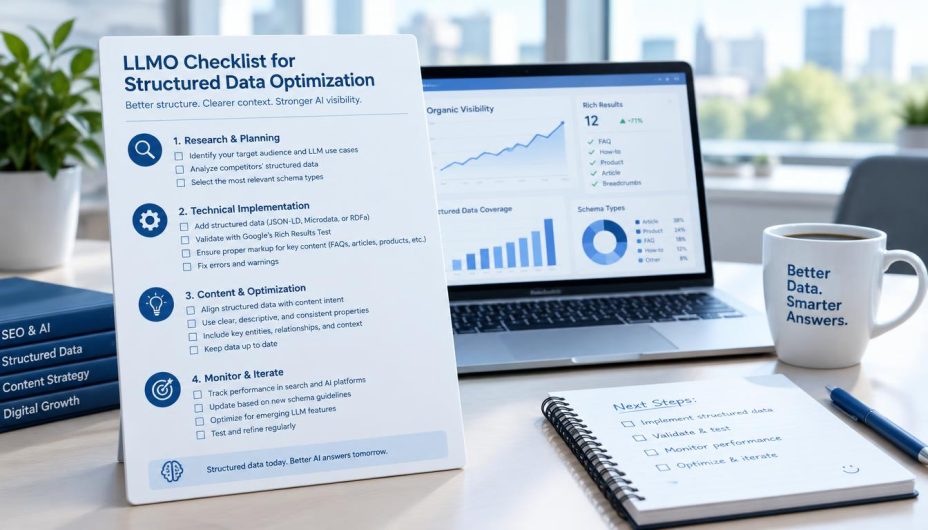
8. Use Structured Data for Its Real Purpose
Structured data belongs in an LLMO checklist, but it should not be marketed as a secret AI citation mechanism.
Google says structured data can help it understand page information and make pages eligible for supported rich results. At the same time, its 2026 AI guidance explicitly says there is no special schema required for generative AI Search.
Use appropriate markup such as:
- Article
- Organization
- LocalBusiness
- Product
- SoftwareApplication
- VideoObject
- Other supported types when the visible page genuinely qualifies
Markup should accurately match visible content and follow Google’s structured-data policies.
One important 2026 change: Google removed the FAQ rich-result feature from Search. Visible FAQs can still help readers, but adding FAQPage solely to chase a Google rich result is no longer a valid strategy.
Our LLMO checklist therefore uses Article/BlogPosting schema for this article rather than adding unnecessary AI-specific or FAQ markup.
9. Build Strong Internal Context and Topic Relationships
Internal links are a major part of this LLMO checklist because they help users and crawlers discover related information and understand how topics connect.
For an AI-search article, relevant supporting resources might include:
- Foundational SEO elements for AI
- AI Search & SEO resources
- Technical SEO audit framework
- Technical SEO guides
- Practical SEO strategies
- Content SEO resources
Use descriptive anchor text rather than generic “click here” links.
A strong LLMO checklist also identifies orphan pages, weak topic clusters, duplicated intent, and supporting articles that should link back to an important hub.
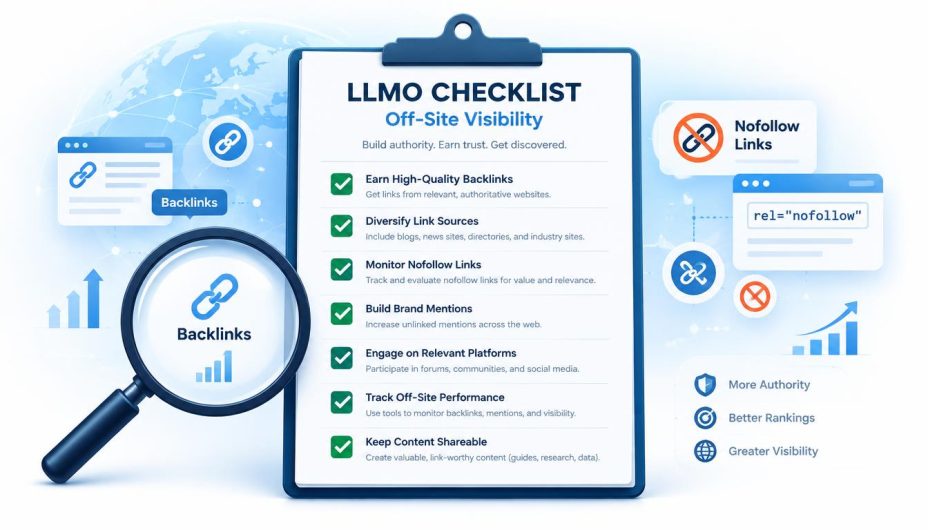
10. Earn Credible External Evidence and Brand Visibility
An LLMO checklist should include off-site evidence, but avoid turning this into a manufactured brand-mention campaign.
Useful visibility can come from:
- Editorial coverage
- Industry publications
- Professional associations
- Research citations
- Relevant directories
- Podcasts and interviews
- Community participation
- Original research that others reference
Google’s current AI Search guidance specifically warns against chasing inauthentic mentions as an “AI optimization” tactic.
Focus on becoming genuinely worth mentioning.
For broader authority strategy, review the Off-Page SEO & Link Building hub.
If a legitimate mention uses a nofollow link, do not automatically dismiss it. Our guide on how nofollow links can still create value explains referral traffic, discovery, and brand exposure without claiming guaranteed ranking credit.
11. Use Images and Video When They Add Information
Modern AI search experiences increasingly work across text, images, video, local information, and other content formats, so media belongs in an LLMO checklist.
Use media to add information rather than decorate the page.
Good practices include:
- High-resolution relevant images
- Descriptive alt text
- Logical filenames
- Real screenshots when they clarify a process
- Charts with readable labels
- Video demonstrations when a visual explanation is genuinely useful
Google’s AI optimization guide specifically says normal image and video SEO best practices continue to apply to generative AI Search.
Our article on whether video podcasts can support SEO provides additional context for using multimedia without assuming it automatically improves rankings.
12. Measure AI Visibility and Business Outcomes Separately
The final item in an LLMO checklist is measurement.
AI visibility is not the same thing as revenue, qualified traffic, rankings, or conversions.
For Google, Search Console now provides a dedicated Generative AI performance report. Google says the report includes impressions from AI Overviews and AI Mode and can be segmented by page, country, date, and device.
For other AI experiences, combine:
- Referral traffic
- Server logs
- Landing-page engagement
- Conversions
- Branded search trends
- Manual prompt testing
- Observed citations
- Observed brand mentions
Prompt testing should be repeatable. Build a representative set of real questions and run them periodically rather than cherry-picking one answer that mentions your brand.
A responsible LLMO checklist records observations over time without claiming that one change caused one AI citation.
When Google visibility shifts, use our Google Algorithm Update Tracker, core update guide, spam update guide, and Google Search Updates hub before attributing changes to an AI optimization tactic.

Page-Level LLMO Checklist
Use this shorter LLMO checklist when reviewing an individual article or landing page.
- The page returns a valid crawlable response.
- The canonical points to the intended URL.
- The page is indexable where indexing is desired.
- The primary question is answered early.
- Headings clearly describe each section.
- Facts and statistics are supported by reliable evidence.
- Primary sources are used for platform-specific claims.
- The page adds original or non-commodity value.
- Named entities are clear and consistent.
- The author and publisher are identifiable.
- Important related pages are internally linked.
- External citations lead to authoritative sources.
- Images have useful alt text.
- Structured data matches the visible content.
- The page works well on mobile devices.
- Important content is not hidden behind unnecessary interaction.
Site-Level LLMO Checklist
A site-level LLMO checklist looks beyond one article and evaluates whether the whole publishing system supports discovery and trust.
- Important pages are accessible to intended search crawlers.
- OAI-SearchBot and GPTBot rules reflect the publisher’s actual policy.
- XML sitemaps contain canonical URLs.
- Topic clusters have clear hub-and-spoke relationships.
- Important pages are not orphaned.
- Duplicate and low-value pages are controlled.
- Author profiles contain accurate information.
- Organization details are consistent.
- Editorial and corrections policies are visible.
- Structured data is maintained and validated.
- Internal links support important topics.
- Search Console is actively monitored.
- AI referral traffic is measured separately from normal organic traffic.
- Content is periodically reviewed for outdated AI/search claims.
Use the full Online SEO Blogs library and Online SEO Blogs homepage to connect this checklist with related technical, content, Google Search, and AI-search guidance.
What the LLMO Checklist Does Not Require
One of the most useful parts of an LLMO checklist is knowing what not to over-optimize.
| Common Claim | Better Guidance |
|---|---|
| You need an llms.txt file to rank in Google AI | Google says llms.txt neither helps nor hurts Google Search visibility |
| You need special AI schema | Google says no special structured data is required for generative AI Search |
| Every paragraph must have a fixed word count | Write for human clarity; no universal paragraph-length rule exists |
| Content must be split into tiny AI chunks | Google explicitly says forced chunking is not required |
| Every prompt variation needs its own page | Creating scaled pages mainly to manipulate AI or Search can violate spam policies |
| FAQ schema guarantees AI visibility | No; Google removed FAQ rich results from Search in 2026 |
| Structured data guarantees citations | No; structured data can aid machine-readable understanding but does not guarantee AI citation |
This is why the best LLMO checklist is evidence-led and periodically updated as platforms publish new documentation.
How Often Should You Run an LLMO Checklist?
There is no mandatory audit schedule.
Run the LLMO checklist when:
- Publishing an important new pillar or commercial page
- Refreshing a major evergreen article
- Changing robots.txt or crawler policies
- Migrating domains or site architecture
- Changing structured data
- Launching a new topic cluster
- AI referral traffic changes materially
- Google or OpenAI updates relevant documentation
- Important content becomes outdated
For ongoing Google changes, monitor our live update tracker rather than assuming every visibility fluctuation comes from an announced algorithm update.
Frequently Asked Questions
What is an LLMO checklist?
An LLMO checklist is a repeatable audit covering technical access, content quality, structure, entities, structured data, internal links, external evidence, crawler controls, media, and measurement for AI-powered discovery experiences.
Does LLMO replace traditional SEO?
No. Google’s current guidance says normal SEO best practices continue to be relevant to generative AI Search. A practical LLMO checklist therefore builds on technical SEO and people-first content rather than replacing them.
Do I need llms.txt for Google AI Overviews or AI Mode?
No. Google says llms.txt is not needed for Google Search and does not positively or negatively affect visibility or rankings there. Other services may choose to use similar files independently.
Should I allow OAI-SearchBot?
If you want your public website to be eligible for inclusion in ChatGPT Search results, OpenAI recommends allowing OAI-SearchBot and making sure your host, CDN, and firewall do not block its published crawler traffic. Eligibility does not guarantee inclusion.
Is GPTBot the same as OAI-SearchBot?
No. OpenAI documents GPTBot for potential model-training use and OAI-SearchBot for Search. Publishers can configure their robots.txt policies independently.
Do I need special schema for AI search?
No special AI schema is required for Google’s generative AI Search features. Continue using valid structured data where it accurately represents visible content and supports normal Search features.
Can an LLMO checklist guarantee ChatGPT or Google citations?
No. No legitimate LLMO checklist can guarantee a ranking, mention, citation, AI Overview appearance, ChatGPT Search placement, traffic level, or business outcome.
How can I measure AI search visibility?
Use Google’s Generative AI performance report for eligible Search visibility, analytics for AI referral traffic, server logs where useful, and a consistent prompt-testing methodology for observing brand mentions and citations across other AI experiences.
Conclusion
A strong LLMO checklist is not a collection of speculative AI hacks. It is a disciplined extension of modern SEO: make important pages crawlable, publish original and reliable information, use clear structure, identify real entities, implement accurate schema, connect related pages, earn genuine external visibility, and measure outcomes carefully.
The best LLMO checklist also respects platform differences. OpenAI lets publishers manage Search crawling separately from GPTBot training access, while Google says its generative AI Search features remain rooted in established Search systems and do not require llms.txt, special AI schema, forced chunking, or content written only for machines.
Use the LLMO checklist as an audit framework, not a promise of citations. AI discovery systems will continue changing, so reliable technical foundations, people-first content, transparent sourcing, and ongoing measurement are more durable than any temporary optimization theory.
Continue with our AI Search & SEO hub, foundational SEO for AI guide, Technical SEO resources, Content SEO resources, and Off-Page SEO resources for the supporting pieces of the framework.