
Link Prospecting: 9 Proven Steps to Find Quality Backlinks
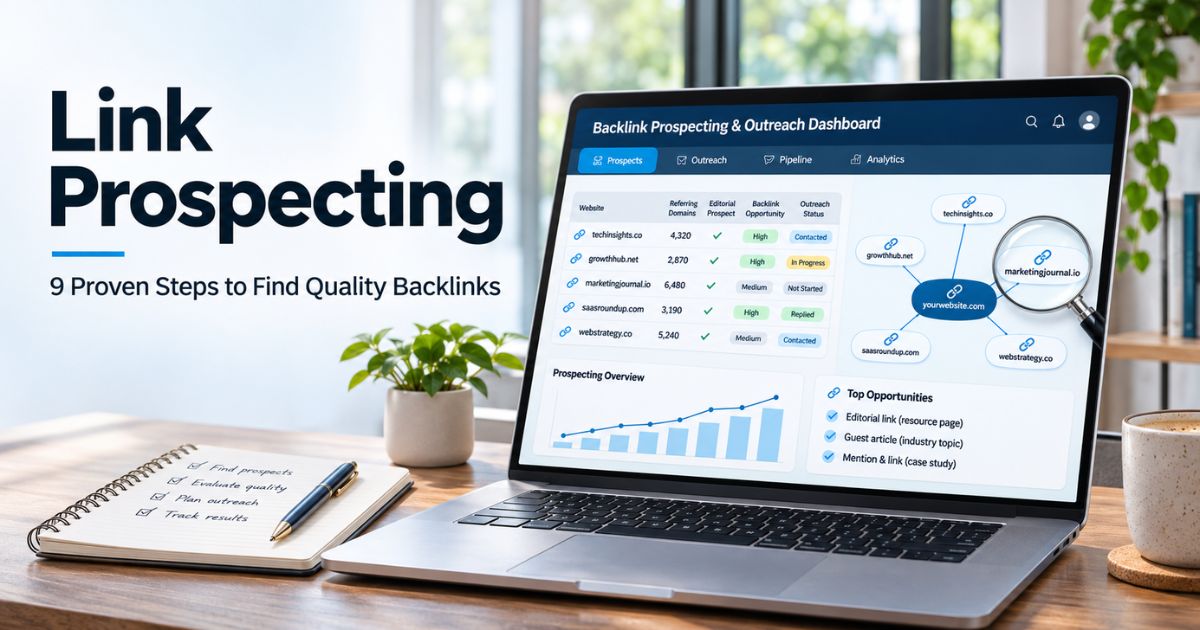
Link prospecting is the process of finding and assessing websites that might link to a useful page, report, resource, or original piece of research. Rather than collecting thousands of domains, a sound campaign identifies publishers whose audiences could genuinely benefit from the material being offered.
Successful link prospecting starts with a clear goal, a link-worthy asset, and research into relevant websites. It continues through manual quality checks, personalized outreach, and careful measurement. A backlink is never a guaranteed ranking boost; its value depends on context, audience, editorial independence, and the outcomes it creates.
This practical guide walks through nine steps for discovering quality backlink opportunities without relying on spammy placements or arbitrary authority scores. For the wider strategy, explore our Off-Page SEO & Link Building resources.
Key Takeaways
- Begin with a useful resource and a defined audience before assembling a list of prospects.
- Use competitor backlink research, relevant publications, resource pages, and genuine brand mentions to discover opportunities.
- Evaluate editorial relevance, audience fit, page quality, and placement context rather than relying on Domain Rating alone.
- Document the specific reason each publisher might reference your resource.
- Use personalized outreach that offers genuine value, not a demand for a followed link.
- Qualify sponsored and user-generated links correctly, and avoid buying ranking credit.
- Measure qualified placements, referral visits, and business outcomes alongside search visibility.
What Is Link Prospecting and Why Is It Important?
Link prospecting means researching potential websites and individual pages that may be suitable for earned editorial links or legitimate, properly qualified mentions. The task is different from link acquisition: prospecting identifies and evaluates possible opportunities; outreach and editorial decisions determine what happens next.
For example, a company publishing a detailed guide to home energy costs could seek out journalists covering utility bills, educational resource pages explaining efficiency, and local organizations sharing consumer guidance. It would not make sense to send the guide to unrelated lifestyle blogs merely because their third-party authority scores look high.
Relevant editorial references can help people discover useful material and may support broader search visibility. However, Google identifies links created primarily to manipulate rankings as link spam. For broader context on sustainable off-page work, see our enterprise link-building strategy guide and practical SEO improvement guide.

9 Proven Link Prospecting Steps for Quality Backlinks
1. Set a Campaign Goal and Choose a Link-Worthy Asset
Begin link prospecting by defining what you want to achieve and who should benefit. Are you promoting original research, improving awareness of a free tool, earning citations for a practical guide, or inviting an expert to contribute insights to a publisher’s story?
Write down your target reader, geographic market, preferred destination page, and the unique value you can offer. A campaign promoting an original dataset will require different publishers from one highlighting a local community project. Avoid choosing the target URL simply because it is a commercial page: publishers need a good reason to reference the resource.
| Campaign Type | Suitable Prospects | Reason to Contact |
|---|---|---|
| Original research | Journalists and industry publications | Relevant findings, data, and expert interpretation |
| Educational resource | Libraries, educators, and resource curators | A practical guide that fills an identified gap |
| Expert commentary | Editors and specialist publishers | Credible insight on a timely topic |
| Local community project | Relevant regional organizations and publications | Useful information for a shared local audience |
Your link prospecting brief should state the claim you can support, the resource readers will find useful, and the editorial angle. Our content mapping guide helps align a resource with search intent and audience needs, while the content strategy hub offers ideas for building genuinely useful assets.

2. Discover Prospects Through Competitor Backlinks
In link prospecting, competitor backlink analysis can reveal publications already interested in a subject. Identify comparable websites or articles, then review which referring pages link to their relevant resources. Tools such as Ahrefs Link Intersect and comparable backlink databases can surface domains linking to competitors but not yet to you.
Do not assume every competitor backlink is worth copying. A competing page may have earned legitimate coverage, but its backlink profile can also include irrelevant directories, outdated links, paid placements, or manipulative entries. Review the actual referring page and why its link exists.
For link prospecting, compare the topic and editorial purpose of the referring page against your asset. A publication that cited a research dataset may be a reasonable prospect if you can offer new, verifiable findings. Simply asking the publication to replace a competitor’s link without a meaningful benefit is unlikely to help its readers.
When competitive work affects technical destination pages, our site architecture guide can help ensure the resource is easy to discover and connected to supporting content.
3. Search for Resource Pages and Relevant Editorial Coverage
For link prospecting, search engines can help identify publishers without a paid backlink database. Start with topics related to your resource, then inspect actual pages rather than trusting a search operator alone. Example research searches include intitle:resources "home energy", "energy saving" "useful links", and "industry report" "sustainability".
These searches are discovery tools, not shortcuts to automatic link placement. Check whether the page is maintained, whether it links to resources like yours, and whether its audience would benefit. Editorial blogs, specialist publications, association guides, and university resource pages can all be suitable when the subject and purpose genuinely match.
Broaden link prospecting beyond your exact main keyword to adjacent topics that share the same readers. A financial education guide, for example, may be relevant to a consumer-protection publication even if the publisher uses different keyword vocabulary. Our guide to keywords and SEO explains why audience intent matters more than repeating an exact phrase.
4. Identify Unlinked Mentions and Broken Resource Opportunities
Another link prospecting tactic is to look for legitimate online mentions of your organization, original study, product, or spokesperson that do not contain a useful reference link. If an article quotes your report, politely offering the original source can help readers verify the claim. If it only mentions your brand incidentally, a link request may add little value.
Broken-link research is another possible method. When a relevant page points to a missing resource, determine whether you have an accurate replacement that fulfills the same user need. Contact the editor with a specific explanation rather than a generic request to insert your URL.
A responsible link prospecting campaign does not exploit dead links by offering unrelated pages. If the broken URL belongs to your own website after a migration, an appropriate redirect or content restoration is often the first fix. Our technical SEO audit resource and canonical pagination guide provide context for maintaining accessible destination pages.
5. Qualify Websites for Relevance, Trust, and Editorial Fit
Finding a domain is only the start. High-quality link prospecting requires reading the proposed referring page and several other recent pieces from the publisher. Ask whether the content demonstrates actual editorial review, cites sources accurately, and serves a recognizable audience.
Evaluate topical relevance, likely reader interest, placement visibility, editorial standards, recent publishing activity, obvious spam patterns, and the naturalness of outbound references. Third-party metrics such as Domain Rating or estimated organic traffic can be screening inputs, but they are not Google quality scores or guarantees of ranking value.
| Evaluation Factor | Useful Question | Warning Sign |
|---|---|---|
| Topic relevance | Would readers genuinely benefit from this source? | Unrelated placement sold as an SEO package |
| Editorial standards | Are claims supported and content reviewed? | Thin, repetitive or copied posts |
| Audience fit | Does the site reach the intended readers? | Traffic claims without audience context |
| Linking behavior | Are external citations natural and selective? | Many keyword-rich promotional links |
| Transparency | Is paid content clearly identified? | Offers guaranteeing followed ranking links |
| Maintenance | Does the page work and show current information? | Broken links, missing authors or outdated material |
For link prospecting, prefer a smaller, defensible shortlist to an export full of irrelevant websites. Before considering any cleanup of questionable backlinks already pointing to you, read our disavow list decision guide; unfamiliar links alone are not a reason to disavow them.

6. Build a Prospect Spreadsheet With a Clear Outreach Angle
Keep link prospecting findings in a single shared spreadsheet or CRM. Record the specific referring page, not only the website’s homepage. That context prevents generic pitches and makes it easier to audit decisions when the campaign grows.
Useful columns include publisher, relevant URL, audience, topic fit, candidate destination page, contact source, reason for outreach, editorial status, contact date, response, placement URL, and notes about sponsorship or link qualification. Use professional contact details obtained through appropriate channels, and respect opt-outs.
A simple prioritization score can help your team work efficiently: rate relevance, usefulness of your asset, strength of the editorial opportunity, and effort required. Explain the rating rules and do not present the score as Google’s assessment of a website.
Strong link prospecting documentation also prevents duplicate emails from different team members. The enterprise link-building workflow explains why shared ownership and publisher records matter at scale.
7. Personalize Outreach Around Reader Value
In link prospecting, good outreach starts with something specific about the editor’s page. Identify a genuine gap, newly relevant fact, or useful supporting resource; explain briefly why your material could help its audience. Do not insist on an exact-match anchor, promise ranking benefits, or imply that the editor owes you a link.
For example, an outreach note might mention a publisher’s guide to energy efficiency and offer a new, transparent dataset comparing regional household costs. The recipient should be able to decide independently whether it belongs in the article. For outreach to local publications, consider whether a neighborhood resource meets a real need; our local SEO example for real estate professionals illustrates the importance of useful, location-relevant information.
Keep messages concise and honest. Avoid bulk personalization that only inserts the person’s first name while sending the same irrelevant pitch to hundreds of websites. Track replies, respect refusals, and follow up only when reasonable. A thoughtful link prospecting process should protect editorial relationships instead of treating publishers like entries in a link marketplace.

8. Understand Sponsored, UGC, and Nofollow Link Attributes
Link prospecting includes evaluating why a placement exists. A genuinely independent editorial citation normally does not require a special rel attribute. Google prefers rel="sponsored" for paid advertisements, sponsorships, and affiliate arrangements. For links contributed by users in comments or forums, rel="ugc" is recommended.
rel="nofollow" can be appropriate when another relationship value does not apply and a publisher does not want to imply endorsement. These values help describe link relationships; they are not a way to obtain guaranteed rankings. Google explicitly warns against buying or exchanging links to manipulate search ranking systems.
Review Google’s Search spam policies on link schemes and official guidance on qualifying outbound links when deciding how a placement should be marked. For practical examples of referral and discovery benefits, read our nofollow links SEO guide.
9. Track Placements, Referrals, and Business Results
The final link prospecting step is measurement. Record which qualified prospects were contacted, which editors responded, which references were published, and what happened afterward. Keep activity metrics separate from business outcomes.
Useful indicators include qualified prospect acceptance rate, editorial placements, actual referral sessions, engaged visitors, newsletter registrations, inquiries, and conversions where tracking supports them. Search visibility can be monitored alongside these signals, but a coinciding ranking change does not prove that one backlink caused it.
Compare like-for-like time periods and assess source quality rather than measuring success by sheer volume. For a reporting template, see our SEO reporting guide, SEO metrics overview, and SEO Tools & Analytics resources. If a broad ranking shift occurs, consult the Google algorithm update tracker before assigning the cause to outreach.
Simple Link Prospecting Worksheet Example
The example below is illustrative; the names and evaluations are fictional. Replace them with verified observations from the actual referring pages before contacting anyone.
| Prospect | Relevant Page | Editorial Angle | Next Action |
|---|---|---|---|
| Industry publication A | Guide to home energy costs | Updated original cost comparison | Check editor and data fit |
| Resource directory B | Consumer efficiency resources | Free, practical educational calculator | Verify resource criteria |
| Local publisher C | Regional sustainability coverage | Relevant local expert commentary | Research recent reporting |
Common Link Prospecting Mistakes to Avoid
- Chasing high scores alone: Domain Rating and similar metrics cannot establish editorial quality or real audience relevance.
- Sending identical outreach: Generic emails rarely explain why your content belongs on a specific page.
- Buying ranking links: Commercial links intended to pass ranking credit can violate Google’s spam policies.
- Copying every competitor backlink: A competitor’s profile may contain irrelevant or questionable placements.
- Ignoring the target page: Editors need a credible, accessible asset worth referencing.
- Over-optimizing anchors: Demanding an exact phrase can make a placement unnatural.
- Promising a ranking outcome: No honest prospecting campaign can guarantee a particular Google position.
- Neglecting measurement: Link counts without referral quality or business impact tell an incomplete story.
Link Prospecting Checklist Before Outreach
- Define the business objective, target audience, and candidate resource.
- Confirm that the resource contains accurate, useful, and current information.
- Find relevant competitors’ referring pages and subject-specific publications.
- Inspect each candidate page manually for audience and editorial fit.
- Screen out manipulative placements, unrelated link offers, and obvious spam.
- Record the page URL, contact source, and specific reason for outreach.
- Prepare a short, personalized pitch without demanding a followed link.
- Disclose compensation and use appropriate sponsored or UGC attributes.
- Track genuine placements, referrals, useful actions, and lessons learned.
- Review campaign results regularly and improve future prospect selection.
Frequently Asked Questions
What is link prospecting in SEO?
Link prospecting is the research and evaluation stage of link building. It identifies relevant websites and pages that may have a legitimate editorial reason to reference your content.
How can I find backlink opportunities without paid tools?
Use search engines to research industry publications, educational resource pages, unlinked mentions, relevant community organizations, and editorial articles. Manually verify the context and quality of each opportunity.
Is Domain Rating enough to judge a backlink prospect?
No. Third-party authority scores can help prioritize research, but they are not Google’s quality metrics. Relevance, editorial standards, audience fit, and the actual referring page matter more.
Should I copy links from competitors?
Competitor links can reveal suitable publications and topics, but every opportunity requires independent review. Avoid recreating manipulative placements or irrelevant directory listings.
Are nofollow backlinks worthless?
No. A relevant nofollow mention can attract readers, brand attention, and qualified referrals. It should not be treated as guaranteed ranking credit.
Can I pay a publisher to link to my website?
Advertising and sponsorships can be legitimate when disclosed and qualified appropriately, such as with rel="sponsored". Buying links to manipulate search rankings is contrary to Google’s spam policies.
How do I measure outreach success?
Measure qualified replies, relevant published references, source quality, referral visits, and meaningful business actions. Assess organic search trends separately without claiming that any single link caused a specific ranking change.
Conclusion
Effective link prospecting is selective research, not bulk domain collection. Start with an asset people genuinely need, look for publishers serving the same audience, and qualify each opportunity through careful editorial review.
Then personalize your outreach, respect commercial link rules, and measure actual audience and business value. A consistent process can build stronger publisher relationships and help useful resources earn recognition without relying on manipulative backlinks. For more related guidance, explore the Online SEO Blogs article library.