
Google Algorithm Volatility: 9 Proven Ways to Respond
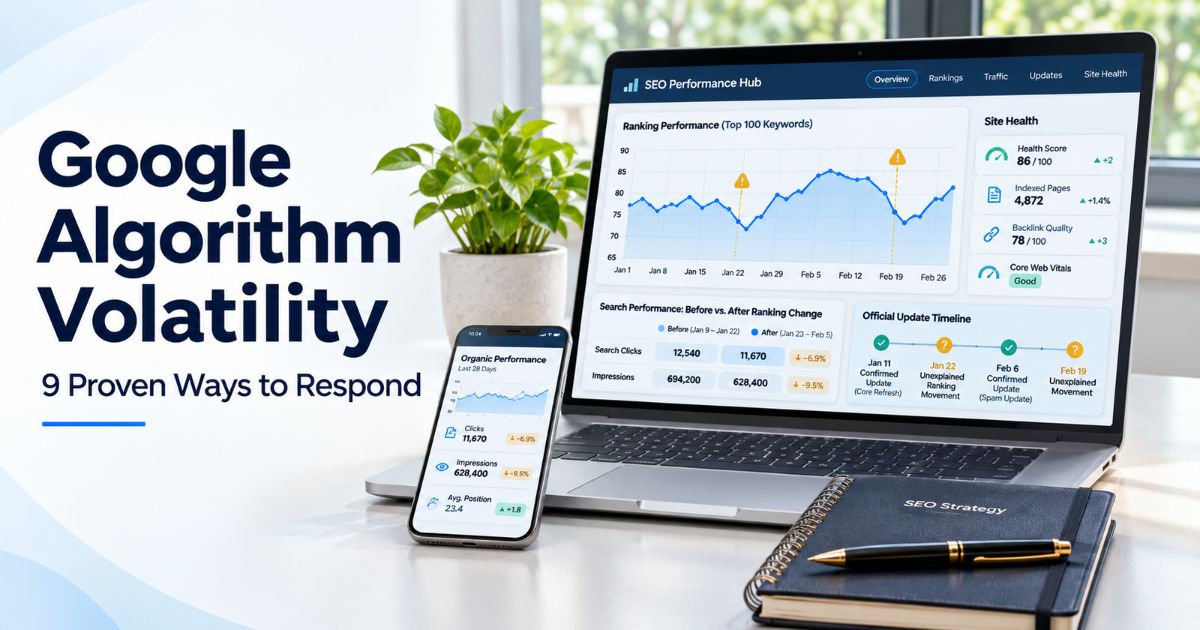
Google algorithm volatility describes the movement of webpages within Google’s search results over time. A ranking may rise, fall, or disappear from one observed results page as Google’s systems, competing content, search demand, and the appearance of results change. These movements are not automatically evidence of a penalty or an announced core update.
Understanding Google algorithm volatility means looking beyond a single keyword tracker. The same site can lose impressions for one topic and gain clicks for another, while rankings change by country, device, and search intent. A sensible response starts with reliable observations, examines the actual pages and queries affected, and identifies whether any technical or editorial correction is justified.
This guide offers nine practical steps for distinguishing routine ranking movement from a problem worth investigating. It explains Google Search Console checks, confirmed updates, volatility tools, changes in search-result features, and an evidence-based action plan. For related examples, see our SERP volatility guide and the Google Search Updates resource hub.
Key Takeaways
- Ranking movement does not by itself prove a Google update, penalty, or website error.
- Check Google’s official Search Status Dashboard before attributing shifts to a confirmed rollout.
- Compare affected pages, queries, countries, devices, and date ranges in Search Console.
- Distinguish changes in impressions, clicks, average position, and actual business results.
- Rule out tracking issues, site deployments, crawling failures, redirects, and unexpected indexability rules.
- Use third-party volatility scores for wider context; they do not diagnose a particular site.
- Following a broad core update, allow enough time for the rollout and reliable comparison data before drawing conclusions.
- Make durable improvements for users instead of reacting to a single day’s position.
What Is Google Algorithm Volatility?
Google algorithm volatility is a practical way to describe how much search-result ordering changes across a set of queries and observations. It is often called ranking volatility or SERP volatility. A tracking tool may see large movements across many keywords, while an individual publisher may see only a small change in clicks. Both can be true because the tools monitor different samples and metrics.
Google updates its ranking and serving systems continuously, and some major changes are announced as core updates or other named rollouts. But Google algorithm volatility can also arise when competing pages improve, the public searches for different topics, new results features take space, or a website changes its content and technical settings. A sudden movement can have more than one contributing factor.
To understand Google algorithm volatility, keep four concepts separate. Ranking is a page’s observed placement for a query; impressions record search exposure under Google’s reporting rules; clicks record interactions with results; and organic sessions are onsite visits attributed by analytics software. Their trends can diverge. Our SEO metrics reference explains those differences in more depth.
Google Algorithm Volatility: 9 Proven Ways to Analyze and Respond
1. Record the Change Before Looking for an Explanation
When Google algorithm volatility becomes noticeable, begin an observation log. Record when you first detected the change, which queries or URLs moved, the target country, device, search type, and the reporting tools involved. Note whether the movement is an isolated ranking screenshot or a sustained pattern across comparable data.
For a useful Google algorithm volatility baseline, capture a period before the change and a period after it. Label any unusual factors such as holidays, advertising campaigns, product launches, recent site migrations, or an outage. Avoid comparing seven days with thirty days and interpreting the raw totals as equivalent. Some reports take time to settle, so review data freshness as well.
Imagine that a page drops from position three to eight in one manual desktop search. That may matter, but the same URL could still receive stable clicks from many related queries. Rather than declare a sitewide crisis, compare its impressions, CTR, and clicks over meaningful periods. Our SEO reporting framework shows how to document findings without mistaking an observation for an explanation.
Google algorithm volatility investigations become more reliable when evidence is preserved. Save the exact affected URL, report filters, relevant change-log entries, and any screenshots needed to reproduce the finding. Do not rewrite metadata immediately; doing so can make it harder to understand what initially happened.

2. Separate Confirmed Google Updates From Unconfirmed SERP Movement
A central part of Google algorithm volatility analysis is checking whether Google has actually confirmed an update. The official Google Search Status Dashboard identifies publicly reported ranking updates and incidents, with published rollout dates and status changes. Search discussions and volatility trackers can be useful signals, but an unusual temperature score is not confirmation of a particular algorithm change.
Compare the exact dates of the affected pages with official information. A core update may overlap with a decline, but its timing cannot establish that the update caused every change. One site section may improve while another declines; broader competitive or technical factors may be involved. Our Google Algorithm Update Tracker provides a convenient view of confirmed rollouts and history.
During Google algorithm volatility, also distinguish a broad core update from a spam update, Discover change, or specific crawling, indexing, ranking, or serving incident. Each type has a different scope. A confirmed ranking rollout should not be described as a manual action against an individual website. A manual action is communicated through the appropriate report within Search Console.
For Google algorithm volatility reporting, label an observation as confirmed update overlapping the period, unconfirmed broad movement, or site-specific change under investigation. That wording gives stakeholders useful context without making claims your evidence cannot support. Our Google spam updates guide explains a separate category of official changes.
3. Review Search Console by Page, Query, Device, and Country
Google Search Console is the starting point for site-specific Google algorithm volatility analysis. In the Performance report, select a comparable period and inspect total clicks, total impressions, average CTR, and average position. Then filter by pages and queries rather than relying only on the overall property chart. A sitewide average can hide a steep decline in one important section.
For Google algorithm volatility, segment queries into branded and non-branded groups where useful. Compare informational posts, product categories, service pages, and regional landing pages separately. If a decline appears mostly on mobile in one country, checking the desktop average alone may lead to an incorrect conclusion. Also examine Web Search separately from image, video, or news visibility.
A page might lose clicks while impressions remain similar, suggesting a CTR or search-presentation change. If both clicks and impressions fall, the issue could involve ranking exposure, search demand, indexing, or other factors. Average position alone is an aggregate; it is not a fixed rank that every user sees. The SEO analytics reporting guide explains how to build these comparisons into a repeatable decision process.
To investigate Google algorithm volatility responsibly, note the limitations of Search Console exports, especially aggregated and low-volume query data. Do not assume a missing query row means nobody searched for it. A useful report records the filters and known limits alongside the observed trend.

4. Rule Out Technical Problems Before Changing Content
Some apparent Google algorithm volatility is actually a website problem. Before blaming a ranking update, check whether important URLs resolve correctly, whether the server was available, and whether pages became unavailable or changed their indexability signals. An accidental noindex tag, incorrect canonical, redirect error, or major template failure can affect search exposure.
Use Search Console’s Page indexing and URL Inspection reports on representative affected pages. Check the declared and Google-selected canonical where available, response behavior, last known crawl information, and current live accessibility. A live inspection is not a guarantee that Google’s indexed version has already updated. For a structured review, use our Google Search Console audit checklist.
When investigating Google algorithm volatility after a deployment, inspect robots.txt, internal navigation, sitemap entries, JavaScript-rendered content, and HTTP responses. Compare the site version before and after the change. Common examples include a staging noindex setting left active, an incorrect URL mapping during migration, or a navigation redesign that makes key pages harder to reach.
Do not interpret every excluded URL as a failure. Redirected URLs, deliberately noindexed utility pages, and duplicate alternates may have expected statuses. Our crawl accessibility guide, canonical versus noindex reference, and XML sitemap guide can help distinguish intentional configuration from real barriers.
5. Compare Search Intent, Competitor Pages, and SERP Features
Even if no technical problem appears, Google algorithm volatility may reflect the changing usefulness or presentation of results. Search queries can shift from informational to commercial, local, or recent-news intent. A page that once answered the dominant question may now face different types of competitors or new result features.
Inspect the search results in relevant markets, preferably under repeatable conditions. Record whether the page competes with category pages, guides, videos, forums, local results, shopping features, or AI-assisted answer experiences. The existence of a feature does not prove it caused your decline. Look for specific changes in the content and results users can see.
For Google algorithm volatility, compare the strongest current competitors on factual accuracy, freshness where it matters, completeness, firsthand examples, readability, and whether they solve the actual query. Do not simply copy their headings or add more words. Sometimes your page needs a clearer answer, while at other times a specialized service or comparison page better fits the searcher’s task.
Use a content mapping framework to connect query intent to suitable pages. For informational results that feature concise answers, our featured snippets guide explains how clear explanations and helpful structure can make content easier to use without promising special search placement.
6. Understand Third-Party Volatility Scores Without Treating Them as Proof
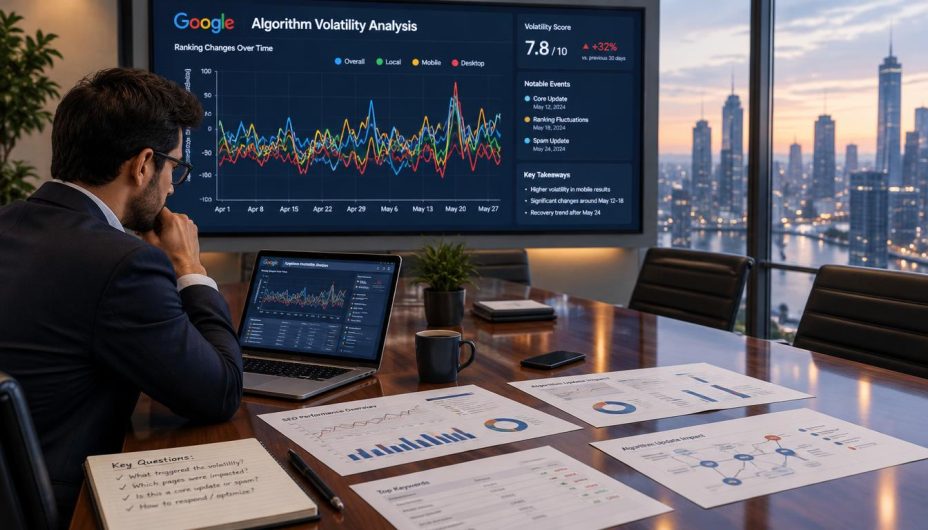
Independent trackers can alert you to broad Google algorithm volatility by monitoring sets of keywords and observing changes in rankings. Some express movement as a temperature, percentage, or proprietary index. Their methodology, geographic scope, tracked verticals, update frequency, and keyword sample determine what the score can tell you.
A high score may indicate widespread movement in the tracked sample but cannot identify why your individual site lost a specific position. A low score does not rule out a major problem with your own website. Avoid using arbitrary temperature cutoffs as official Google thresholds, and never write that a third-party chart has confirmed an update that Google has not announced.
When using Google algorithm volatility tools, compare trends across more than one source only when their definitions are understood. Then return to first-party evidence from Search Console and your own analytics. If one tool reports a broad spike but your important pages have stable clicks, impressions, and qualified leads, you may have little immediate action to take.
Our keyword competition guide also explains why third-party scoring models are not direct statements from Google. Ranking fluctuation scores deserve the same caution: useful for triage, insufficient as a diagnosis.
7. Choose the Correct Comparison Window Around a Core Update
When Google algorithm volatility overlaps an announced core update, Google recommends checking whether the rollout has finished before drawing a firm conclusion. Its guidance suggests waiting at least a full week after completion, then comparing an appropriate post-update period with a similar period before the rollout. For a large sustained decline, it recommends evaluating the affected pages and site quality more deeply.
The official Google core updates guidance also cautions against drastic reactions to relatively small position drops. A move from an observed position two to four is different from a sustained fall from four to twenty-nine across important queries. Even a large change is a prompt for investigation, not proof that the affected content violates a rule.
For Google algorithm volatility, an active rollout can produce continued movement. Unless there is an urgent technical fault, avoid changing many titles, templates, and content pages at once during that unstable comparison window. Keep a changelog so you can distinguish deliberate website changes from evolving search-result observations.
Do not promise that a website will recover at the next update. Google’s systems can reassess pages outside major rollouts, and improvements may take days or months to become visible. Our core update recovery guide discusses how to evaluate quality and site-level changes without relying on a guaranteed timeline.
8. Prioritize Sustainable Page and Site Improvements
Once Google algorithm volatility has been investigated, separate confirmed problems from speculative fixes. A 500 server error calls for technical repair. A guide that contains outdated instructions needs editorial correction. A page that is simply displaced by a better answer may require original examples, stronger sourcing, clearer structure, or a more useful explanation.
For Google algorithm volatility caused by changing competition or intent, review high-impact page groups first. Check that they satisfy the current task, use accurate evidence, answer key questions without padding, and provide clear navigation to supporting resources. Rewriting every article or stuffing an exact-match keyword into dozens of headings is unlikely to address the real problem.
Use our content development workflow to make research-backed edits, and our content pruning guide to choose whether weak pages should be retained, improved, consolidated, or retired. Removal should not be a reflexive response to one volatility chart, especially when useful pages have genuine visitors and links.
Google algorithm volatility is easier to withstand when important pages are crawlable, internal links are descriptive, and routine site changes are tested before release. The site architecture resource and practical SEO improvements guide offer long-term maintenance priorities that remain useful even without a major update.
9. Build a Monitoring and Decision Log for Future Changes
To manage Google algorithm volatility over time, maintain a small dashboard with clear definitions. Include Google Search clicks, impressions, average position, important landing pages, organic sessions, and relevant conversions or qualified leads. Add a dated change log for major releases, content updates, indexing issues, and officially confirmed ranking rollouts.
In your Google algorithm volatility report, record the affected page group, evidence, confidence level, probable explanations, next test, action owner, and date for follow-up. Not every observation needs an immediate fix; “monitor for another comparable period” is a legitimate decision when evidence is weak and the business outcome is stable.
For Google algorithm volatility, separate urgent technical incidents from gradual competitive changes. Someone should respond quickly to a broken checkout, widespread 5xx errors, or accidental sitewide noindex. A small fluctuation on one low-value informational query should not consume the same resources.
Our recurring SEO tasks checklist can support weekly and monthly reviews. For a client-facing summary of difficult technical findings, use the technical audit presentation template. The goal is to create an accountable process, not a dashboard that encourages panic.

How to Tell Normal Fluctuations From a Serious SEO Problem
Google algorithm volatility is not a binary state: some movement is expected, while other changes require immediate attention. Use both the breadth of the change and its business significance to set priorities. The following patterns are illustrative, not official thresholds for declaring a Google penalty.
| Observation | Possible Interpretation | First Check |
|---|---|---|
| One query shifts for a day; total clicks remain stable | Normal variation or a narrow SERP change | Repeat the comparison with consistent settings |
| Many pages lose impressions in one country | Demand, competition, regional relevance, or indexing | Segment affected country, pages, and query intent |
| Clicks drop while impressions are similar | CTR or results-page presentation changed | Review query mix and current search results |
| Major section disappears after deployment | Possible technical/indexability error | Inspect live URLs, server logs, robots, and canonicals |
| Sitewide decline overlaps confirmed core update | Possible update relationship; not proven causation | Wait for rollout completion and compare periods |
| GA4 sessions fall but GSC clicks remain steady | Possible analytics, attribution, consent, or loading difference | Validate tracking and source definitions |
In a Google algorithm volatility assessment, describe evidence as clearly as possible. “Search Console clicks to six service pages dropped 28% in comparable periods” is a testable observation. “Google penalized the website yesterday” is not justified unless you have an actual manual action notice or other specific confirmation.
Example: Investigating a Hypothetical Ranking Decline
Consider a fictional publisher whose organic clicks fall from 10,000 to 7,500 between comparable four-week periods: a 25% decrease. This example is not actual data from Online SEO Blogs. The publisher initially suspects Google algorithm volatility because an independent tracker reports substantial movement during the same month.
Instead of rewriting the site immediately, the team segments Search Console data. It finds that most lost clicks come from three product comparison posts in the United States, while technical tutorials remain steady. Impressions fell for a small cluster of commercial queries, and competing results now include more current comparison pages. No major server or indexing fault appears in the sample.
That evidence does not prove exactly which ranking-system change caused the decline. The team reviews the affected comparisons, verifies product facts, adds documented testing details, and fixes outdated availability information. It records publication dates, then monitors the same query group over subsequent reporting periods.
This example illustrates why Google algorithm volatility should be treated as a diagnostic context rather than an automatic instruction to change everything. A real team should also look at its qualified leads, revenue, and current customer needs before deciding how much effort to invest.
A Practical Weekly and Monthly Monitoring Routine
For ongoing Google algorithm volatility monitoring, choose a schedule that matches the website’s business risk and publishing pace. A frequently changing ecommerce site may need daily alerts for critical URL failures, whereas a smaller informational blog may rely on weekly checks and a more thorough monthly review.
- Daily when needed: Watch urgent hosting incidents, critical page availability, and major confirmed Search Status Dashboard announcements.
- Weekly: Compare important page and query groups in Search Console, noting movement that persists beyond one observation.
- Monthly: Review organic traffic, business outcomes, content changes, and technical findings together.
- After a confirmed update: Recheck official rollout status, allow an appropriate comparison window, then investigate sustained losses.
- After site changes: Test important URLs and preserve a record of what was deployed.
Google algorithm volatility should not become a reason to constantly change content. A stable process allows teams to invest in factual corrections and meaningful improvements while avoiding repeated sitewide edits that are hard to evaluate.
Common Google Algorithm Volatility Mistakes
- Assuming every ranking drop is a penalty: Routine movement and competition are not equivalent to a manual action.
- Calling third-party scores official updates: A volatility index can describe movement but cannot announce a Google rollout.
- Comparing mismatched periods: Different date lengths, countries, devices, or query groups can distort conclusions.
- Using average position alone: Clicks, impressions, search demand, and business outcomes add essential context.
- Ignoring technical deployments: A broken template or noindex error may explain what appears to be algorithmic movement.
- Making simultaneous sitewide edits: Too many changes make diagnosis and verification more difficult.
- Deleting useful content reflexively: Declining rankings alone are not a sufficient reason to remove pages.
- Promising a recovery date: No SEO provider can guarantee when or whether a Google ranking improvement will occur.
Google Algorithm Volatility Checklist Before Taking Action
- Record the exact change, dates, affected pages, keywords, devices, and countries.
- Check the Google Search Status Dashboard for confirmed rollouts or incidents.
- Compare clicks, impressions, CTR, and average position with consistent filters.
- Separate search types, branded demand, and important content groups.
- Inspect representative URLs for crawling, server, canonical, and indexability issues.
- Review recent content releases, redesigns, redirects, and analytics changes.
- Compare current search intent and the types of pages appearing in results.
- Use third-party volatility readings as context, not proof of cause.
- Wait for a confirmed core rollout to finish before making a final comparison.
- Prioritize verified errors and valuable user-facing improvements.
- Assign an owner, record the change, and set a meaningful follow-up date.
Frequently Asked Questions
What is Google algorithm volatility?
Google algorithm volatility is movement in search-result positions across queries and time. It can reflect changes to ranking systems, competitors, intent, page content, technical availability, or result presentation. It does not automatically indicate a penalty.
How do I know whether Google announced an update?
Check the official Google Search Status Dashboard and its ranking update history. Record the reported start and completion dates. Third-party volatility tools can reveal broader movement but are not authoritative announcements.
Can rankings fluctuate without a core update?
Yes. Competitor content, shifting demand, localized results, technical changes, and ongoing smaller system updates can cause rankings to move even when no large public rollout is announced.
How long should I wait after a core update before analyzing?
Google recommends confirming that the core rollout has completed and waiting at least a full week before making the main Search Console comparison. Address urgent technical failures immediately rather than waiting for a rollout to finish.
Does a high volatility score mean my site was penalized?
No. Third-party scores describe movement in a tracked sample. They do not reveal whether your site received a manual action, which should be checked in the relevant Search Console report.
Why can clicks fall while average position appears stable?
Search demand, the mix of queries, result appearance, and CTR may change without an obvious movement in aggregate average position. Examine affected pages and individual query groups before drawing conclusions.
Should I rewrite every page after a ranking decline?
No. First locate the real problem and distinguish technical errors from competitive or content opportunities. Improve individual pages where evidence shows a user need; do not make broad changes solely to chase a volatility chart.
Which tools are most useful for monitoring fluctuations?
Start with Google Search Console, the official Search Status Dashboard, and your website analytics. Third-party SERP trackers can add context if you understand their sample and scoring methods.
Can I recover from a core update without waiting for another one?
Google can reassess pages outside major core rollouts. Meaningful improvements sometimes become visible sooner and sometimes take considerably longer. There is no guaranteed timetable or specific change that assures recovery.
Conclusion
Google algorithm volatility is a normal part of search, but meaningful changes deserve careful investigation. Confirm whether Google announced a rollout, compare consistent first-party data, rule out technical problems, and examine whether the current page still meets the searcher’s need.
A resilient response to Google algorithm volatility is based on evidence, useful content, stable site architecture, and measured decisions—not panic-driven rewrites or speculative penalties. Continue exploring practical guidance on the Online SEO Blogs homepage.