ChatGPT Search Visibility: 9 Best Ways to Get Found
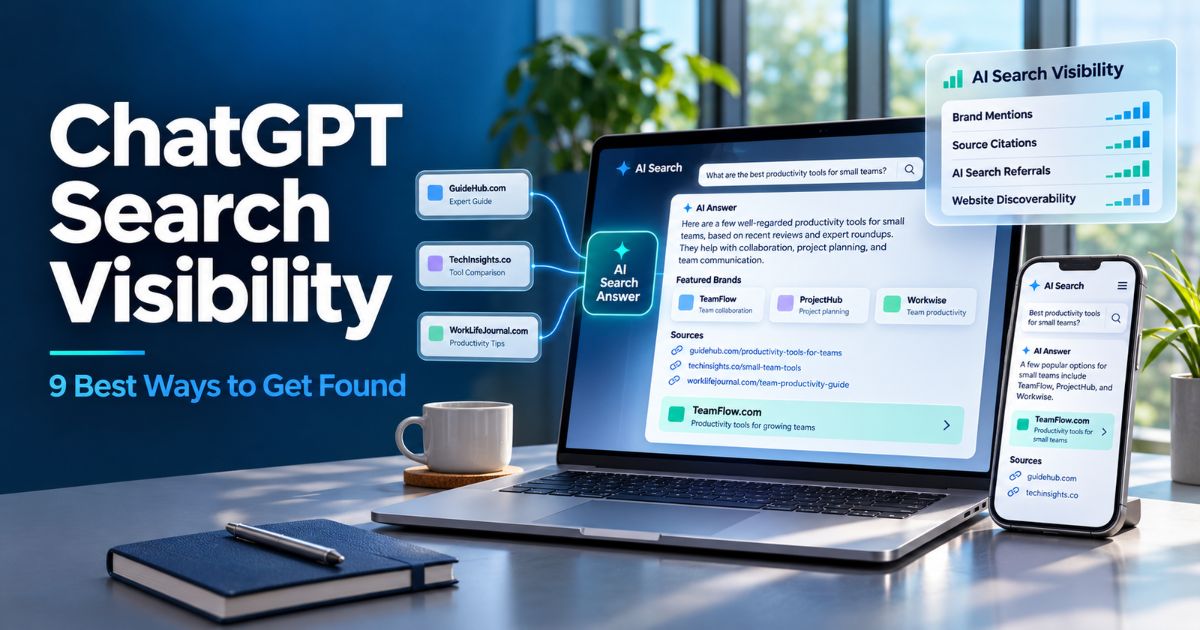
ChatGPT search visibility describes whether a brand, its products, or its webpages appear in relevant ChatGPT search answers. A company may be mentioned by name, linked as a source, recommended for a specific need, or omitted entirely. Those outcomes are different, and none can be guaranteed by adding a keyword or changing a single HTML tag.
Improving ChatGPT search visibility begins with information that people can verify: clear product descriptions, accurate business facts, useful explanations, accessible webpages, and trustworthy editorial references. It also requires realistic measurement. A brand mentioned in one test conversation has not necessarily achieved consistent visibility across other prompts, markets, or users.
This guide explains nine practical actions for brands, including crawl access, content structure, credible third-party coverage, citation checking, and referral analysis. It builds on our AI Search & SEO resources and practical SEO improvement guide.
Key Takeaways
- ChatGPT search visibility is not a fixed Google-style ranking; observe mentions, recommendations, citations, and actual referrals separately.
- OpenAI’s OAI-SearchBot is associated with search discovery, while GPTBot is a separate crawler for potential model-training use.
- Allowing a search crawler makes content eligible for certain discovery pathways but does not guarantee a citation or brand recommendation.
- Publish accurate, specific, accessible pages that directly answer customers’ real questions.
- Strengthen useful editorial context without assuming nofollow backlinks or schema markup force ChatGPT mentions.
- Use repeatable prompt tests and analytics to measure change, documenting sample limitations and source accuracy.
- Prioritize business value, corrections, and user usefulness over invented AI visibility scores.
What Is ChatGPT Search Visibility?
ChatGPT search visibility refers to the observable presence of a company, website, product, or publisher in ChatGPT experiences that use web search. You might see a brand described in the answer, a link to its own webpage, a third-party review cited as evidence, or a product result presented in a shopping context. These are not equivalent signals.
Unlike a familiar search engine results page, ChatGPT can generate a response tailored to the question and available context. The wording of the prompt, whether search was used, current source availability, user context, and product features can affect what appears. A source citation is not necessarily an endorsement, and a recommendation does not always include a clickable link to the brand’s own website.
For ChatGPT search visibility, separate four observations: a mention names the brand; a recommendation suggests it for a use case; a citation points to a source page; and a referral is a visitor who actually follows a link. Our competitor visibility in LLMs guide explains why these measurements should not be merged into one claim of “AI ranking.”
9 Practical Ways to Improve ChatGPT Search Visibility
1. Define the Customers and Questions That Matter
Start your ChatGPT search visibility plan with your actual audience. A local accounting practice, an enterprise software provider, and a consumer product brand need different discovery opportunities. Identify customer problems, buying constraints, locations, price ranges, and product categories that your business genuinely serves.
Collect questions from support tickets, sales calls, product reviews, and existing search queries. Group them into informational questions, comparisons, recommendations, and purchase or contact tasks. For example, “What features should a small team look for in a CRM?” reveals a different need from “Compare Brand A and Brand B for a five-person agency.”
Build an initial panel of perhaps 15–20 carefully selected prompts as a manageable research sample, not as an official standard. Include questions that do not name your brand. If every prompt begins with your company name, the resulting ChatGPT search visibility report will overstate your discoverability among people who have never heard of you.
Record the exact prompt, target market, audience, relevant product line, and intended action. Use our content mapping guide to align questions with pages rather than producing duplicate articles for minor wording variations.
2. Check OAI-SearchBot and Website Accessibility
ChatGPT search visibility depends partly on whether public content can be reached for relevant search experiences. OpenAI identifies OAI-SearchBot as its crawler for surfacing websites in ChatGPT search results. Review your robots.txt rules, server responses, authentication restrictions, content delivery network policies, and firewall settings to check that the search crawler is not unintentionally blocked.
For a publicly available section you deliberately want eligible for ChatGPT search, an illustrative robots.txt rule is:
User-agent: OAI-SearchBot
Allow: /
Do not paste this example blindly into a complicated robots.txt file: a site may already allow crawling by default, and existing more-specific policies need to be reviewed. Also verify access from OpenAI’s published searchbot IP ranges where relevant. OpenAI notes that robots.txt changes may take about a day to be reflected in its search systems. See the official OpenAI crawler documentation for up-to-date user-agent and access details.
For ChatGPT search visibility, distinguish OAI-SearchBot from GPTBot. GPTBot concerns crawling content that may be used for foundation-model training; its robots controls are separate. ChatGPT-User handles certain user-initiated page visits and is not the crawler that determines automatic search inclusion. Allowing search access does not mean a website will automatically be recommended or cited.
Also test actual page URLs, not only robots.txt. A public page can still fail because of repeated server errors, a challenge screen, a blocked script needed to reveal key text, or a login wall. The technical SEO audit guide and technical SEO resources provide a structured way to document these issues.
3. Make Brand and Product Facts Easy to Verify
Accurate first-party pages are central to a responsible ChatGPT search visibility strategy. State what the business does, whom it serves, where it operates, and what its products can and cannot do. Make these details available as readable text rather than hiding everything inside decorative images or downloads.
To strengthen ChatGPT search visibility, publish current product specifications, pricing conditions when applicable, plan differences, eligibility, warranties, and limitations. For services, explain scope, process, deliverables, geography, and how prospective customers can get in touch. Use the same real-world brand name and product terminology consistently across important pages.
ChatGPT search visibility may suffer in practical terms when public information about a brand is ambiguous or outdated, but there is no published formula proving that changing a particular field will earn a citation. Treat mismatches as customer-information problems first. Our foundational SEO with AI guide covers the broader importance of accessible and useful information.
For international businesses, confirm language, regional availability, currencies, and local product versions. Do not claim to have a branch or partnership where none exists. Our international keyword research guide can help identify genuine regional vocabulary and needs.
4. Answer Important Questions With Useful, Original Content
A content plan for ChatGPT search visibility should focus on questions that a prospective customer would reasonably ask. Write answer-first explanations, comparisons with clear criteria, practical procedures, and trustworthy examples. A page should give users the information they need even when they arrive directly from a recommendation or citation.
Use descriptive H2 and H3 headings, short explanatory paragraphs, numbered steps for processes, and tables only when a real comparison benefits from them. Include original observations or data when you have permission and evidence to publish them. Do not fabricate case studies, expert quotes, customer reviews, or survey numbers to make content appear more authoritative.
For ChatGPT search visibility, a specific guide can be more useful than a generic sales pitch. A software vendor might explain how integrations work, identify known limitations, and offer a transparent comparison of different subscription tiers. The aim is to answer a question accurately, not to write text that sounds like a machine-readable advertisement.
Our featured snippets guide offers complementary answer-formatting practices, and the Content SEO & Marketing library provides guidance on helpful editorial structure. These practices improve clarity, but no specific format guarantees selection in ChatGPT.
5. Connect Related Pages Through Clear Navigation
Good navigation matters for users and for ChatGPT search visibility research because readers need reliable routes to supporting information. Build a logical path between core service pages, product details, FAQs, comparisons, original research, and support articles. Use anchors that explain the destination rather than repeating the same commercial phrase in every link.
For ChatGPT search visibility, avoid treating a sitemap submission or a page’s presence in a menu as a promise of inclusion. Those elements can help expose relevant material, but selection depends on systems and context outside the publisher’s control. Check for broken paths, redirects, competing canonical URLs, and key pages that are isolated from the rest of the site.
Readers who want practical examples can explore our site architecture guide, XML sitemap resource, and canonical versus noindex explanation. These are general search-engine fundamentals; they should not be misrepresented as guaranteed ChatGPT citation techniques.
6. Earn Relevant Third-Party Coverage Without Link Schemes
Beyond your own website, ChatGPT search visibility work should consider public discussion of a brand in independent articles, customer reviews, editorial citations, professional directories, community conversations, and research. These can give potential customers additional evidence about your offer. They are also useful places to monitor factual inaccuracies or outdated descriptions.
ChatGPT search visibility should not be treated as a reason to buy dozens of keyword-rich backlinks, flood forums with promotional messages, or create fake positive reviews. There is no verified rule that a set number of backlinks, brand mentions, or appearances on a specific publisher will make ChatGPT recommend your company.
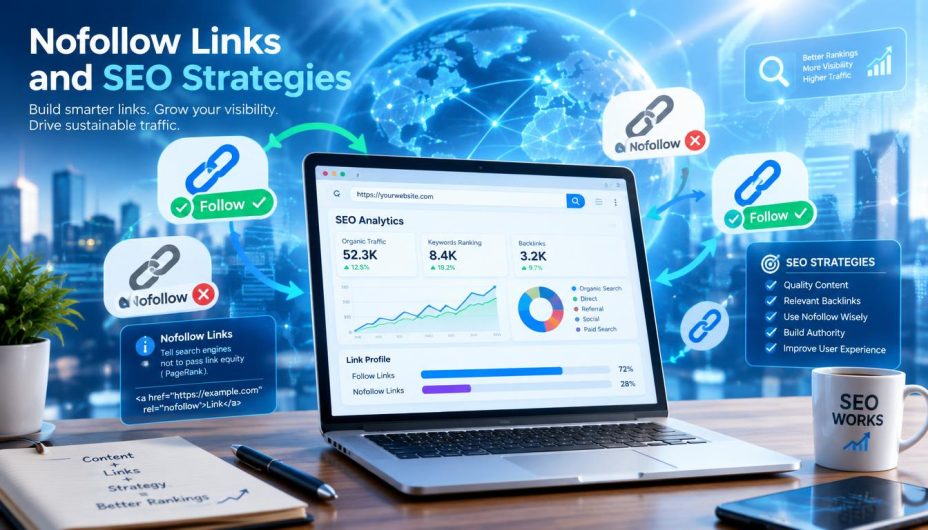
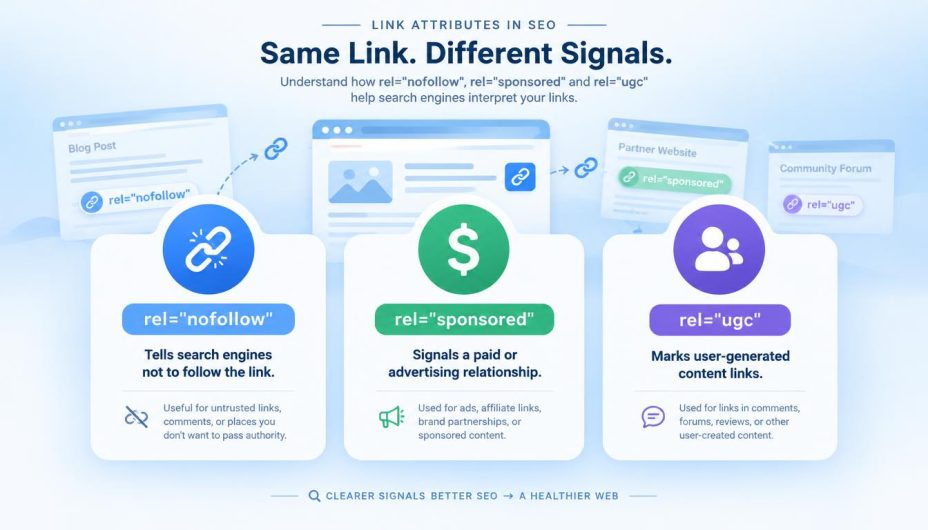
Some publishers qualify links with rel="nofollow", rel="sponsored", or rel="ugc". These values describe link relationships for systems such as Google; they are not published ChatGPT recommendation controls. A nofollow link can still bring a relevant human visitor, but its existence does not prove a brand will be cited by an AI assistant.
For ethical outreach, see our link prospecting guide and enterprise link-building resource. Focus on original research, genuinely useful resources, transparent partnerships, and accurate editorial references.
7. Keep Visible Content and Structured Information Consistent
When reviewing ChatGPT search visibility, use appropriate structured data only when it accurately describes the page’s visible content and fits its actual type. Business details, product facts, availability, and organization descriptions should not contradict what a visitor sees. Schema can help certain systems interpret information, but there is no special markup that guarantees a brand citation in ChatGPT.
As part of a ChatGPT search visibility audit, inspect the rendered page on mobile and desktop. Confirm that important facts do not disappear behind inaccessible tabs, an unsupported interface, or an account requirement. Keep authorship, publication dates, and cited references understandable when they are relevant to evaluating a claim.
For sites that publish several versions of the same information, use consistent preferred URLs and avoid showing conflicting specifications on duplicate pages. Our canonical pagination guide provides an example of managing multiple pages carefully. The objective is to reduce confusing or incorrect information, not to trick a search system.
8. Track Mentions, Recommendations, and Citations Separately
A useful ChatGPT search visibility report begins with a reproducible set of prompts. Record the platform experience, whether web search was used, date, geography where relevant, the exact question, and any important personalization or conversation context. Repeat a subset of tests because answer wording and cited sources can vary.
For ChatGPT search visibility, use distinct labels. A named brand is not necessarily a recommendation; a source link is not necessarily a brand endorsement; and a mentioned product may not be available in the user’s country. Where citations are shown, open the source pages and check whether they genuinely support the answer.
| Measurement | Definition in Your Test | Key Limitation |
|---|---|---|
| Brand mention rate | Eligible responses naming the brand / all eligible responses | Depends on the prompts and test conditions |
| Recommendation rate | Responses actively suggesting the brand / eligible responses | Requires consistent judgment of recommendations |
| Owned-site citation rate | Responses linking to a brand-owned source / citation-eligible responses | Not every answer includes source links |
| Source accuracy | Checked citations that support the associated claim | Requires opening and evaluating each cited page |
| Referral activity | Sessions or visits identifiable as arriving from ChatGPT | Tracking can be incomplete or differently attributed |
For example, if a brand is named in 12 of 40 eligible test responses, the observed mention rate is 30%. This is a hypothetical sample calculation, not a share of all ChatGPT users. Several brands may appear in the same answer, so their mention rates need not add to 100%.
Compare ChatGPT search visibility with competitors using the same prompt panel and scoring rules. Do not generalize results from a handful of cherry-picked questions to the entire market. The LLM competitor audit guide provides a detailed measurement framework, while our LLMO checklist helps turn observations into useful site improvements.

9. Measure Referrals and Improve Based on Evidence
ChatGPT search visibility can matter to a business when people follow a cited link, request a demo, buy a product, or make another meaningful decision. OpenAI’s publisher guidance states that ChatGPT search referral URLs include utm_source=chatgpt.com, which can help publishers identify inbound visits in analytics tools.
Review source and campaign dimensions carefully. Some visits may not be attributable, users may arrive later through another channel, and a branded search increase is not proof that a specific AI answer caused it. Track landing pages, engaged sessions, relevant key events, qualified leads, and revenue where the tracking supports those conclusions.
For ChatGPT search visibility, combine observation and action: if your pricing information is repeatedly misunderstood, make the pricing page clearer; if useful content is blocked, investigate access rules; if a third-party review cites outdated specifications, request a correction where appropriate. Do not promise clients that one technical adjustment will secure a fixed placement.
The official OpenAI publishers and developers FAQ explains crawler access and referral tagging. For broader traffic reporting, use our SEO reporting guide and SEO Tools & Analytics resources.
ChatGPT Search Visibility vs Traditional SEO
Both workflows benefit from useful, accessible, reliable information. However, the measurements and search experiences differ. Traditional SEO often evaluates specific queries, clicks, impressions, and positions on search results pages. ChatGPT search visibility research evaluates answer content, source citations, recommendations, and identifiable referrals under a documented test setup.
| Area | Traditional Search Reporting | ChatGPT Search Assessment |
|---|---|---|
| Primary observation | Page impressions, clicks, and reported positions | Mentions, recommendations, citations, and links |
| Search context | Query, country, device, date, and result appearance | Prompt, product mode, date, sources, and conversation context |
| Common evidence | Search Console and site analytics | Recorded prompt tests, cited sources, and referral analytics |
| Main uncertainty | Competition, demand, result features, and attribution | Variable answers, source selection, and incomplete coverage |
| What is not guaranteed | A particular organic ranking | A brand mention, citation, or recommendation |
A realistic ChatGPT search visibility strategy complements existing SEO work; it does not replace site usability, technical maintenance, helpful content, and measurement of actual customers. Our SEO metrics overview explains those traditional baselines, and our ChatGPT product-page monitoring guide explores product-specific testing.
Common Mistakes That Reduce the Value of AI Visibility Work
- Using one test answer as proof: A single response is not representative of all users or sessions.
- Confusing search and training crawlers: OAI-SearchBot and GPTBot have different purposes and controls.
- Promising a fixed ChatGPT ranking: Answers are contextual; ordinary page positions do not map directly onto every AI response.
- Buying artificial brand mentions: Manipulative posts or fake reviews are not a dependable discoverability strategy.
- Assuming nofollow links control citations: Link attributes are not a published ChatGPT recommendation formula.
- Adding unsupported schema: Structured data must reflect real visible information; it does not guarantee inclusion.
- Publishing vague product claims: Missing limitations, prices, or regional eligibility can confuse customers and reviewers.
- Ignoring referral quality: A mention without relevant clicks or leads may have limited measurable business impact.
- Comparing inconsistent prompts: Changes in the test set can be mistaken for changes in visibility.
ChatGPT Search Visibility Checklist for Brands
- Define relevant audiences, markets, products, and customer questions.
- Prepare a documented mix of branded and non-branded prompts.
- Check OAI-SearchBot robots.txt access, server responses, and firewall behavior.
- Keep search-crawler decisions separate from GPTBot training settings.
- Publish accurate, useful product and service details as accessible text.
- Use descriptive headings, comparisons, FAQs, and original evidence when helpful.
- Link related pages through a sensible website structure.
- Review reputable third-party coverage and correct false information when possible.
- Verify visible content and relevant structured information agree.
- Record mentions, recommendations, and citations as separate results.
- Check cited sources for factual support and record test conditions.
- Review identifiable ChatGPT referrals and meaningful conversion outcomes.
- Repeat the audit consistently and prioritize evidence-based improvements.
Frequently Asked Questions
What is ChatGPT search visibility?
ChatGPT search visibility is the observable presence of a brand, product, or webpage in ChatGPT experiences that use web search. It can include mentions, recommendations, citations, and links, which should be measured separately.
How can I make my website eligible to appear in ChatGPT search?
Make relevant pages publicly accessible and check that OAI-SearchBot is not blocked by robots.txt, the hosting environment, or security services. Eligibility does not guarantee a citation or recommendation.
Are OAI-SearchBot and GPTBot the same?
No. OpenAI documents OAI-SearchBot as the search crawler and GPTBot as a crawler associated with content that may be used for model training. Their robots.txt controls are separate.
Does schema markup guarantee ChatGPT citations?
No. Accurate structured data can clarify information for systems that use it, but OpenAI does not publish a schema property that guarantees inclusion, source citation, or a brand recommendation.
Do nofollow backlinks improve ChatGPT recommendations?
There is no verified rule that a nofollow backlink causes ChatGPT to recommend a brand. Relevant references can generate referral visits or independent editorial attention, but those outcomes should be measured separately.
How can a brand track ChatGPT search referrals?
Review analytics for ChatGPT referral sources and the utm_source=chatgpt.com parameter where present. Track useful visits and conversions, recognizing that attribution may be incomplete.
How do I calculate AI brand mention rate?
Divide the number of eligible test responses naming the brand by all eligible responses in your documented prompt sample. State the prompts and test settings so the percentage is not mistaken for an overall market share.
How often should I test visibility?
A monthly or quarterly repeat is a reasonable operational starting point for many teams, with extra checks after important product or website changes. Keep a stable core prompt set for meaningful comparisons.
Can a small business improve discoverability without paid AI tools?
Yes. It can begin with accurate public pages, a small repeatable prompt sample, basic server-access checks, and standard analytics. Paid monitoring can help scale observations, but no tool guarantees inclusion.
Conclusion
ChatGPT search visibility should be approached as discoverability research, not as a new form of guaranteed ranking. Brands can improve their public information, keep important webpages accessible, publish useful answers, and earn credible editorial attention while carefully measuring where they appear.
The strongest plan combines technical checks, original content, transparent prompt testing, source verification, and actual business outcomes. Continue to review ChatGPT search visibility as products and search experiences evolve, and use our SEO article library for related guidance.