
SEO Topic Clusters: 9 Proven Steps to Build Authority
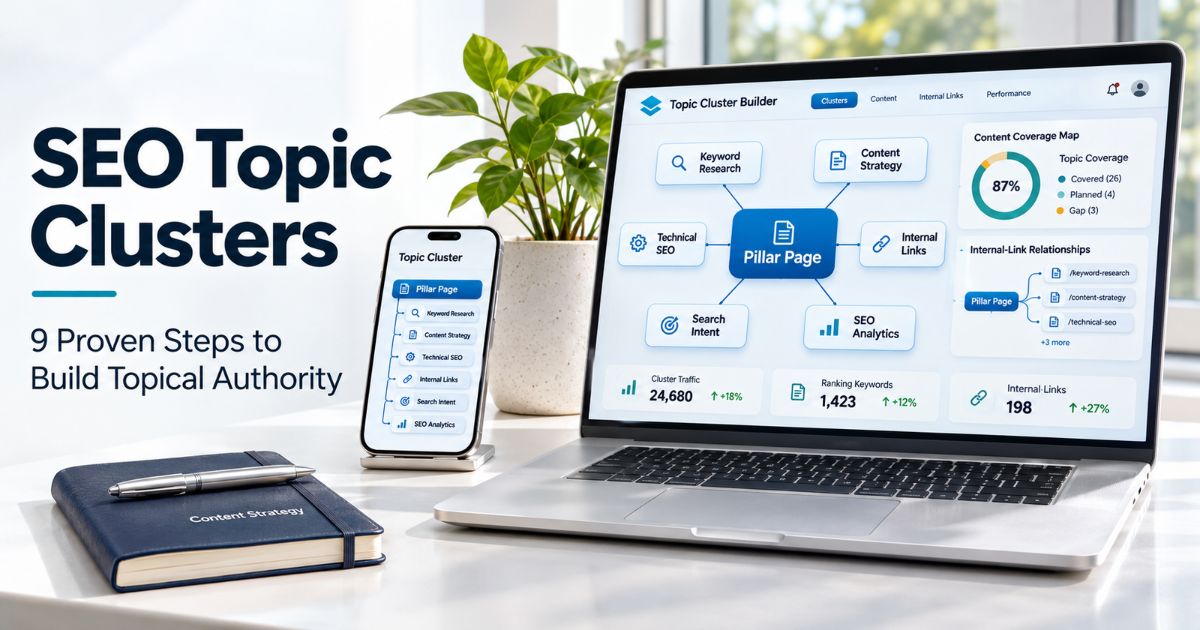
SEO topic clusters organize a website’s related articles and pages around a clear subject, helping visitors move from broad questions to detailed answers. Instead of publishing disconnected posts for every keyword variation, a cluster brings a useful overview page together with focused supporting resources and contextual internal links.
A well-planned structure can make content easier to discover, maintain, and navigate. It does not automatically create a Google ranking factor called “topical authority,” guarantee indexing, or replace original expertise. This guide explains how to choose a subject, plan a pillar page, connect supporting articles, avoid unnecessary overlap, and measure whether the arrangement benefits real visitors.
We’ll build an illustrative technical SEO cluster and walk through nine practical steps you can apply to a WordPress site. For related planning methods, review our content mapping guide and browse the Content SEO & Marketing library.
Key Takeaways
- To plan SEO topic clusters, start with a useful subject and an identifiable audience need, not an arbitrary list of high-volume keywords.
- A pillar page covers the broader subject; supporting pages address narrower questions that deserve a distinct answer.
- Use existing quality articles wherever possible before commissioning new URLs.
- Match page purpose to search intent and distinguish true subtopics from near-duplicate wording.
- Use descriptive HTML links between the overview and relevant supporting resources, including links among sibling pages where useful.
- Keep navigation, canonical URLs, and indexability consistent so important resources can be discovered.
- Google has not published a special “topic-cluster score” or a guaranteed authority threshold.
- Evaluate groups of pages through Search Console, website analytics, and meaningful customer outcomes.
What Are SEO Topic Clusters?
SEO topic clusters are an editorial and site-architecture model. A central pillar page introduces a broad subject and directs readers to detailed supporting pages. Each supporting page answers a specific question, explains a distinct process, or compares options. Internal links make those relationships usable to visitors and discoverable to crawlers.
Imagine a website offering advice on technical SEO. Its central resource could explain crawling, indexing, site structure, and the purpose of technical audits. Separate pages could cover XML sitemaps, canonical tags, crawl errors, and Search Console inspections. A person unfamiliar with the subject can start with the overview; an experienced visitor can land directly on an advanced article.
The model differs from a list of related keywords because it defines a purpose for every URL. Two phrases might share the same search intent and deserve one page. Alternatively, a broad term and a specific troubleshooting question could justify separate pages. Our site architecture SEO guide explores how those relationships fit into site navigation.
| Element | Role | Example | Common Mistake |
|---|---|---|---|
| Pillar page | Broad, useful overview and navigation hub | Technical SEO fundamentals | Trying to answer every detailed question on one huge page |
| Supporting article | Focused explanation of a separate need | How to validate an XML sitemap | Repeating the pillar with slightly changed wording |
| Contextual link | Connects relevant next steps | Audit guide linking to crawl-error troubleshooting | Adding links without explaining their relevance |
| Content inventory | Shows what already exists and what is missing | Published URL, intent, status, owner | Creating new pages before checking for overlap |
Why SEO Topic Clusters Help People and Search Engines
The practical strength of SEO topic clusters is clarity. Visitors can find an introduction, drill into a subtopic, and return to a broader overview without relying on site search. Editors can see missing explanations, redundant posts, and outdated resources more easily. Links also give Googlebot routes to discover pages and context about their subject matter.
Google’s SEO Starter Guide recommends descriptive anchor text, sensible site organization, and useful content. The guidance does not say that installing a cluster plugin, linking a fixed number of articles, or repeating a topic phrase creates an automatic ranking advantage.
For a newer site, SEO topic clusters can also impose valuable editorial discipline. Instead of scattering articles across unrelated trends, a team can develop reliable coverage of a subject it genuinely understands. Even then, search rankings depend on many systems and competitors; a connected set of pages is no promise of better positions.
The structure is especially helpful when different users need different levels of detail. An ecommerce store might connect buying guides to product categories. A publisher might connect introductory explainers to advanced tutorials. A local service website might connect a service overview with genuine branch information, use cases, and FAQs.
How to Build SEO Topic Clusters in 9 Practical Steps
1. Select a Topic That Fits Your Audience and Expertise
Begin SEO topic clusters planning by defining the audience and the problem your website is equipped to solve. Interview customers, examine support requests, review sales questions, and look at Search Console queries. Choose subjects you can explain accurately and maintain rather than topics that merely appear popular in a keyword research tool.
A small SEO consultancy might reasonably develop a comprehensive technical audit resource, because its team can provide useful examples and troubleshooting advice. It may not be credible to publish hundreds of medical or financial advice articles simply because those keywords have volume. Expertise, purpose, and reader value should determine the boundary.
Document the target audience, core problem, related business offering, and main outcome of the planned set. For SEO topic clusters, this keeps the pillar useful even when search terminology changes. The outcome might be better educational engagement, qualified service inquiries, or fewer repetitive support questions; rankings are only part of the picture.
For a broader editorial process, consult our SEO content development workflow. It explains why research, accurate information, and editorial quality come before publication volume.
2. Audit Existing Pages Before Creating More
Before expanding SEO topic clusters, export existing URLs and classify what you already have. Record title, primary purpose, search intent, content quality, canonical URL, organic performance, internal links, and last meaningful update. A spreadsheet is sufficient; the important step is reviewing the existing content instead of assuming every missing keyword deserves a new article.
An audit of SEO topic clusters may show that some pages are good supporting resources already. Others may overlap heavily, target an outdated question, or fail to answer the title. Assign actions such as keep, improve, consolidate, redirect, or create. Avoid deleting useful content merely because a dashboard reports low clicks in one month.
As you map SEO topic clusters, identify any competing articles that answer the same request with minimal differences. One strong page may be better for users than three confusing alternatives. Our content pruning guide outlines how to review and consolidate articles without treating a traffic dip as proof that deletion is necessary.
Preserve published URLs when possible. If consolidation requires a redirect, confirm that the chosen replacement genuinely serves the original audience and update contextual links. Search engines can select a different canonical from the one you declare, so check actual indexing behavior when important changes are made.
3. Group Keywords by Intent and User Questions
For competition context, see our keyword difficulty evaluation guide. Keywords are inputs for SEO topic clusters, not instructions to publish an individual page for every phrase. Group searches by what the person wants to accomplish. Useful categories include definitions, step-by-step methods, comparisons, troubleshooting, and commercial decisions. Then inspect representative search results to check whether the same content format would serve these needs.
A key rule for SEO topic clusters is to make each page serve a distinct intent. For example, “what is crawling in SEO” and “how search engines crawl websites” may belong on one introductory resource. “Why is Googlebot blocked by my firewall?” is a narrower technical problem that could justify a standalone guide. “Best technical audit service” may require a transparent service page rather than another educational article.
To build SEO topic clusters efficiently, assign one primary question and one intended page to each group. Record closely related secondary terms without inserting them repeatedly into titles and paragraphs. Our featured snippets guide demonstrates how direct answers and appropriate formatting can serve informational queries clearly.
International audiences may describe similar problems in different ways. If you target several countries, use regional keyword research rather than translating the same keyword list mechanically. The correct URL structure and content depend on language, market needs, and actual service availability.
4. Design a Pillar Page That Answers the Broad Question
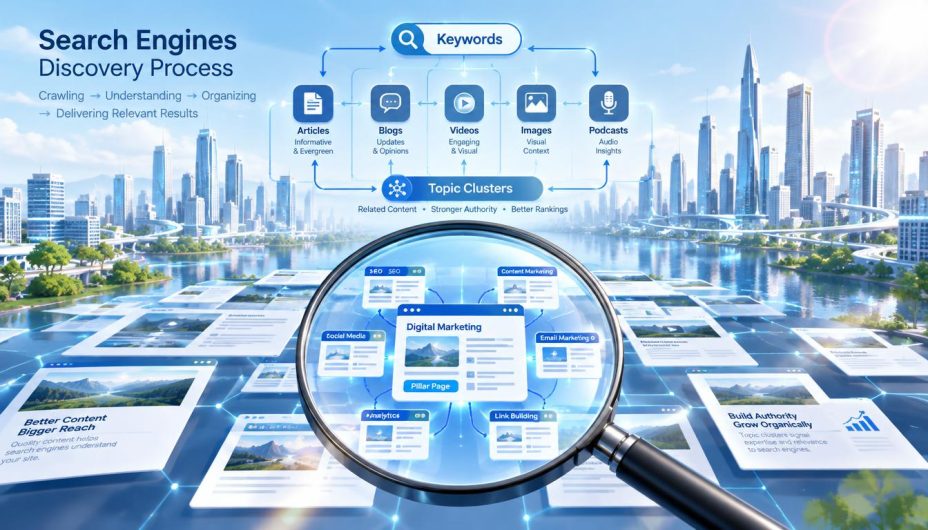
For readers and editors, the pillar is the starting point of many SEO topic clusters, but it does not need to be the website homepage or a fixed word count. It should explain the subject well enough to stand alone, show readers how the main concepts fit together, and point to detailed resources where a narrower question needs more space.
A technical SEO pillar might introduce discovery, crawling, indexing, canonicalization, page experience, and monitoring. It should define those concepts plainly instead of copying the entire content of six supporting articles. Each section can link to the appropriate resource at the moment the reader is likely to need it.
When designing SEO topic clusters, ask whether the overview offers a satisfying answer without forcing a visitor to click through ten additional pages. Helpful navigation should supplement useful content, not compensate for a thin hub. Google’s people-first content guidance emphasizes audience value, original information, and reliable explanation rather than arbitrary length targets.
Use a descriptive title, an opening that states the topic, clear section headings, and a table or diagram when they genuinely improve understanding. A contents list is helpful on a substantial guide, but it is not a ranking shortcut. Keep important links accessible in normal HTML rather than hiding them only in scripts or decorative image maps.
5. Give Every Supporting Page a Distinct Job
Supporting articles expand SEO topic clusters by handling specific tasks in depth. Each page should answer a different question with enough practical detail to justify its own URL. For technical SEO, this might mean one resource for testing crawl accessibility, another for XML sitemap errors, and another for deciding between canonical and noindex.
In well-maintained SEO topic clusters, a useful supporting article identifies the problem, explains the relevant concepts, gives a repeatable method, and describes limitations. It may include screenshots, examples, tables, or code where those elements make an instruction easier to follow. Do not create multiple near-identical posts merely to target variations such as “best tips,” “easy tips,” and “simple tips.”
As you develop SEO topic clusters, consider whether the supporting content requires expertise or access to original examples. A firsthand audit walkthrough may be more useful than a generic list of supposed ranking factors. Our crawl accessibility checklist, XML sitemap guide, and canonical versus noindex comparison illustrate distinct technical subjects within a broader site structure.
For source reliability and review principles, see our editorial policy. Check editorial accuracy before publishing. If a page makes a claim about Google’s rules, prefer the current official source. Clearly label hypothetical examples and avoid inventing case-study performance, expert quotes, or customer outcomes.

6. Connect Related Pages With Useful Internal Links
Internal linking is the navigational foundation of SEO topic clusters. The pillar should link to focused resources, and relevant supporting pages should link back to the overview or to appropriate neighboring articles. These connections help visitors select a path based on their next question and help crawlers discover useful pages.
When building SEO topic clusters, use anchor text that previews the linked resource: “review Search Console indexing issues” is more descriptive than “read more.” Place links within relevant explanations instead of creating a repetitive block of unrelated destinations. A page does not need to link to every other member of the cluster, and Google does not publish an exact ideal number of internal links per article.
Within SEO topic clusters, links should reflect actual relationships. An XML sitemap article might link to crawl-access troubleshooting because both topics affect discovery; a keyword research article may link to content mapping because it is the next editorial step. Keep high-value URLs reachable through menus, categories, or contextual links rather than leaving them orphaned.
Our Search Console audit checklist explains how to inspect important page statuses. If several internal links resolve through redirects, become broken, or point to old versions, repair them to maintain a reliable user journey.
7. Make URLs, Navigation, and Indexability Consistent
Strong SEO topic clusters require a usable site, not only a content spreadsheet. Choose readable URLs, consistent categories, predictable navigation, and canonical versions of important pages. Avoid making crucial resources accessible only through a filtered interface that crawlers cannot follow. A tidy directory structure may be useful, but moving existing URLs solely to fit an imagined perfect silo can introduce unnecessary redirect risk.
For SEO topic clusters, review whether important content can be fetched, rendered, and indexed. Google may discover a linked page without selecting it for indexing. An XML sitemap is another discovery source, not a substitute for links or a guarantee of search visibility. Check robots rules, accidental noindex directives, response codes, and duplicate-canonical choices before attributing poor performance to the cluster model.
When maintaining SEO topic clusters, WordPress categories should describe real editorial themes. A category archive can help visitors browse related posts, while a dedicated pillar article can provide a more substantial explanatory resource. Those are different purposes; neither must replace the other.
For sitewide checks, use the Technical SEO resource section alongside the recurring SEO tasks checklist. These provide a workable routine for crawlability, page maintenance, navigation, and analytics rather than treating every plugin warning as an emergency.
8. Distinguish Editorial Links From Nofollow, Sponsored, and UGC
Some editors ask about link qualifications when planning SEO topic clusters, but they are not the organizing principle. Ordinary editorial links between your own useful pages generally do not need a nofollow attribute. The purpose of a contextual internal link is to help readers and crawlers follow a relevant path.
rel="nofollow" indicates that a publisher does not wish to endorse a link in the normal way; rel="sponsored" identifies compensated placements, and rel="ugc" identifies user-generated links. Google treats these attributes as hints for link treatment. They do not create a topical-authority score, guarantee PageRank transfer, or replace truthful content.
For SEO topic clusters, spend most of your effort on navigation, page quality, and the accuracy of linked resources. Use qualified attributes where the actual relationship warrants them, such as paid placements or community submissions. Do not automatically nofollow useful internal editorial links just because a checker flags a high link count.

9. Measure the Whole Group and Update What Needs Attention
Evaluate SEO topic clusters as connected resources, but retain page-level detail. Build a list of member URLs and monitor their Google Search clicks, impressions, query groups, and indexing status. Combine those observations with website sessions, useful engagement, lead quality, and other meaningful business outcomes where tracking is configured.
Even well-organized SEO topic clusters may gain impressions without gaining qualified visits. A mature supporting article may drive valuable product inquiries despite attracting fewer clicks than the pillar. Group totals can help show overall direction, but they can also conceal a decline in one crucial URL, so review both views together.
For SEO topic clusters, compare equivalent periods and document meaningful edits. Record what changed, the pages affected, why the change was justified, and when it was implemented. Use the organic SEO metrics reference and reporting framework to separate search exposure, website behavior, and business results.
Do not claim that creating a cluster caused a ranking gain simply because the numbers improved after publishing. Competition, site changes, search demand, and Google’s evolving systems can all affect performance. A good report distinguishes observed improvement from unproven causation. Our SEO analytics reporting guide provides a practical framework for comparing member URLs.

Example: SEO Topic Clusters for Technical Websites
Consider an educational publisher planning SEO topic clusters around website crawling and indexing. Its pillar introduces the main concepts, and supporting pages solve more specific problems. The table below illustrates how an editor might assign content, intent, and relevant next steps. It is a planning model, not a claim about live ranking results.
| Proposed Page | Main Reader Question | Page Type | Helpful Next Connection |
|---|---|---|---|
| Technical SEO overview | What should I understand first? | Pillar | Link to specific crawl and indexing guides |
| Crawl accessibility | Why can’t a crawler reach this page? | Supporting guide | Connect to robots, status, and inspection checks |
| XML sitemap errors | Why is a submitted sitemap failing? | Troubleshooting article | Connect to preferred URLs and indexing guidance |
| Canonical versus noindex | Which instruction suits this duplicate page? | Decision guide | Connect to page-indexing audits |
| SEO reporting | How can I assess the result of fixes? | Measurement guide | Connect search metrics to business outcomes |
Within SEO topic clusters, not every supporting resource must mention the pillar in its first paragraph. The relationship should be obvious from the subject, navigation, and meaningful links. Use our SEO marketing funnel guide when a reader’s next question moves from learning a topic to comparing solutions or selecting a service.
How to Measure SEO Topic Clusters
The success of SEO topic clusters should be judged by whether useful pages become easier to discover and help people accomplish relevant tasks. Set a baseline before major changes and review member pages consistently. Do not confuse Search Console clicks with GA4 sessions; they measure different events and may not match.
| Metric | What It Tells You | What It Cannot Prove |
|---|---|---|
| Indexed member URLs | Which intended pages appear eligible in Google’s index | That a page must rank for a target query |
| Search impressions | How often cluster pages appear in relevant search contexts | That users clicked or read the result |
| Organic search clicks | Google Search interactions for member URLs | Completed purchases or qualified leads |
| Engaged visits | How tracked visitors interact on the site | Every person’s real satisfaction |
| Qualified leads or sales | Recorded business outcomes | That one content page alone caused a multi-touch sale |
| Internal link health | Whether intended navigation paths still function | A guaranteed increase in search rankings |
For SEO topic clusters, select metrics that match each page’s purpose. An introductory guide may reasonably be judged by relevant organic discovery and useful engagement, while a service page may be evaluated by qualified inquiries. A single traffic chart should not dictate the value of every resource.
Common Topic Cluster Mistakes to Avoid
- Publishing a page for every keyword: Closely related variations often share one search intent and do not require separate URLs.
- Creating thin pillar pages: A hub should provide a worthwhile overview rather than function only as a list of links.
- Leaving supporting pages orphaned: Important resources should have relevant pathways from the rest of the site.
- Reusing the same anchor everywhere: Describe the linked page naturally rather than mechanically repeating an exact phrase.
- Forcing a fixed internal-link number: A useful relationship matters more than satisfying an arbitrary link quota.
- Ignoring content overlap: Audit and consolidate confusing duplicates when they truly serve the same purpose.
- Treating nofollow as a ranking shortcut: Link attributes describe relationships, not editorial quality or authority.
- Changing existing slugs unnecessarily: Published URLs may already have useful links and indexing history.
- Claiming guaranteed topical authority: Google does not provide a universal official cluster-completeness score.
- Reporting only the pillar: Inspect supporting pages and meaningful outcomes as well as group totals.
SEO Topic Clusters Checklist Before Publishing
- Define a real audience need and the topic your website can cover accurately.
- Inventory existing content and identify pages worth improving or consolidating.
- Group related queries by purpose, not merely shared wording.
- Give the pillar a useful overview, logical headings, and meaningful outbound paths.
- Assign every supporting article a unique, clearly defined question.
- Use descriptive contextual links between relevant resources.
- Check status codes, indexability, canonicals, mobile navigation, and orphan pages.
- Choose helpful visual aids and alt text that actually describe each image.
- Confirm official facts against reliable sources and avoid invented performance claims.
- Record a baseline in Search Console and website analytics.
- Review outdated pages and broken links as your subject coverage grows.
Frequently Asked Questions
What is an SEO topic cluster?
An SEO topic cluster is a group of related pages centered on a broad subject, usually with a pillar resource and focused supporting articles connected through helpful internal links. Its purpose is clearer navigation and organized coverage, not a guaranteed ranking formula.
How many supporting articles should a pillar page have?
There is no official Google requirement. Use as many distinct, useful pages as the audience needs and your editorial team can maintain. Five high-quality resources may serve a narrow subject better than fifty repetitive articles.
Do topic clusters guarantee topical authority?
No. Topical authority is a broad marketing and SEO concept, not a single published Google metric awarded when a site reaches a prescribed number of pages. Reliable expertise, usefulness, relevance, and many other search factors still matter.
Should the pillar link to every cluster article?
A pillar can link to its principal supporting resources, but each link should help the reader. If the collection is very large, topic sections or sub-hubs may work better than an overwhelming list of destinations.
Can an existing article become a pillar page?
Yes. If the existing URL already serves the broader question, improve its explanations and navigation instead of automatically creating a new page. Preserve useful URLs and review overlap before publishing another hub.
What is the difference between a topic cluster and a website category?
A category groups related posts for browsing. A cluster adds an editorial map of an overview, distinct supporting resources, and contextual connections. The same website can use both without treating them as identical features.
Do I need to add nofollow to internal links?
Not as a general cluster strategy. Ordinary internal editorial links usually exist to help navigation and discovery. Use link attributes only where the real relationship justifies them rather than treating nofollow as a topical-authority tool.
How long does it take for topic clusters to improve rankings?
No reliable fixed period exists. Crawling, indexing, competitive changes, and user demand differ across sites. Review comparable periods and meaningful outcomes rather than promising a precise recovery or traffic increase.
How often should I audit a content cluster?
Check after major publishing or website changes and use an ongoing schedule appropriate to the site. Review dead links, stale facts, overlapping pages, indexing issues, and relevant performance changes before deciding which updates are worth doing.
Conclusion
SEO topic clusters offer a practical way to turn disconnected pages into a coherent learning and discovery experience. Start with real audience questions, create an informative overview, publish distinct supporting content, and connect the right resources with descriptive links. Keep the structure usable for visitors rather than building it around a rigid ranking theory.
Maintain technical accessibility, review the quality of each page, and measure organic search performance alongside genuine business outcomes. For more guidance on content planning and sustainable search growth, visit the Online SEO Blogs homepage and use its supporting SEO resources as your site evolves.