Local Landing Pages: 9 Proven SEO Tips & Examples
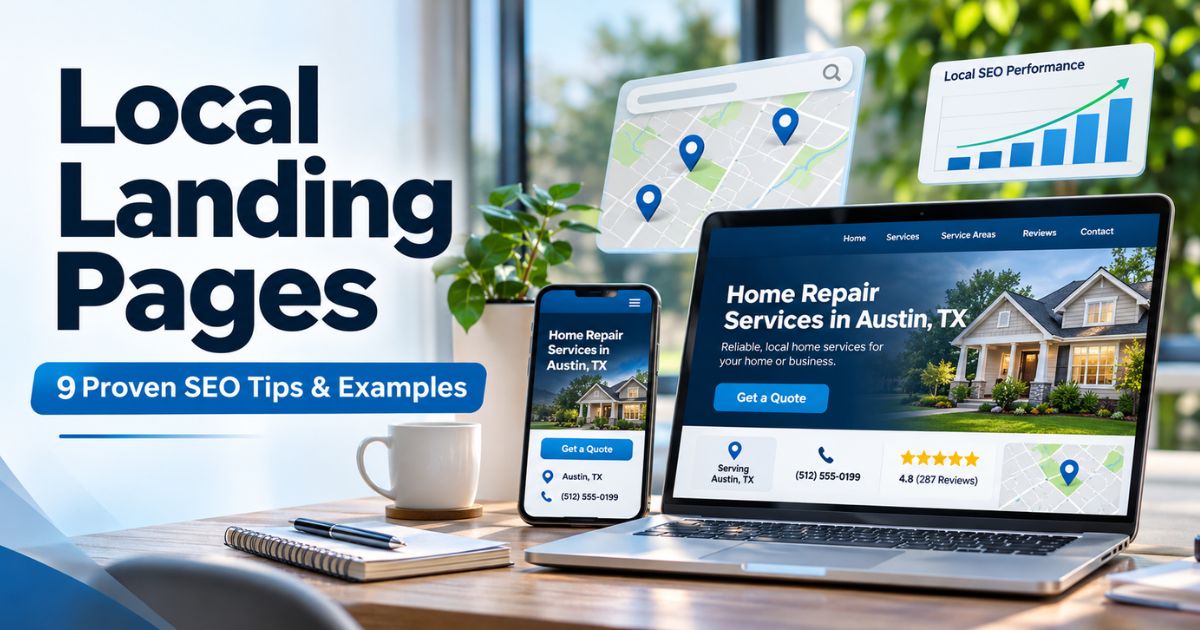
Local landing pages help customers understand where a business operates, which services are available nearby, and how to take the next step. A useful location page answers practical questions about coverage, hours, contact details, and availability rather than simply repeating a city name throughout generic sales copy.
For a business with several genuine branches or distinct service areas, local landing pages can connect geographic search intent to the right customer experience. They do not guarantee map rankings or more calls. Their value comes from accurate information, useful local detail, clear navigation, and an easy way to contact the business.
This guide explains nine actionable SEO practices, examples for storefront and service-area businesses, mistakes to avoid, and a publication checklist. For broader context, see our Local SEO resource hub.
Key Takeaways
- Publish local landing pages for real branches or service areas that your business can genuinely serve.
- Check local search intent before choosing page types, headings, and content.
- Add actual location-specific details instead of copying one template across dozens of cities.
- Keep contact information, availability, real photos, and next steps easy to find.
- Align your pages with accurate Google Business Profile details and applicable structured data.
- Support geographic pages with helpful internal links, accessible mobile layouts, and regular measurement.
- Avoid doorway-style city pages built only to attract similar searches.
What Are Local Landing Pages?
Local landing pages are dedicated website pages that describe a real business location or a genuine geographic service offering. A multi-branch clinic might have a page for each physical clinic. A mobile repair provider might create a regional service page only when it has meaningful coverage details to explain to customers.
Local landing pages differ from a generic homepage. A customer searching for an emergency plumber in a specific city may need immediate confirmation of coverage, service hours, and a contact method. Someone searching for a particular store branch may need its address, parking information, or directions. Understanding the difference improves both content and conversion design.
Search engines can use website content and links to understand relevance, but the customer’s actual need should determine the page. For a deeper treatment of geographic page types, read our location pages for SEO guide and local search intent guide.
9 Proven SEO Tips for Local Landing Pages
1. Choose Markets You Actually Serve
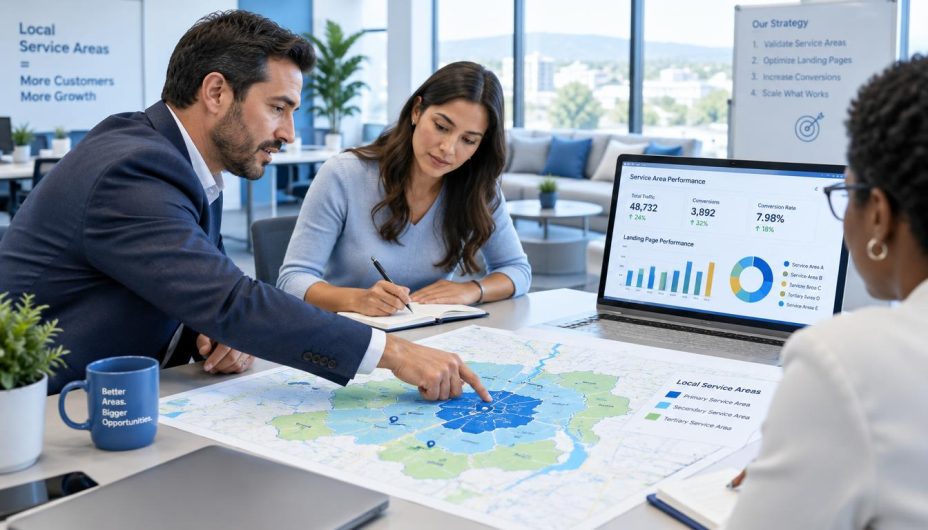
Before drafting local landing pages, list your genuine branches, offices, and service coverage. Ask whether you have staff, delivery capacity, appointments, or another real way to serve customers in each proposed area. A high search-volume estimate alone is not enough reason to publish a city-specific page.
Review aggregate location trends in GA4, relevant Google Search Console queries, customer calls, CRM records, and service inquiries. If people frequently ask whether you cover a suburb, that question may justify clearer information on an existing regional page—or a dedicated page when the need is distinct.
For businesses with multiple locations, our multi-location SEO framework explains how to scale accurate geographic information without turning every neighborhood into an artificial destination. For an industry-specific illustration, see local SEO for real estate agents.
Document the proposed page’s purpose before publishing: who it serves, what information differs from other locations, which customers can act on it, and who will keep the details current. If those answers are unclear, strengthen an existing page instead.
2. Match the Page to the Local Searcher’s Intent
Effective local landing pages start by separating different customer questions. A search such as “dentist in Austin” may involve provider comparison, while “Brand Name downtown hours” asks for a specific branch’s opening times. “Emergency locksmith near me” usually calls for immediate service confirmation, not a long history of the company.
| Search Intent | Illustrative Query | Information to Prioritize |
|---|---|---|
| Service in a city | Roof repair in Denver | Coverage, services, availability, proof of local work |
| Brand and branch | Example Clinic Northside hours | Address, hours, telephone, directions, appointments |
| Urgent nearby need | Emergency electrician near me | Actual emergency coverage, call option, response expectations |
| Planning or comparison | Best family dentist in Austin | Services, staff, credentials, relevant reviews, booking options |
Compare real search results in each area and read the questions your customer service team receives. Use your findings to decide whether a service page, branch page, or regional hub is the best answer. Our content mapping guide shows how to match distinct intent to an appropriate destination.
When planning local landing pages, do not create several near-identical pages for minor keyword variations. One well-designed location page can answer related questions through headings, practical details, and concise FAQs without trying to repeat every query verbatim.
3. Add Real, Distinctive Local Information
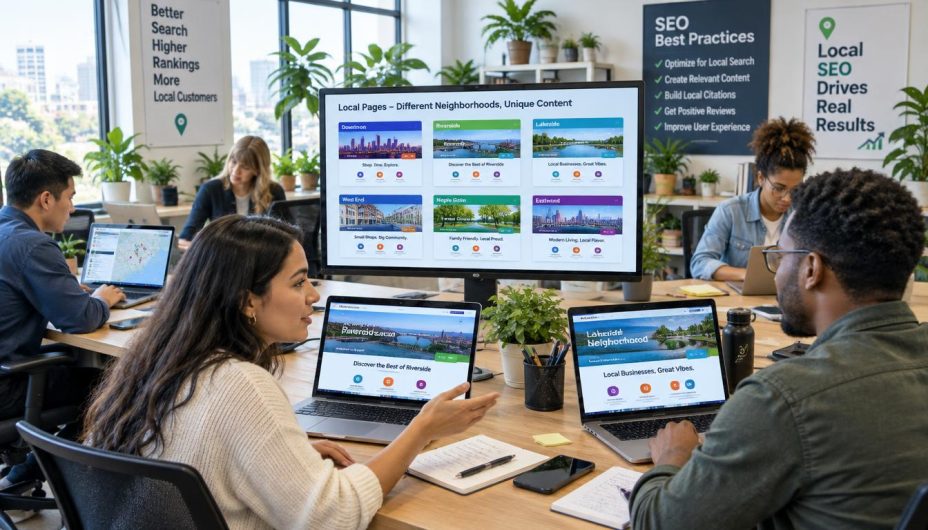
The strongest local landing pages provide information that would be less useful—or inaccurate—if copied to another city. For a physical branch, this could include the actual team’s names, facilities, parking guidance, access arrangements, hours, or location-specific services. For a service-area business, specify genuine coverage boundaries and relevant local operating conditions.
For local landing pages, use original photos of the branch or genuine work, locally relevant customer questions, and examples you can verify. Do not invent reviews, case studies, response times, or storefront addresses. Shared descriptions of standard services are acceptable, but the page should still contain enough distinct value to justify its existence.
Google warns against doorway abuse, including substantially similar pages aimed at closely related geographic queries that funnel people to the same destination. Read the official Google Search spam policies for the current explanation. There is no universal percentage of “unique text” that makes a page safe or helpful.
When reviewing local landing pages, ask a simple question: would a customer intentionally use this page to decide whether the business can help them in that area? If the answer is no, do not rely on a city name in the title to solve the problem.
4. Write Clear URLs, Titles, and On-Page Copy
Readable structure helps visitors find and understand local landing pages. A multi-branch business might use /locations/chicago/ while a service-area business could use /service-areas/phoenix/. Choose a hierarchy that reflects real offerings and can grow without unnecessary duplication.
Write a unique SEO title and main heading that identify the service and location accurately. Our keywords versus SEO explanation also clarifies why intent matters more than mechanical keyword repetition. A genuine branch might use “Dental Care at Our Chicago Clinic”; a service provider could use “Plumbing Services in North Phoenix” if the service is actually available there. Put essential facts near the start of the page rather than burying them below generic promotional text.
For local landing pages, use the location naturally in headings, alt attributes when visually relevant, and descriptions. Avoid stuffing the city name into every sentence or adding a long list of adjacent towns with no supporting detail. Our practical on-page SEO guide covers readable titles and useful page structure.
If your business already has published URLs, do not change them merely to shorten a Rank Math warning. Review existing links and traffic first, and implement suitable redirects for any necessary move. A consistent website architecture should connect the location hub, branch pages, and service pages logically.
5. Show Accurate Business Details and Real Social Proof
Useful local landing pages make trust and logistics easy to verify. A physical location page should include the genuine branch name, address, opening hours, contact number, and directions where applicable. For a service-area operation without a customer-facing storefront, describe the service region honestly rather than inventing a public office.
Genuine customer reviews, team bios, staff credentials, licensing information when relevant, original photos, and clear service limitations can help visitors make a decision. Be precise about what a review covers and do not present a quotation from another branch as if it originated locally.
On local landing pages, use visible, selectable text for essential contact information; do not hide phone numbers or opening hours inside an image. If you list holiday schedules or appointment availability, assign someone to update them. Customers expect those details to remain accurate after publication.
| Trust Element | Why It Helps | Accuracy Check |
|---|---|---|
| Address or coverage area | Confirms where service is available | Matches the real business model |
| Phone and hours | Supports calls and visits | Current and functional |
| Local reviews | Shows relevant customer experience | Authentic and correctly attributed |
| Photos and staff | Helps visitors recognize the location | Represents the actual branch or team |
| Local service details | Clarifies availability and limits | Supported by current operations |
For writing useful service and location details, our content SEO resources provide additional guidance on helpful copy and customer experience.

6. Make Calling, Booking, and Navigation Simple on Mobile
High-quality local landing pages put customer actions near the top. Depending on the business, the next step could be calling, requesting a quote, booking a visit, checking availability, or getting directions. Use clear labels such as “Call the Dallas Branch” or “Request Service in Phoenix” only when those actions reflect the actual offer.
Test the page on real mobile screen sizes. Ensure the phone number is tappable, forms are short and usable, text is readable, and essential service information is accessible without awkward menus. A heavy map embed or large gallery should not block the main contact action or slow down the page unnecessarily.
For local landing pages, review page speed and layout stability as usability issues, especially on templates used by many branches. For example, avoid images that jump around as they load and buttons that are difficult to tap. A technically fast page still needs to answer the customer’s question clearly.
For local landing pages, use analytics to measure useful outcomes instead of assuming every visit becomes a lead. Our SEO metrics guide explains clicks, engagement, conversions, and reporting limitations, while our SEO reporting resource offers a repeatable review process.
7. Connect Locations Through Helpful Internal Links
Local landing pages should be discoverable through ordinary website navigation, not only through an XML sitemap. Build a useful path from your homepage or location finder to the relevant branch or region. From a service page, link to real locations that offer that service; from a branch page, link to the services available there.
Descriptive anchor text helps users anticipate a destination. “Our Chicago clinic” is more helpful than “click here” when the link goes to that branch. You can also link between nearby branches when customers might reasonably want to compare availability or travel distance.
For larger websites with local landing pages, review whether important pages have internal links and whether location URLs are reflected correctly in your XML sitemap. For collections with multiple pages, also check canonical pagination so location hubs remain navigable. See our XML sitemap optimization guide and technical SEO audit template for further checks.
When a business expands across languages or countries, do not assume every region needs the same content. Research the audience’s vocabulary and intent first; our international keyword research guide covers that distinction.
8. Align Google Business Profile and Structured Data
For eligible businesses, local landing pages should agree with the corresponding Google Business Profile on the real-world name, address or service area, contact information, category, and opening hours. A branch-specific profile should direct people to a relevant destination that actually describes that location.
LocalBusiness structured data can help search systems interpret accurate details about a business. Use the most appropriate subtype where relevant, describe a real location, and keep machine-readable facts consistent with visible page content. It is not appropriate to generate fictitious locations in markup.
Google’s official LocalBusiness structured data guide describes supported properties and validation steps. Test your implementation, but remember that correct schema does not guarantee a rich result, placement in the local pack, or improved rankings.
When local landing pages represent several true branches, manage their factual information centrally so updates do not leave stale hours or conflicting addresses. For technical troubleshooting, see our technical SEO guides.
9. Measure Performance and Maintain Accurate Pages
After publishing local landing pages, track whether they serve actual customers. In Search Console, review relevant page and query trends, clicks, impressions, and indexing issues. In GA4, examine landing-page sessions and configured key events. If the business can connect calls, bookings, or qualified inquiries to individual branches, that provides valuable additional context.
Compare similar periods and avoid interpreting every ranking change as a page failure. A drop can reflect search demand, stronger competitors, measurement changes, or technical problems. Segment results by relevant location and page group before making a decision.
Keep local landing pages accurate by reviewing phone numbers, opening hours, reviews, service coverage, photos, and contact forms on a recurring schedule. Remove or consolidate outdated pages when locations close or service areas change; update internal links and redirects carefully. Our SEO tools and analytics resources can help organize the reporting process.
Practical Example: Storefront Versus Service-Area Page
Not all local landing pages need the same sections. A storefront page should help someone visit a real physical location; a service-area page should help them determine whether a provider can reach their address and deliver the promised work.
| Page Element | Physical Storefront | Service-Area Business |
|---|---|---|
| Location information | Genuine street address and directions | Honest coverage area; no invented storefront |
| Main CTA | Visit, call, book, or get directions | Request service, call, or check availability |
| Useful proof | Staff, storefront photos, facilities, reviews | Real work examples, service boundaries, reviews |
| Common FAQs | Parking, accessibility, hours | Travel area, response expectations, service limits |
| Internal links | Branch finder and services at this location | Service hub and relevant regional coverage |
For local landing pages, a real estate firm with three staffed offices might create separate office pages with address, agent, and appointment details. A mobile cleaning service that covers one broader region may be better served by a strong regional page explaining its coverage than dozens of interchangeable neighborhood pages.
Common Local Landing Page SEO Mistakes
- Inventing locations: Never claim an office, branch, or customer-facing address that does not exist.
- Changing only city names: Near-identical pages with no useful local difference can become doorway-style content.
- Hiding the main action: Phone, booking, coverage, and directions should be easy to locate.
- Publishing unsupported statistics: Check the source, date, and method before citing local consumer percentages.
- Keyword stuffing: Write for people and avoid repeating the same location phrase in every sentence.
- Copying reviews inaccurately: Use genuine testimonials and identify the relevant location when appropriate.
- Misusing schema: Structured data must reflect real, visible business facts.
- Ignoring older pages: Closed branches and changed services require content and link updates.
Local Landing Pages Pre-Publish Checklist
- Verify that the business truly serves the location or region described.
- Confirm that the page serves a distinct user need.
- Use a clear, unique title, heading, and readable URL.
- Include accurate contact details, hours, and coverage information.
- Add original, location-relevant information and images.
- Use truthful reviews, staff details, and customer examples.
- Make important actions accessible on mobile.
- Link from relevant location, category, and service pages.
- Keep Google Business Profile and structured data consistent where applicable.
- Test page functionality, indexability, and analytics tracking.
- Assign responsibility for ongoing updates.
Frequently Asked Questions
What are local landing pages?
Local landing pages are dedicated website pages that explain a genuine branch, physical location, or geographic service offering. They should help customers confirm coverage, contact details, and how to take action.
Does every city need a separate landing page?
No. Create a new page only when it serves a meaningful customer need and the business genuinely operates in or serves that area. A stronger regional hub may be more useful than many similar city pages.
What should a local landing page include?
Usually a clear service description, accurate business or coverage details, contact options, genuine supporting information, and relevant FAQs. Storefront and service-area pages need different details.
Can local landing pages improve Google Maps rankings?
Useful pages can support a consistent online presence, but no page or schema implementation guarantees a particular Google Maps position. Local rankings depend on several factors, including relevance, distance, and prominence.
How much unique content should each location page have?
There is no universal required percentage. Focus on whether each page includes genuine local information that helps customers make a different decision from the one another page supports.
Should a service-area business show a street address?
Only if displaying that address accurately represents the business and follows applicable profile guidance. Do not invent a storefront or publicly list a location merely to target a city.
Is LocalBusiness schema mandatory?
No. Relevant, accurate structured data can help describe a business, but adding it does not guarantee a rich result or ranking improvement. Only use facts that apply to the real business.
How do I measure local page success?
Review search visibility, relevant landing-page traffic, inquiries, bookings, and other meaningful outcomes, along with accurate tracking and technical health. Compare similar periods and real service areas.
Conclusion
Effective local landing pages are built around real customers and real operating locations. Start with the geographic needs your business can actually meet, then create clear, locally useful pages with accurate details, helpful internal links, genuine proof, and easy mobile actions.
Review these pages as services, hours, locations, and customer expectations change. A useful page should still make sense even if search rankings did not exist. For more guidance on honest, practical search optimization, explore our SEO resource collection.