Link Building Reports: 9 Best Practices for Clients
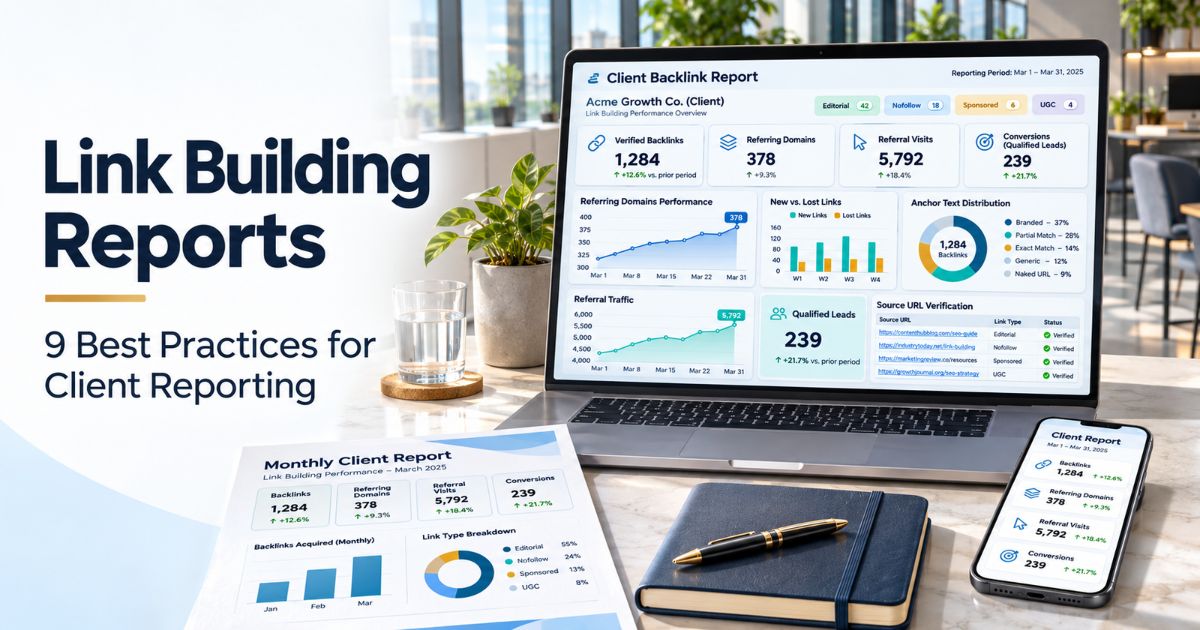
Link building reports show clients what a campaign delivered, whether the published references are still live, and how the work relates to visibility, referral traffic, and business outcomes. A useful report is more than a spreadsheet of domains or a screenshot of rising backlink counts. It allows a client to inspect the evidence, understand limitations, and agree on what the team should do next.
Effective link building reports separate work completed from results observed. A published editorial mention is a verified output; a referral visit is an observed interaction; a change in Google rankings is a separate search outcome. Seeing them together can be useful, but the presence of a new backlink does not prove it caused a change in rankings or sales.
This guide explains nine practical reporting steps, the metrics that matter, a copyable placement log, how to check link attributes, and a client-ready monthly summary template. If you are planning the campaign itself, start with our link prospecting guide and browse the Off-Page SEO & Link Building resources.
Key Takeaways
- Separate link-building activity, verified placements, traffic outcomes, and business results.
- Report the exact linking page, destination URL, anchor text, relevant attributes, publication date, and latest verification date.
- Track relevant unique referring domains, new and lost links, topical fit, and real referral sessions rather than raw totals alone.
- Google Search Console’s Links report provides a sample, not a complete independent verification of every campaign placement.
- Domain Authority and Domain Rating are proprietary third-party scores, not Google ranking factors or guaranteed link-quality measures.
- Mark sponsored and user-generated placements accurately; do not describe a nofollow link as automatically worthless.
- Compare matching dates and landing pages, and label correlation or estimates instead of claiming that an individual backlink caused growth.
- Finish every report with decisions, owners, risks, and the next review date.
What Should Link Building Reports Include?
Link building reports are evidence-based records of external coverage and its observed outcomes. At minimum, they should contain a short executive summary, a verifiable placement table, link-health changes, campaign activity, source and destination context, and an explanation of any relevant search or business metrics.
Clients need different depths of information. An owner may want a one-page explanation of which business objectives the campaign supported. An in-house SEO specialist may need individual referring URLs, HTTP statuses, link attributes, anchors, and dates checked. Both views can come from the same source-of-truth workbook rather than two contradictory sets of figures.
When preparing link building reports, define the scope. Is the document about links acquired by your outreach team this month, links discovered by a third-party crawler, all known historical backlinks, or editorial mentions without links? These are not interchangeable datasets. Label them precisely before presenting numbers.
| Reporting Section | Purpose | Evidence |
|---|---|---|
| Executive summary | Explain important progress and uncertainty | Campaign goals and verified highlights |
| Placement register | Show where each link exists | Live source URL, target URL, anchor, date |
| Link health | Identify removals and changes | Current page and HTML checks |
| Audience outcomes | Review visits and engagement | Analytics referral data where identifiable |
| Search context | Track related visibility | Search Console clicks, impressions, pages |
| Next actions | Turn findings into a plan | Named owner, priority, and review date |

9 Practical Steps to Create Link Building Reports
1. Define Campaign Goals and the Reporting Period
Begin link building reports with the reason the campaign exists. An ecommerce brand may want relevant product-guide coverage and referral purchases; a B2B company may value earned citations for research, brand exposure, and qualified demo requests. A publisher may prioritize references to original investigations. These objectives influence what the report should highlight.
State the exact start and end dates, the target website, relevant markets, the destination pages, and which outreach team or agency owns the placements. If the report covers a calendar month, separate newly published links from older links that were merely rediscovered by a monitoring tool. Record whether a placement is earned editorial coverage, paid promotion, a community contribution, or another relationship.
For consistent link building reports, choose a comparison period before analyzing performance. A current 28-day period compared with the previous 28 complete days is one practical option; a year-over-year period can help when seasonality matters. Our SEO reporting framework explains how to align reporting definitions with business goals. When selecting resources for editorial outreach, a content mapping worksheet can clarify the intended audience and purpose.
2. Build a Placement Log With Verifiable URLs
The most important asset behind link building reports is a structured placement register. Record the actual URL of the page containing the reference, not just the domain homepage. Add the exact destination page, anchor text, surrounding context, publication date if known, first verified date, and most recent verification date.
Before marking a placement as delivered, load the source page and confirm that the link points to the intended destination. Check whether it appears in the rendered content, whether the target redirects, and whether the source page returns an expected response. A screenshot can supplement the evidence, but a screenshot of a promised placement is not proof that the link remains live.
In link building reports, distinguish published, pending editorial review, removed, redirected, and unable to verify. If a link is technically in HTML but hidden in an unrelated footer or buried on a low-quality page, describe that context rather than presenting it as high-value editorial coverage. Our enterprise link building guide covers shared placement ownership and outreach governance. For destination URLs that are hard to reach, review the site architecture SEO guide.
3. Track Unique Referring Domains and New or Lost Links
Among the essential link building reports metrics, unique referring domains deserve a separate line from total backlinks. One publication may contain several links to your site; counting them as multiple domains would inflate the apparent diversity of coverage. State whether your source groups subdomains, redirects, and canonicalized URLs when creating totals.
Track new verified referring pages, new distinct referring domains, lost links, and recovered links. Separate active outreach placements from links discovered organically by a monitoring tool, where that attribution can be established. A third-party index may first detect a backlink weeks after it was published, so a discovery date is not always the actual publication date.
Link building reports should also identify meaningful removals. A prominent editorial citation that disappears may deserve attention; a spammy scraper page no longer linking to the site may not. Avoid describing every lost backlink as a crisis. Our disavow list decision guide explains why unfamiliar links and automated risk scores alone are not reasons for sweeping cleanup actions.
4. Evaluate Relevance, Editorial Context, and Link Quality
High-quality link building reports explain why a placement is relevant. Record the topic of the referring page, the intended audience, the reason the content was cited, the link’s visible context, and whether the publisher appears to apply meaningful editorial standards. A useful mention in an appropriate specialist publication can be more compelling than many irrelevant directory entries.
Third-party indicators such as Moz Domain Authority or Ahrefs Domain Rating can provide background for screening, but they are proprietary models. They are not Google metrics, guaranteed measures of ranking credit, or substitutes for reading the referring article. If included, label the vendor and the measurement date so clients do not assume all tools define the scores identically.
In link building reports, flag obvious quality concerns: unrelated placement topics, mass-produced anchor text, paid placements masquerading as editorial links, missing attribution, and pages containing little unique value. Do not automatically call a site “toxic” based on a single score. Our Google spam updates guide provides context for legitimate link-risk investigation.

5. Review Anchor Text, Target Pages, and Link Attributes
Link building reports should show the exact clickable anchor text and the destination URL for each placement. Readers need to understand whether a citation naturally references a brand, a research resource, a topic, or a product. Do not report a link as pointing at a priority service page when it actually lands on a different article or an outdated redirected URL.
Check each link’s rel values. Google’s guidance recommends rel="sponsored" for paid, advertising, or affiliate placements and rel="ugc" for user-generated links. rel="nofollow" is appropriate where other values do not apply and the publisher does not want to imply the normal endorsement relationship. These are link qualifications, not rankings guarantees.
For link building reports, use simple labels such as unqualified editorial, nofollow, sponsored, or UGC. The industry term “dofollow” usually means a link without the nofollow qualifier; it is not an actual standard rel="dofollow" requirement. See Google’s official link qualification documentation and our nofollow links explainer.
6. Measure Referral Sessions, Engagement, and Qualified Actions
Referral traffic makes link building reports more useful when analytics can identify visits from published coverage. Review GA4 or another configured analytics platform by referral source, landing page, date, and useful events. A link that attracts a small number of highly relevant visitors may support more valuable inquiries than a high-volume placement that reaches the wrong audience.
Google Search Console cannot measure all referral sessions from external websites, nor does its Links report provide onsite conversions. Search Console measures Google Search visibility and clicks; analytics and business systems measure website behavior and outcomes according to their own configurations. Their totals should not be presented as if they counted the same event.
When creating link building reports, separate referral sessions from organic search clicks. If 20 referral sessions arrive from an article and two generate a validated inquiry, the illustrative session-to-inquiry rate is 10%, assuming the defined session denominator and inquiry tracking are correct. Do not present that hypothetical result as a normal industry rate. Our SEO metrics guide clarifies these differences. If clients need a realistic planning range instead of a promise, consult the SEO traffic forecasting guide.
7. Show Search Visibility Without Claiming a Guaranteed Backlink Effect
Link building reports may include search impressions, organic clicks, and ranking trends for pages mentioned in the campaign. This context can show whether the business is becoming easier to find, but a coincidence in timing does not demonstrate that one newly acquired reference caused the movement.
Review search performance at the destination-page level, matching dates and markets where possible. Note concurrent content updates, changes in internal links, technical releases, seasonality, and major search-system changes. A landing page can gain clicks for reasons unrelated to a reported backlink; equally, a legitimate editorial mention might attract valuable visitors without an immediate ranking change.
For honest link building reports, write findings such as “six target pages gained organic clicks during the quarter” rather than “our backlinks increased Google rankings by 25%.” If a broad shift overlaps a confirmed algorithm rollout, use the Google update tracker and the SERP volatility guide as context instead of inventing a causal explanation.
8. Verify Links Again and Explain Reporting Limitations
Before sending link building reports, recheck the main placements. Confirm that the linking page remains accessible, the source actually contains the link, the target is correct, and the recorded anchor and attributes match the current HTML. Link removal, redirects, and editorial revisions can change a placement after its initial publication.
Google’s Search Console Links report is a useful independent discovery source, but Google explicitly says it shows a sample of known internal and external links, not a comprehensive inventory. Links may be consolidated or omitted and the report does not identify whether an individual link is nofollow. Therefore, a legitimate live placement missing from the report should not automatically be marked fake or lost.
In link building reports, distinguish your manual verification register, a vendor’s backlink index, and Google’s sample report. Use each for what it can support. Read the official Search Console Links report documentation for its counting and coverage limitations, and our Search Console audit checklist for broader property checks.

9. Present a Clear Summary, Risks, and Next-Month Actions
A client-ready link building reports workflow ends with a decision rather than another export. Summarize the agreed goals, verified results, useful audience outcomes, and any important gaps. Explain delays and uncertainty in ordinary language. For example, distinguish six published links from four pending editor decisions rather than reporting ten completed placements.
Use one short paragraph to describe the most meaningful result, one to explain what remains uncertain, and one to describe the next action. Where a link was removed, say whether recovery outreach is reasonable; where a page earned qualified visits, consider whether related content could help those visitors further. For reporting presentation tips, review our SEO analytics reporting guide.
Well-prepared link building reports assign owners and dates to outstanding work: verify a removed placement, improve a referenced resource, assess referral quality, or update campaign targeting. The SEO tasks checklist provides a repeatable schedule for follow-up checks. Clients should know what was accomplished, what is pending, and what decision the report supports. Link building reports work best when written for a real decision. A technical SEO audit presentation template can help communicate any related technical blockers separately.
Copyable Link Building Report Template
Use the following structure for monthly link building reports. Replace all illustrative values with verified campaign records. A dashboard should not silently combine a crawler’s discovered backlink total with an agency’s delivered-placement count, because those sources may include different pages and dates.
Executive Summary Template
| Field | What to Enter |
|---|---|
| Client and campaign | Client name, site, campaign scope, market |
| Reporting period | Exact start and end dates |
| Objective | Relevant editorial coverage, referral leads, research citations, etc. |
| Verified outputs | Live editorial placements and unique referring domains |
| Changes | New, lost, recovered, and requalified links |
| Observed outcomes | Identifiable referrals, relevant actions, search context |
| Risks and unknowns | Pending verification, attribution limits, removed placements |
| Next actions | Specific steps, owner, deadline, and follow-up measurement |
Placement Register Template
The table below is a fictional example of how link building reports can present evidence. It does not describe actual links that were placed for any business.
| Referring Page | Target Page | Anchor | Link Relationship | Status | Checked |
|---|---|---|---|---|---|
| Example industry publication /article-a | Original research guide | Research report | Editorial, unqualified | Live | Example date |
| Example partner newsletter /issue-b | Resources page | Company resource | nofollow | Live | Example date |
| Example sponsored article /post-c | Product overview | Product name | sponsored | Pending check | Example date |
Store the full source and destination URLs in your actual sheet, preferably as clickable cells. Add columns for first-seen date, checked date, screenshot or archive evidence, publisher contact, topic relevance, cost disclosure, and any redirect. When using link building reports at scale, a separate evidence tab and a controlled list of statuses reduce confusion between outreach and client-service teams.
Which Link Building Metrics Matter Most?
Not all numbers deserve equal emphasis in link building reports. Activity metrics indicate effort, output metrics confirm published results, and outcome metrics show observed audience or commercial value. The table distinguishes common measures without suggesting that any one number represents Google’s ranking assessment.
| Metric | Definition | Typical Source | Caution |
|---|---|---|---|
| Verified placements | Live linking pages meeting agreed criteria | Manual verification log | Not the same as outreach emails sent |
| Unique referring domains | Distinct sites referencing the target | Placement log / backlink tool | Define domain grouping rules |
| Lost and recovered links | Changes in previously confirmed placements | Rechecks and monitors | Discovery delays can distort dates |
| Anchor text and rel | Published link wording and attributes | Live HTML inspection | May change after publication |
| Editorial relevance | Fit between referring page and target audience | Manual review | Requires transparent qualitative judgment |
| Referral sessions | Identifiable visits from referring websites | GA4 or other analytics | Attribution may be incomplete |
| Qualified actions | Validated inquiries, signups, purchases | Analytics / CRM | Define scope and denominator |
| Organic clicks | Google Search clicks to relevant target pages | Search Console | Does not prove a backlink caused the change |
Nofollow, Sponsored, and UGC in Client Reporting
Link-relationship labels deserve a concise section in link building reports because clients may incorrectly assume every link is either a powerful followed backlink or worthless. In reality, an independently earned editorial citation, a paid placement, and a forum contribution are different relationships with different disclosure requirements and audience implications.
A genuine nofollow mention can still lead interested people to a useful page or increase brand awareness. It should not be sold as guaranteed ranking credit. For compensated links, use the appropriate sponsored qualification and follow applicable advertising disclosure rules. For user-contributed links, recognize the UGC relationship. Our editorial policy explains the distinction between sourced editorial work and sponsored relationships.

Monthly and Quarterly Reporting Cadence
Choose a predictable rhythm for link building reports. Monthly reviews are practical for outreach activity, newly published placements, status changes, referral visits, and urgent issues. Quarterly reviews offer a broader window for interpreting search visibility and business outcomes, although even a quarter cannot prove which backlink caused a particular ranking result.
For a monthly link building reports workflow, verify the current placements, add discoveries and removals, reconcile campaign records with analytics, and communicate any publisher delays. For the quarterly version, compare consistent page groups, note simultaneous website changes, and evaluate whether future outreach should focus on different topics or audiences.
Domain migrations, major website redesigns, search updates, and analytics configuration changes can distort trend comparisons. Record these events clearly. If rankings fluctuate across an industry, use the site’s reporting period and relevant search data, not an unsupported promise of link-driven recovery. The SEO Tools & Analytics library covers complementary measurement methods.
Illustrative Client Reporting Example
Suppose a fictional B2B software company begins a campaign to promote its original research. Its agency sends 35 relevant pitches, receives 11 editorial responses, and verifies six published mentions across five distinct referring domains. Those are activity and output figures. The agency does not count unanswered pitches as placements or the six links as six unique domains.
In the same illustrative reporting period, identifiable referral sessions from the published sources total 90, and three users submit validated demo requests. If the relevant denominator is 90 referral sessions and all three submissions are attributed to them, the simplified session-to-demo rate is 3.33%. This example is arithmetic, not a benchmark or an actual campaign outcome.
The company also sees more organic clicks to its research page, but a content refresh and seasonal demand change occurred during the same period. Responsible link building reports present the trends together and explain that causation has not been established. The next action might be verifying referral lead quality and preparing a more useful data visualization for future editorial coverage.
Common Link Building Reporting Mistakes
- Reporting promised links as delivered: Require a live, checked referring URL before counting a placement.
- Counting links as unique domains: State exactly how multiple references from one site are grouped.
- Using DA or DR as Google scores: Identify vendor-specific models and avoid presenting them as ranking factors.
- Ignoring the rel attribute: Disclose sponsored, UGC, and nofollow relationships accurately.
- Claiming direct ranking causation: A link’s publication date alone cannot establish why a Google position changed.
- Mixing Search Console clicks and GA4 referral sessions: These systems measure different events.
- Relying only on the Search Console Links sample: Verify campaign placements on their actual referring pages.
- Failing to recheck removed or redirected links: Historical screenshots do not prove current placement health.
- Hiding costs and campaign scope: Separate earned editorial placements, paid promotion, and research effort.
- Sending reports without next steps: Every meaningful issue should lead to a decision or an explicit monitoring plan.
Link Building Reports Checklist Before Sending
- Confirm client, target site, business goals, and reporting dates.
- Recheck important referring URLs and destination links.
- Record published anchor text, current rel attributes, and status.
- Separate new domains, new links, recovered links, and lost links.
- Review topical relevance, placement context, and publisher transparency.
- Identify paid or sponsored placements and disclose the relationship properly.
- Compare referral sessions and validated business events where tracked.
- Compare Search Console search data only for appropriate pages and periods.
- Label third-party metrics and data limitations.
- Avoid unsourced statistics, guarantees, and unsupported ranking-cause claims.
- Proofread names, dates, URLs, figures, totals, and chart labels.
- Assign an owner and follow-up date for every major action.
Frequently Asked Questions
What are link building reports?
They are summaries of external link acquisition and monitoring work, showing verified referring pages, link relationships, changes in link health, observed referral activity, and relevant search or business outcomes. A credible report distinguishes evidence from estimates. This distinction is fundamental to link building reports.
How many backlinks should a client expect each month?
No universal number is appropriate. The achievable volume depends on the asset, publisher relevance, audience, outreach resources, editorial independence, and campaign scope. Relevant verified coverage is more meaningful than an arbitrary quota.
Can Google Search Console verify every backlink?
No. Its Links report is a sample of links known to Google, not a complete inventory. It can support broader understanding but should not replace live verification of placements reported as campaign deliverables.
Should I include Domain Authority and Domain Rating?
You may include them as optional vendor-specific context if the source and limitations are disclosed. Neither is a Google ranking factor, and neither can independently prove the quality or ranking impact of a link. For link building reports, identify the vendor and report date.
Are nofollow links worth including?
Yes, when they are legitimate published mentions within the campaign scope. Label them accurately and report useful referral or audience outcomes if observed. Do not imply guaranteed ranking credit.
What is the best way to count unique referring domains?
Use a documented grouping rule and a consistent data source, then deduplicate appropriately. Multiple linking pages from one domain may count as multiple backlinks but not necessarily multiple unique referring domains.
How frequently should clients receive backlink reports?
Monthly reporting works for many campaigns, with additional checks after major removals or site changes. Longer-period reviews can help interpret search and business trends, provided attribution limits are acknowledged.
Can link building reports prove ROI?
They can help describe campaign cost, identifiable referrals, and recorded commercial actions. A precise causal return is often difficult because customers interact with multiple channels and search rankings change for many reasons. State the measurement and attribution assumptions clearly.
What should I do if a reported backlink disappears?
Verify the source and target again, check whether the article moved or was redirected, and record the new status. If recovery is reasonable, contact the publisher professionally. Do not claim the removed link remains live in the next report.
Conclusion
Link building reports should answer three questions: what work was completed, what can be independently verified, and what meaningful results were observed. Use accurate placement registers, sensible link-quality judgments, correctly described attributes, referral analytics, and clearly labeled search context.
Strong reporting does not depend on inflated backlink totals or claims of guaranteed ranking gains. It helps clients make the next informed decision. For broader SEO guidance and client reporting resources, visit the Online SEO Blogs homepage.