Nofollow Links: 9 Proven SEO Facts & Real Benefits
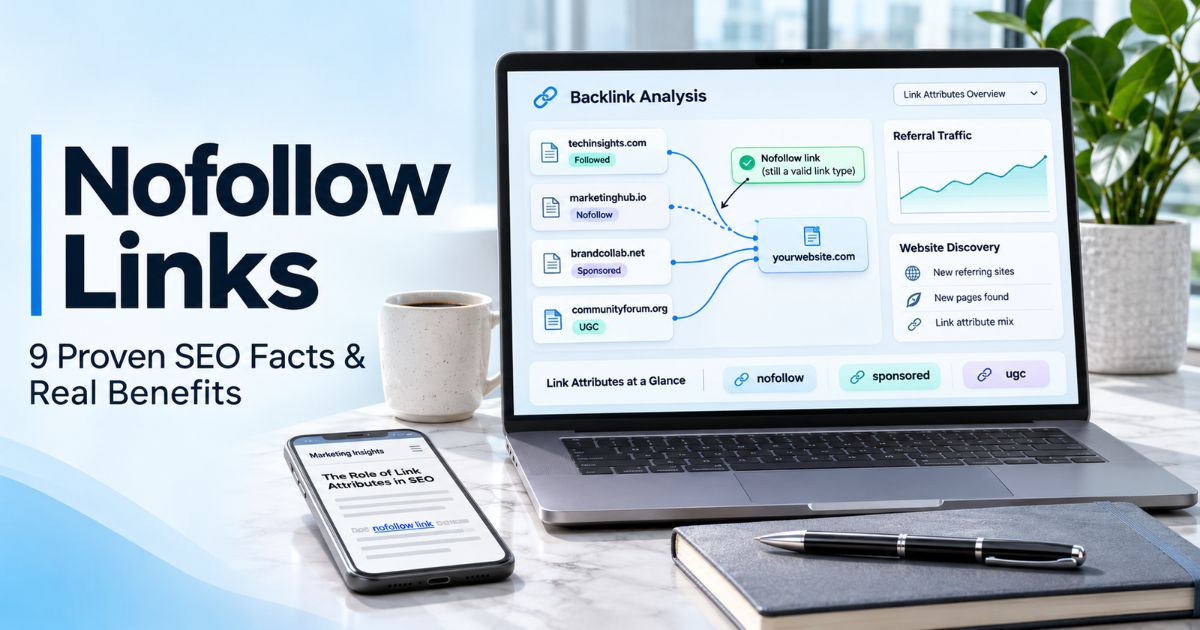
Nofollow links can help a website attract readers, earn brand exposure, and create opportunities for future editorial coverage. However, they should not be treated as guaranteed ranking signals. When people ask, “Do nofollow links help SEO?”, the practical answer depends on whether they mean ranking credit, referrals, discovery, or measurable business results.
Google treats the nofollow, sponsored, and ugc link attributes as hints about link relationships. That does not mean every qualified backlink transfers the same credit as an ordinary editorial citation. This guide explains nine useful facts, shows when each attribute belongs in your HTML, and offers a repeatable checklist for judging link value. For the broader context, explore our off-page SEO and link-building resources.
Key Takeaways
- Nofollow links can send qualified visitors even when their direct ranking contribution cannot be measured.
- Google introduced nofollow in 2005 and announced a hint-based treatment for ranking in 2019 and crawling/indexing in 2020.
- Use
rel="sponsored"for paid or affiliate placements andrel="ugc"for suitable user-generated links. - Normal, independently selected editorial links generally do not need a special
relvalue. - Do not use nofollow as a dependable method for blocking indexing or protecting private content.
- Evaluate publisher relevance, editorial context, referral engagement, and conversions instead of chasing a fixed follow-to-nofollow ratio.
- Inspect live HTML and document your findings before changing a website-wide link policy.
What Are Nofollow Links?
Nofollow links are hyperlinks carrying the rel="nofollow" attribute. A publisher can use this value when linking to another page but does not want to imply the usual endorsement or association. The anchor remains clickable for visitors; the attribute communicates information to search systems rather than disabling the link.
A regular editorial hyperlink might appear as <a href="https://example.com/">Helpful resource</a>. A qualified version looks like <a href="https://example.com/" rel="nofollow">Referenced resource</a>. Both are clickable. Their difference is the relationship the publisher expresses. Nofollow links remain ordinary clickable web links for users.
The phrase “dofollow link” is widely used by marketers, but rel="dofollow" is not required to make a normal link. When you want an ordinary editorial link, you can generally omit the rel attribute. For more detail about earning relevant citations, review our link prospecting guide.
9 Essential Facts About Nofollow Links and Their SEO Value
1. Google Treats Qualified Links as Hints, Not Guaranteed Ranking Credit
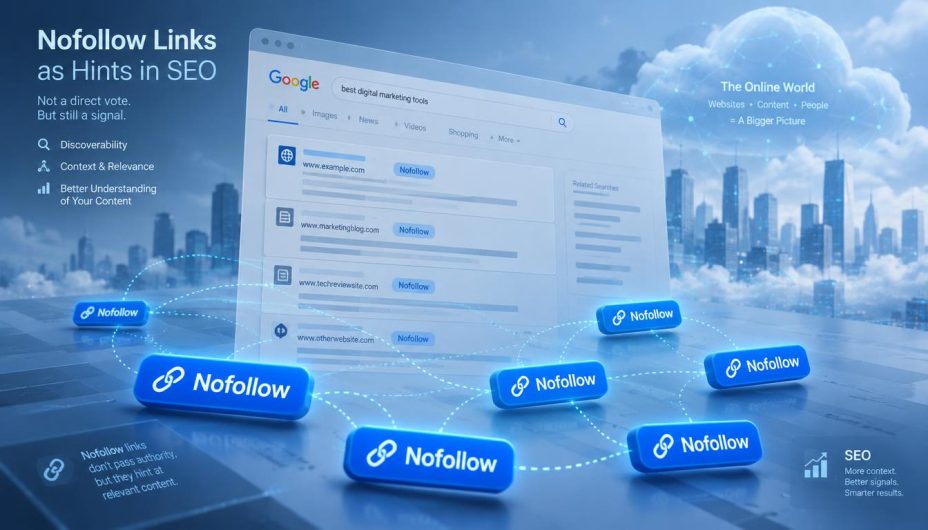
Originally designed to discourage comment spam, nofollow was introduced in 2005. In September 2019, Google announced sponsored and ugc and said those values, together with nofollow, would be treated as hints for ranking analysis. For crawling and indexing, nofollow became a hint from March 1, 2020.
This history explains why absolute claims about nofollow links are misleading. It is incorrect to promise that each one passes a fixed percentage of PageRank. It is also too broad to say Google must ignore every qualified link in every circumstance. Google’s published model leaves decisions to its systems rather than offering a universal transfer formula.
The official Google announcement on nofollow’s evolution explains the timeline and why the new attributes were introduced. For a search strategy that does not depend on one kind of backlink, see our practical SEO improvement guide.

2. Nofollow, Sponsored, and UGC Express Different Relationships
Choose attributes according to why a link exists. Nofollow links are a general option when you do not want to imply endorsement and a more specific value does not apply. Google prefers rel="sponsored" for advertising, paid placements, affiliate relationships, and similar compensation. It recommends rel="ugc" for user-contributed links in comments, forums, or comparable spaces.
| Link Relationship | Suggested Attribute | Illustrative Use |
|---|---|---|
| Independent editorial citation | No special rel needed | A writer links to a resource they independently recommend |
| Non-endorsement or unverified destination | nofollow | Critical reference without publisher endorsement |
| Paid advertisement or affiliate link | sponsored preferred | Compensated review or paid promotional placement |
| User-submitted link | ugc recommended | Comment, forum reply, or community profile |
| Paid user-generated placement | Multiple values when appropriate | ugc sponsored on a paid community contribution |
Google still accepts nofollow for compensated placements, but sponsored more clearly identifies the commercial relationship. For nofollow links and other qualifying attributes, see Google’s official outbound link documentation. You can combine values, for example rel="ugc nofollow", when that accurately describes the link. The attributes are not a trick for forcing a particular search position or passing a predetermined amount of authority.
3. Nofollow Links Can Still Generate Valuable Referral Traffic
The clearest measurable benefit of nofollow links may have nothing to do with rankings. If a relevant industry publication, community discussion, or resource directory links to your article, visitors can click through regardless of the link’s rel value. They may read, register, request a quote, or purchase a product.
Imagine a software guide mentioned in a specialist community. The community qualifies external links automatically, yet a few readers reach the guide, join a demo, and become customers. The link has business value even without evidence that it changed the guide’s organic ranking. Such outcomes are more defensible than claims about invisible PageRank transfers.
To understand whether nofollow links are useful for a campaign, review referral sessions, engagement, relevant landing pages, and completed key events in your analytics. Our SEO metrics guide explains the difference between visits, engagement, and conversions, and our SEO reporting framework helps present those outcomes consistently.
4. Discovery Is Possible, but Indexing Is Never Guaranteed
Another misconception is that a nofollow link makes the destination invisible to search engines. Google may use qualified links as hints in crawling decisions, and a URL can be discovered independently through ordinary internal links, other websites, or XML sitemaps. A nofollow value is not an indexing-control directive for the target page.
Therefore, nofollow links should not be a website’s sole method of helping important pages get discovered. Use sensible navigation, working anchor links, correct response codes, and a sitemap where appropriate. If your actual goal is to prevent a page from appearing in search results, configure a suitable noindex rule on a page Google can crawl. Private material needs real access controls.
For the distinction between canonical preferences and indexing exclusions, read our canonical vs noindex guide. Our XML sitemap guide also explains why listing a URL helps discovery without guaranteeing that it will be indexed.
5. Use Sponsored for Paid Links and Affiliate Relationships
A sponsored post, affiliate product recommendation, or advertising deal should be disclosed according to relevant advertising rules, and its search link relationship must be marked appropriately. Google prefers rel="sponsored" for links connected to payment or other compensation. A nofollow value is still acceptable, but sponsored communicates the specific relationship more clearly.
The HTML syntax for a compensated link could be:
<a href="https://example.com/offer/" rel="sponsored">Partner offer</a>This is an illustrative code example rather than an actual promotion. Do not disguise paid placements as independent editorial votes, promise ranking benefits, or require followed backlinks in exchange for compensation. Google’s link-spam policies address manipulation through purchased links and large-scale arrangements intended to influence rankings.
When evaluating nofollow links offered through outreach vendors, distinguish genuine editorial mentions from paid inventory. Our enterprise link-building guide discusses governance, publisher relationships, and appropriate disclosure, while the off-page SEO resource hub covers sustainable acquisition strategies.
6. Use UGC for Comments and Community Submissions
Comment sections, discussion forums, and public user profiles may contain links that were added without editorial review. For this reason, Google recommends rel="ugc" on user-generated links. Some publishers combine it with nofollow, especially where community systems or moderation processes use both values.
For example:
<a href="https://example.com/community/" rel="ugc">Member resource</a>Link labeling does not replace moderation. A forum still needs spam detection, user permissions, reporting tools, and sensible review of submissions. Trusted contributors can be treated differently when publishers have reason to vouch for their contributions, but ordinary user links should not automatically become editorial endorsements.
Healthy nofollow links often emerge from real discussions. Nofollow links in useful community posts should be judged by relevance rather than automated link counts. It is better to help community members with accurate information than to post repetitive keyword-rich signatures across dozens of forums. If community outreach forms part of your strategy, our prospecting process offers a more selective approach.

7. Do Not Add Nofollow to Every Editorial or Internal Link
Sometimes publishers apply nofollow to every external citation because they worry that linking out automatically harms their own SEO. That blanket approach obscures real differences between paid placements, untrusted destinations, and genuinely useful editorial sources. Google’s guidance says ordinary links do not need special qualification when the publisher independently stands behind the reference.
Internal nofollow links are also a poor substitute for sound site architecture. They are not a recommended technique for sculpting PageRank or deciding which site pages should be indexed. If a destination should remain accessible but outside search results, select the appropriate indexing control for that URL rather than altering unrelated internal links.
The best practice for ordinary navigation is straightforward: help readers reach useful pages through crawlable hyperlinks and descriptive anchor text. Our site architecture guide covers those fundamentals, while our pagination guide explains why distinct page-series URLs require careful treatment.
8. Judge Nofollow Backlinks by Context, Not Ratios
No universal share of followed versus nofollow links proves that a backlink profile is natural. Different industries earn links from different communities, news outlets, directories, partners, and customer conversations. A publisher using nofollow on all outside links can still send relevant readers; a low-quality followed link may provide little value or create risk.
When reviewing nofollow links, ask whether the referring page is relevant, whether the placement is visible, why it exists, whether the source is credible, and what visitors are likely to do after clicking. Domain Rating, backlink counts, and other third-party numbers can support research, but they are not Google-issued approval scores.
| Review Question | Useful Evidence | Warning Sign |
|---|---|---|
| Does the page serve your audience? | Relevant topic and credible editorial context | Unrelated article assembled around paid links |
| Will people notice the link? | Contextual, readable placement | Hidden or repetitive sitewide placement |
| Why was the link added? | Editorial source, community discussion, or disclosed advertising | Followed ranking credit being sold |
| Can outcomes be assessed? | Referral visits and meaningful actions | Promises of guaranteed position gains |
Do not panic over unfamiliar nofollow links appearing in a backlink export. Google’s disavow list guide explains why disavowing every unknown domain is inappropriate. When a broad visibility change occurs, check verified events and site evidence before assigning the cause to links; our Google algorithm update tracker can provide context.
9. Measure Referral Outcomes Without Claiming a Ranking Effect
Nofollow links can create measurable marketing value even when direct algorithmic credit is unknowable. Use analytics reports to compare referral sessions, engaged visitors, form submissions, purchases, and assisted journeys where your data configuration supports them. Keep a record of the referring URL, placement date, relevant landing page, and campaign context.
If a campaign earns a mention, review performance using consistent periods. A spike in branded searches after publicity may be interesting, but it does not prove the original nofollow backlink caused the change. Other campaigns, news coverage, demand shifts, and tracking differences may contribute. Likewise, a ranking increase during the same period is correlation rather than verified causation.
For ongoing nofollow links evaluation, report outcomes in separate groups: editorial or community placements, referral traffic, conversions, brand mentions, and organic search. The SEO tasks checklist can help schedule monthly checks, while our analytics resources explain useful data categories.

Nofollow vs Follow Links: An Illustrative Decision Example
Suppose an independent technology publication offers a relevant editorial mention but qualifies all outbound links. Separately, an unrelated website sells a followed link promising faster rankings. The qualified editorial mention may be better for actual readers, referral traffic, and brand discovery; the paid ranking-credit offer raises clear quality and policy concerns.
The lesson is not that nofollow links are automatically better than followed links. It is that link usefulness depends on the audience and editorial relationship. A genuinely earned followed citation can be excellent, while nofollow can be perfectly appropriate in a compensated or non-endorsed context. The attribute is one part of the decision, not the entire strategy. Nofollow links can be valuable because they connect a real reader to useful information.
How to Inspect Link Attributes in WordPress
To identify nofollow links on a published page, open it in a browser and inspect the relevant anchor element using developer tools. The attribute should appear on the link itself, such as rel="nofollow" or rel="sponsored". An SEO plugin may also provide options for qualifying individual outbound links, but the exact setting depends on the editor and plugin version.
For audits, export a small sample of important links and categorize them as editorial, commercial, user-generated, or intentionally unendorsed. Check the rendered HTML after editing rather than assuming a checkbox applied the correct attribute. Use a crawler for larger sites, but manually review uncertain cases. A site-wide automated rule may incorrectly classify legitimate references. Nofollow links should be added deliberately, not as an indiscriminate default.
Internal linking is a separate maintenance issue: inspect broken destinations, redirects, orphaned pages, and pages excluded from search unintentionally. The technical SEO audit guide provides a structured approach, and our technical SEO library covers crawling and indexability checks.
Common Nofollow Link Mistakes to Avoid
- Assigning a fixed PageRank percentage: Google does not publish such a formula for qualified backlinks.
- Assuming every qualified link is ignored: Google describes the attributes as hints.
- Assuming a nofollow link guarantees rankings: Referral and brand value are separate from search ranking credit.
- Marking every trusted citation nofollow: Standard editorial references generally do not need qualification.
- Failing to qualify paid placement: Sponsored is Google’s preferred value for commercial relationships.
- Using nofollow for indexing control: Use an appropriate noindex rule when search exclusion is the goal.
- Chasing a perfect follow-to-nofollow ratio: There is no universal required proportion.
- Ignoring conversion quality: A smaller relevant audience may outperform high-volume irrelevant referrals.
- Using link attributes instead of moderation: Forums and comments still require spam controls.
Nofollow Links: Pre-Publish and Audit Checklist
- Identify the reason every important outbound link exists.
- Keep normal editorial links standard when no special qualification is necessary.
- Use
rel="sponsored"for paid, affiliate, or otherwise compensated references. - Use
rel="ugc"for appropriate community-contributed links. - Use
rel="nofollow"when other values do not fit and endorsement is not intended. - Check whether multiple attribute values accurately describe a link’s relationship.
- Do not assume nofollow prevents a URL from being crawled or indexed.
- Inspect live page HTML and ensure the intended links are clickable.
- Review risky backlinks with real evidence rather than automated scores alone.
- Measure relevant referral sessions, engagement, leads, and purchases.
- Document changes and review the site periodically.
Frequently Asked Questions
Do nofollow links help SEO?
They can support SEO and wider marketing through referral traffic, brand discovery, qualified visitors, and future editorial mentions. Google does not guarantee that a particular nofollow backlink passes ranking credit or produces higher positions.
Does Google completely ignore nofollow links?
No. Google says nofollow, sponsored, and UGC act as hints in its systems. This does not mean each qualified link is treated like an ordinary editorial endorsement.
What is the difference between nofollow and dofollow?
Nofollow is an explicit rel value. “Dofollow” is an informal term for an ordinary link without a qualifying nofollow-type attribute; a special rel="dofollow" value is not required.
Should an affiliate link use sponsored or nofollow?
Google prefers rel="sponsored" for affiliate and other paid links. Nofollow remains an acceptable alternative for paid placements, but sponsored describes the commercial relationship more precisely.
Can nofollow links help Google discover a page?
They can be treated as hints for crawling, but discovery, crawling, and indexing are separate processes. A URL may also be found through ordinary links and sitemaps. No link attribute guarantees indexing.
Should I nofollow every external link?
No. Independent editorial citations generally do not require a special attribute. Choose one only when the link relationship justifies it.
What percentage of backlinks should be nofollow?
Google provides no universal natural backlink ratio. Link profiles vary by audience, industry, publisher policies, and the ways brands earn coverage. Focus on relevant references instead of fixed percentages.
Can nofollow replace robots.txt or noindex?
No. Nofollow qualifies a link relationship. Robots.txt influences crawler access, while noindex instructs supporting search engines not to include an accessible page in results. They serve different purposes.
How should I measure nofollow backlink value?
Review referral engagement, meaningful events, inquiries, sales, and follow-on editorial mentions. Monitor organic performance separately and avoid attributing a ranking movement to one qualified backlink without supporting evidence.
Conclusion
Nofollow links are neither worthless nor a guaranteed ranking shortcut. They identify a link relationship and can still help people discover useful content, visit a website, and engage with a brand. Sponsored and UGC values make commercial and user-contributed relationships clearer, while ordinary editorial citations can remain standard links.
Use link attributes accurately, prioritize genuine audience relevance, and measure outcomes that matter. If your team is reviewing nofollow links for a new outreach plan, use the Online SEO Blogs article library and the homepage to explore related SEO and link-building guides.