
SEO Traffic Forecasting: 7 Best Steps for Organic Growth
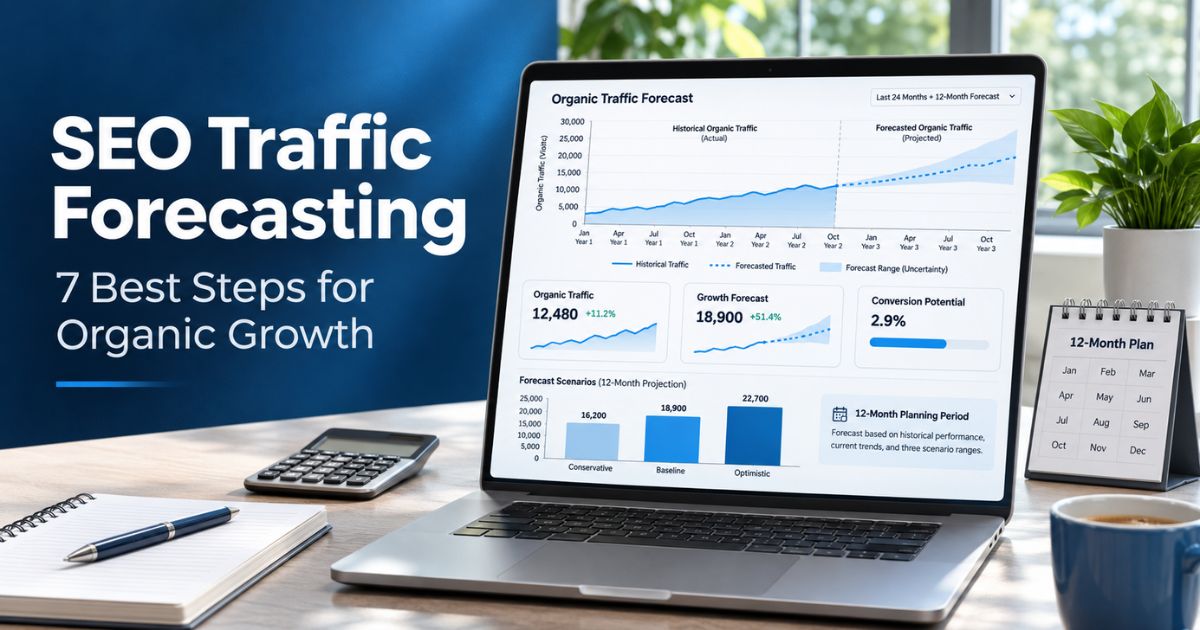
SEO traffic forecasting is the process of estimating future organic search performance using historical results, keyword opportunities, search demand, and explicit assumptions. A forecast can help a business compare investment scenarios, plan content production, and set expectations, but it cannot guarantee a particular ranking, visitor count, or revenue outcome.
A useful SEO traffic forecasting model combines what the website has already achieved with what might change. Rather than projecting a smooth upward line, it considers seasonality, competing pages, changes in search results, implementation delays, and the difference between potential clicks and actual customers.
This guide shows seven practical steps for building a transparent forecast, including example formulas, scenario tables, and ways to validate predictions. For the broader context, explore our practical SEO improvement strategies.
Key Takeaways
- SEO traffic forecasting produces planning estimates, not guarantees of rankings, clicks, leads, or sales.
- Use Google Search Console for Google Search clicks and impressions; use GA4 for onsite sessions and configured business outcomes.
- Separate forecasts for an existing site’s historical performance from estimates for new keyword opportunities.
- Group overlapping keywords by target page and intent to reduce double counting.
- Build conservative, baseline, and optimistic scenarios rather than presenting one precise prediction.
- Adjust for seasonal demand, search result layouts, delivery timelines, and conversion uncertainty.
- Backtest projections against withheld historical data and update assumptions when evidence changes.
What Is SEO Traffic Forecasting?
SEO traffic forecasting estimates how much organic search visibility or traffic a website might earn over a stated period under specified conditions. The result is usually a monthly series of expected clicks or sessions, accompanied by assumptions about growth, seasonality, content improvements, and uncertainty.
A forecast is not the same thing as a goal. A goal may be to grow qualified organic leads by 20%; the forecast asks what is plausible based on observed behavior and proposed work. It is also different from a budget commitment: search engines and users do not follow a marketing team’s spreadsheet.
For SEO traffic forecasting, define the metric before doing any calculations. Google Search Console clicks measure interactions with Google Search results, while GA4 organic sessions measure website sessions attributed to an organic search channel. These numbers are not expected to match exactly. Our SEO metrics guide explains the distinction, and our SEO reporting guide shows how to communicate it clearly.
7 Practical Steps to Forecast Organic Search Growth
1. Define the Forecast Goal, Scope, and Time Horizon
Start SEO traffic forecasting by specifying exactly what the business wants to plan. Is the main concern organic Google clicks, website sessions, marketing-qualified leads, ecommerce sales, or revenue? Choose one primary metric and supporting metrics instead of mixing them into a single number.
Set a time horizon appropriate to your project, commonly six to twelve months for planning. Shorter windows can be valuable for established, stable sites; newer sites and major redesigns require wider uncertainty because the historical pattern may not be predictive. State the market, devices, languages, and page groups included in your scope.
For example, a B2B agency might forecast non-branded organic Google clicks to service pages in the United Kingdom, then separately estimate qualified inquiries from those pages. That is more meaningful than forecasting all traffic worldwide when only one market is commercially important. For longer sales cycles, the B2B SEO guide explains the importance of qualified demand.
A reliable SEO traffic forecasting brief should document the reporting timezone, start and end dates, available resources, planned publishing dates, and assumptions about future website changes. When expanding internationally, compare markets independently; the international keyword research guide explains why local demand can differ.
2. Gather and Clean First-Party Performance Data
The foundation of SEO traffic forecasting is trustworthy baseline data. Export Search Console clicks, impressions, CTR, page URLs, queries, countries, devices, and dates. Review GA4 organic sessions, landing pages, engagement, key events, and relevant revenue where your configuration supports them.
Use a consistent measurement definition. If your forecast concerns Google Search clicks, do not substitute all-channel organic sessions halfway through the model. If you compare Search Console and GA4, align date ranges, page scope, countries, and devices, and note differences in counting and attribution.
Before modeling, flag unusual periods: website outages, analytics tag changes, migrations, accidental noindex directives, major redesigns, and one-off marketing events. Identify whether a sudden spike represents repeatable demand or a single article going viral. The technical SEO audit template can help document site changes that distort a baseline.
For SEO traffic forecasting, aim for at least one full seasonal cycle when available. Twelve to sixteen months of relatively clean history can make year-over-year patterns easier to examine, but shorter histories can still support cautious scenarios. Do not invent missing data to make the model look complete.
Google’s official Search Console and Google Analytics comparison guide explains why clicks and sessions differ and how to compare the data responsibly. The Search Console Performance report guide defines the click, impression, CTR, and position metrics used in many forecasting models.

3. Choose a Historical, Keyword-Based, or Hybrid Model
Different websites need different SEO traffic forecasting methods. Historical models extend observed patterns. Keyword-based models estimate clicks from potential queries and assumed click-through rates. A hybrid model uses a historical baseline while separately estimating the incremental value of planned page improvements or new content.
| Forecast Model | Most Useful When | Primary Limitation |
|---|---|---|
| Historical trend | The site has consistent performance history | Past results may not reflect market or site changes |
| Keyword opportunity | You are researching new pages or markets | Volumes, rankings, and CTR are uncertain |
| Hybrid | You have reliable history and a planned growth program | Incremental estimates can overlap existing baseline demand |
For SEO traffic forecasting on an established blog, start with the baseline and model realistic deviations rather than assuming every new article produces immediate growth. For a brand-new site, use broader opportunity ranges and explicitly acknowledge the lack of first-party evidence.
A transparent historical model might apply a seasonal index to the recent trend, then adjust for planned work. A keyword model might estimate the clicks potentially earned by a specific page, not all monthly searches across a category. Our keyword difficulty guide explains why tool scores cannot predict where a page will rank.
When considering SEO traffic forecasting tools, avoid comparing proprietary traffic forecasts as if they are observed facts. Third-party metrics are directional inputs. Validate them using your own data and a manual review of current search results.
4. Estimate Click Opportunity by Keyword Cluster and Page
For keyword-based SEO traffic forecasting, group queries by search intent and the primary landing page that should answer them. Without grouping, adding every keyword’s estimated search volume can count the same underlying searches and page opportunities more than once.
An illustrative click calculation is Estimated monthly clicks = estimated search demand × assumed organic CTR. For example, 8,000 monthly searches multiplied by an assumed 1% CTR yields 80 projected clicks. The 1% rate is a hypothetical input, not an industry rule for a particular ranking position.
| Illustrative Page Group | Monthly Demand | Assumed CTR | Estimated Clicks |
|---|---|---|---|
| Page A | 8,000 | 1% | 80 |
| Page B | 5,000 | 2% | 100 |
| Page C | 10,000 | 0.5% | 50 |
| Illustrative total | — | — | 230 |
These SEO traffic forecasting examples are not current keyword volumes or promised visits. Actual CTR depends on query intent, brand familiarity, result features, device, location, and the page’s search position. Search volume estimates may describe the entire market rather than clicks available to your domain.
In SEO traffic forecasting, also distinguish total potential clicks from incremental clicks. If Page A already earns 50 clicks monthly, a scenario projecting 80 is an incremental opportunity of roughly 30 clicks, not an extra 80 on top of the existing baseline. Our content mapping guide helps assign related terms to the right pages.
Check the actual results before choosing CTR assumptions. Queries with featured answers, shopping modules, or local results may have a different click pattern from ordinary listings. Our featured snippets guide explains why search appearance matters when evaluating opportunity.

5. Model Seasonality and Create Three Scenarios
Seasonality is an essential part of SEO traffic forecasting. Search interest may rise during holidays, enrollment windows, weather events, or annual business cycles. A model that assumes the same search demand every month can overstate slow periods and understate peaks.
Look for repeating patterns in past Search Console data, customer demand, and other relevant historical evidence. Google Trends can offer directional context, but its normalized index should not be mistaken for absolute search volume. If your history is short, label the seasonal adjustments as assumptions rather than measured site trends.
Use three scenarios for SEO traffic forecasting: a conservative case for slower improvements or weaker demand, a baseline case for expected implementation, and an optimistic case for favorable conditions. Make the reasons for the different outcomes explicit, such as publishing pace, indexing, ranking exposure, and CTR variation.
| Illustrative Scenario | Projected Monthly Organic Clicks | Assumptions |
|---|---|---|
| Conservative | 1,000 | Slower execution and less favorable demand |
| Baseline | 1,500 | Planned work delivered with moderate gains |
| Optimistic | 2,000 | Favorable results, stronger demand, and effective execution |
The figures are hypothetical and should not be interpreted as universal ranges. For SEO traffic forecasting, set your own scenarios using evidence from the actual site and project. It is not responsible to apply an automatic 15% margin to every niche without checking how the model performed historically.
Include a record of relevant search algorithm changes, but do not assume every forecast miss is caused by an update. The Google algorithm update tracker can help distinguish confirmed rollouts from unrelated volatility. Our SEO strategy library offers wider context for demand and competition.
6. Connect Projected Clicks to Leads, Customers, and Revenue
SEO traffic forecasting is most useful when the forecast connects to business decisions. First define the conversion step: a qualified lead, online order, booked appointment, or other meaningful action. Use actual conversion data when available and write down which attribution rule you apply.
For illustration, 80 projected visits at a 5% visit-to-lead conversion rate would produce four estimated leads. If a separate scenario estimates 40 leads with a 5% lead-to-customer rate, it would project two customers. At an illustrative $1,600 in revenue per customer, that would be $3,200 in monthly revenue, or $38,400 annualized if the same monthly result continued for twelve months.
Those calculations are mathematical scenarios, not evidence that future customers will arrive. Do not call projected revenue profit or ROI without accounting for delivery costs, margins, and the chosen attribution model. A small number of high-value sales can also make monthly projections volatile.
| Illustrative Business Metric | Value | Assumption or Formula |
|---|---|---|
| Estimated leads | 40 | From a separately defined traffic and lead-rate scenario |
| Lead-to-customer rate | 5% | Hypothetical closing rate |
| Projected customers | 2 | 40 × 5% |
| Revenue per customer | $1,600 | Hypothetical average |
| Projected monthly revenue | $3,200 | 2 × $1,600 |
| Annualized revenue | $38,400 | $3,200 × 12, if constant |
For SEO traffic forecasting, avoid assuming that one click equals one GA4 session or that all assisted conversions can be assigned to the first organic visit. In SEO traffic forecasting, include qualified leads from your CRM and the lag between inquiry and purchase when possible. Our SEO tools and analytics resources provide reporting ideas for these supporting metrics.

7. Backtest the Model and Revise Assumptions
Before presenting SEO traffic forecasting results as reliable planning inputs, test how the model performs against data it was not trained on. Pick a historical cutoff, fit the model using only earlier information, and predict a later period whose actual results are already known.
Compare the predictions with observed clicks or sessions on the same measurement basis. Mean absolute error (MAE) averages the absolute difference between predicted and actual values; root mean squared error (RMSE) penalizes larger misses more heavily. These metrics help compare models, but neither tells you why a forecast was wrong.
A good SEO traffic forecasting review records whether errors were concentrated during holidays, algorithm rollouts, delayed publications, or tracking changes. For SEO traffic forecasting, keep earlier forecast versions instead of editing the original numbers after seeing actual performance. This preserves a transparent audit trail for clients and decision-makers.
Reforecast on a regular cadence, such as monthly or quarterly, and separate changes in assumptions from changes in actual performance. The SEO tasks checklist can help schedule reviews. For technical problems affecting forecast pages, see the Technical SEO hub.
How to Build a Simple SEO Forecast Spreadsheet
A practical SEO traffic forecasting workbook can use four tabs: Inputs, Forecast, Scenarios, and Actuals. Separate editable assumptions from formulas so another reviewer can reproduce the calculations without guessing which cells are hardcoded.
| Tab | Recommended Fields | Main Purpose |
|---|---|---|
| Inputs | Date, page, query cluster, market, baseline clicks, demand, CTR, conversion rate | Store evidence and assumptions |
| Forecast | Month, seasonal factor, baseline projection, incremental clicks, total scenario | Calculate monthly expected outcomes |
| Scenarios | Conservative, baseline, optimistic assumptions | Show uncertainty and sensitivity |
| Actuals | Observed clicks, sessions, leads, variance, notes | Backtest and diagnose forecast errors |
For SEO traffic forecasting, label every number as observed, estimated, or assumed. Keep source dates and the relevant property or market next to imported data. If you have separate forecasts for branded and non-branded traffic, calculate and report them independently before combining them.
Plan new-content assumptions carefully. A page needs to be published, accessible, and discovered before it can attract organic clicks; its early traffic may not follow a predictable straight line. The site architecture guide and XML sitemap guide explain relevant discovery fundamentals.
Keep Organic Search and Referral Traffic Separate
SEO traffic forecasting should not add referral visits from newsletters, social links, partners, or editorial articles to Google organic clicks. These channels can support the business, but they are distinct acquisition sources and should be modeled or reported separately.
For example, a nofollow link on an industry website may bring genuine referral visits without establishing that Google’s organic rankings improved. If that campaign also creates future brand searches, the relationship is worth studying, but it is not a guaranteed causal uplift. For consistent channel reporting, use the same GA4 acquisition definitions across your baseline and actuals.
Our keywords and SEO overview explains why search performance involves more than one number. This channel distinction is useful when reconciling marketing forecasts with total website traffic.

Common SEO Traffic Forecasting Mistakes
- Treating estimates as promises: Rankings, click-through rates, and conversions are uncertain.
- Mixing measurement systems: Search Console clicks and GA4 sessions do not have identical definitions.
- Double counting overlapping keywords: Related terms can represent the same page opportunity.
- Applying one CTR to every ranking: Actual clicks vary across query intent, devices, brands, and SERP formats.
- Ignoring seasonality: Demand can rise and fall even when a website makes no changes.
- Adding total opportunity to existing traffic: Incremental clicks must account for what the page already receives.
- Calling revenue profit: Projected sales value does not include operating costs or margins.
- Overfitting a short history: A smooth trend may not repeat after a site redesign or market change.
- Hiding assumptions: Stakeholders should know which numbers are observed and which are hypothetical.
SEO Traffic Forecasting Checklist Before Sharing a Report
- Define the target metric, period, geography, and relevant page groups.
- Export comparable Search Console or GA4 data with documented definitions.
- Flag tracking outages, migrations, seasonality, and unusual past events.
- Choose a historical, keyword-based, or hybrid forecasting method.
- Group related keywords by search intent and page to reduce double counting.
- Use defensible CTR and conversion assumptions, not universal promises.
- Model conservative, baseline, and optimistic scenarios.
- Separate existing baseline traffic from potential incremental clicks.
- Connect business projections to realistic lead quality, close rates, and cost assumptions.
- Backtest using withheld historical observations and retain prior forecast versions.
Frequently Asked Questions
What is SEO traffic forecasting?
SEO traffic forecasting estimates possible future organic search performance from past data, market demand, content plans, and explicit assumptions. It supports planning rather than guaranteeing a visitor or revenue result.
How much history is needed for a useful forecast?
One full seasonal cycle is helpful when available, but shorter records can support cautious scenarios. New sites need broader ranges because they lack reliable first-party performance patterns.
How do I estimate organic clicks from keywords?
Group related queries by page, estimate the search demand that is relevant to that page, and apply an evidence-based CTR assumption. Subtract current clicks when calculating incremental rather than total opportunity.
Can an SEO forecast guarantee traffic growth?
No. Rankings, SERP features, competitive activity, content quality, demand, and tracking can change. Responsible forecasts communicate uncertainty and should be updated with observed results.
Should I use Search Console clicks or GA4 sessions?
Use the measure that matches your planning goal and keep it consistent. Search Console describes Google Search activity; GA4 reports onsite sessions and behavior according to its tracking and attribution configuration.
What is the difference between historical and keyword-based forecasting?
Historical models extend prior performance trends, while keyword-based models estimate potential clicks from specific queries and pages. Hybrid models combine a baseline with carefully separated incremental opportunities.
How do I account for algorithm updates?
Track confirmed rollout dates, evaluate affected pages and queries, and include reasonable uncertainty in scenarios. Do not automatically assign every traffic change to an update without supporting evidence.
How can I measure whether a forecast was accurate?
Backtest the model against data withheld from training, compare predicted and actual values, calculate useful error measures such as MAE, and investigate repeated patterns in the misses.
How often should forecasts be revised?
Monthly or quarterly revisions are often practical. Revisit assumptions sooner when the business changes its investment, the website is migrated, tracking breaks, or demand shifts significantly.
Conclusion
SEO traffic forecasting works best as a transparent, evidence-led planning process. Start with reliable first-party data, choose a model suited to your site, estimate incremental opportunities without double counting, and express the result as a range rather than a promise.
Connect projected clicks with meaningful business outcomes, explain uncertainty, and compare each forecast with real results. Consistent SEO traffic forecasting can improve planning discussions even when the final numbers differ from the original estimate. Explore the Online SEO Blogs homepage for additional SEO research and measurement resources.