
Enterprise Link Building: 10 Proven Strategies for Sustainable Growth

Enterprise link building is the process of earning and managing relevant external links for large websites through scalable systems, editorial relationships, digital PR, original resources, clear governance, and consistent risk controls. The enterprise challenge is not simply acquiring more backlinks; it is coordinating multiple teams, agencies, markets, brands, and target pages without creating spammy or conflicting campaigns.
A sustainable enterprise link building program prioritizes business-important pages, earns coverage because the brand has something useful to contribute, qualifies paid relationships correctly, prevents duplicate outreach, and measures referral traffic and business outcomes alongside search visibility.
Key Takeaways
What Is Enterprise Link Building?
Enterprise link building applies off-page SEO and digital PR principles to organizations operating at a scale where several brands, domains, countries, agencies, product teams, and stakeholders may be involved at the same time.
A small site may have one person deciding which page needs promotion and which publishers to contact. A large organization may have:
- Several websites or subdomains
- International country sites
- Multiple product lines
- Acquired brands
- Regional marketing teams
- PR and communications departments
- External SEO agencies
- Affiliate or partnership teams
- Legal and compliance reviewers
- Hundreds or thousands of priority URLs
That complexity makes enterprise link building an operational system as much as an outreach tactic.
The goal should not be to create the largest possible backlink count. Google explicitly identifies links created primarily to manipulate search rankings as link spam. Its current spam policies cover paid ranking links, excessive link exchanges, automated links, manipulative guest posts, low-quality directory links, distributed widget links, and similar practices.
For broader off-page strategy, start with our Off-Page SEO & Link Building hub and the main SEO resource library.
How Enterprise Link Building Differs From Small-Site Outreach
The fundamental idea behind enterprise link building remains simple: create legitimate reasons for relevant websites to mention and link to useful resources.
The difference is operational scale.
| Area | Smaller Website | Enterprise Website |
|---|---|---|
| Target URLs | Small number of pages | Hundreds or thousands of commercial and informational pages |
| Teams | One SEO or marketing team | SEO, PR, content, legal, product, regional and agency teams |
| Markets | Often one market | Multiple countries, languages and audiences |
| Outreach | Centralized | Potentially distributed across teams and vendors |
| Risk control | Relatively simple | Needs policies, permissions, audit trails and vendor standards |
| Reporting | Links and traffic | Placements, markets, target pages, referrals, pipeline and business outcomes |
This is why successful enterprise link building should be designed as a repeatable operating model rather than a collection of disconnected campaigns.
10 Proven Enterprise Link Building Strategies
1. Build Governance Before Launching Outreach at Scale
The first step in enterprise link building is creating one operating standard for everyone involved.
Define:
- Who owns the overall program
- Who can contact publishers
- Who can approve partnerships
- Which agencies can represent the company
- Which target pages are priority
- Which outreach claims are approved
- How sponsored relationships are disclosed
- Which anchor-text practices are prohibited
- How publisher contacts are shared
- How campaigns are reported
A centralized outreach database prevents three departments from contacting the same journalist with three different pitches.
Governance also helps protect the organization from agencies that promise fixed numbers of “high-DA backlinks” without explaining how those links are actually earned.
For broader evidence and publishing standards, use our Editorial Policy. Enterprise teams should apply the same principle to link acquisition: distinguish legitimate editorial opportunities from claims that cannot be verified.
2. Prioritize Pages by Business and Search Value
A large site cannot promote every URL equally. A scalable enterprise link building program needs a target-page framework.
Group potential targets into categories such as:
- High-value product categories
- Strategic service pages
- Evergreen pillar resources
- Original research
- Tools and calculators
- Industry data pages
- Comparison resources
- Major campaign landing pages
Evaluate each target based on:
- Business importance
- Organic opportunity
- Search intent
- Current visibility
- Competitive gap
- Audience usefulness
- Likelihood that publishers would genuinely reference it
Do not force editorial links directly to revenue pages when there is no natural reason for publishers to cite them.
Often, the better enterprise link building strategy is to create a valuable research or educational asset and use strong internal links to connect that resource with relevant commercial pages.
Our content mapping guide explains how to align individual assets with search intent and business objectives, while our practical SEO strategies provide the broader optimization framework.
3. Create Original Research and Link-Worthy Assets
One of the most scalable enterprise link building advantages is access to information that smaller publishers may not have.
Enterprise organizations can potentially create useful assets from:
- Aggregated first-party data
- Industry surveys
- Original research
- Trend reports
- Public datasets
- Expert analysis
- Interactive tools
- Calculators
- Templates
- Benchmark resources
The information must be publishable, privacy-safe, accurate, and genuinely useful.
Do not manufacture statistics merely because numbers tend to attract citations. A dataset that cannot be explained, reproduced, or responsibly sourced can damage trust rather than build authority.
Original resources also support broader content strategy. Use our Content SEO & Marketing hub when planning link-worthy assets and the content mapping framework to connect them to supporting pages.

4. Use Digital PR to Earn Editorial Coverage
Digital PR can be an important enterprise link building channel when the company has genuine news, research, expertise, or insight that matters to a publisher’s audience.
Strong pitches can be built around:
- Original datasets
- New research
- Expert reaction to industry developments
- New product or market information
- Useful trend analysis
- Local or regional insights
- Timely commentary
The objective should be useful editorial coverage, not a contractually guaranteed ranking link.
Google’s Search policies specifically warn against requiring followed links as part of a contract or commercial arrangement when the third-party publisher is not allowed to qualify the link.
A healthy enterprise link building program therefore separates editorial outreach from paid advertising.
If broader B2B visibility is part of the objective, review our B2B SEO guide for additional enterprise-search context.
5. Reclaim Genuine Unlinked Brand Mentions
Large brands are often discussed without receiving a clickable link. Mention reclamation can be one of the lower-friction enterprise link building opportunities because the publisher already knows the brand.
Look for mentions involving:
- Company name
- Product names
- Executives
- Original research
- Campaign names
- Tools
- Reports
Before requesting a link, ask whether a link would actually improve the article for readers.
If the article quotes your research, linking to the original report may provide useful attribution. If it merely mentions the brand in passing, demanding a backlink may add little value.
Do not automate aggressive outreach to every mention. Prioritize relevant, legitimate publishers and communicate like a real editorial partner.
6. Reclaim Broken and Outdated Editorial Links Carefully
Broken-link reclamation can support enterprise link building when a legitimate editorial resource has moved, been consolidated, or changed URL.
Useful opportunities include:
- Old reports moved to new URLs
- Pages lost during migrations
- Acquired-brand resources consolidated onto a main domain
- Useful assets replaced with updated editions
- Publisher links pointing to avoidable 404 pages
Where possible, fix the problem with an appropriate redirect first.
Do not redirect an old linked URL to an irrelevant page simply to preserve backlink signals. The replacement destination should satisfy the intent of the original link.
Large sites should include broken-link and redirect review in their technical SEO audit and ongoing Technical SEO process.
7. Coordinate International and Regional Link Building
Global enterprise link building should account for local languages, audiences, publishers, regulations, and market context.
A publisher that is highly relevant in one country may have little relevance in another.
Regional teams can contribute:
- Language knowledge
- Local journalist relationships
- Market-specific data
- Local trends
- Cultural context
- Regional industry expertise
The central SEO or digital PR team can provide:
- Policies
- Shared databases
- Brand standards
- Link qualification rules
- Reporting frameworks
- Vendor requirements
This hybrid model lets enterprise link building remain consistent without forcing every country to use the same publisher list or campaign.
For businesses operating across many physical markets, our multi-location local SEO guide and location page SEO guide provide additional geographic-search context.

8. Create Clear Policies for Paid, Sponsored, UGC, and Editorial Links
Link qualification is a small but important part of enterprise link building governance.
Google’s outbound link guidance distinguishes several relationships:
| Link Type | Recommended Treatment |
|---|---|
| Normal editorial citation | No special rel attribute is normally required |
| Paid or sponsored placement | rel="sponsored" is preferred; nofollow is also accepted |
| User-generated link | rel="ugc" is recommended |
| Untrusted or non-endorsed destination | rel="nofollow" may be appropriate |
Google treats these attributes as signals about the relationship between pages. They should describe why the link exists rather than be used as a hidden ranking tactic.
For a more detailed explanation, see our guide answering whether nofollow links help SEO.
A sophisticated enterprise link building program can still value a relevant nofollow mention for referral traffic, brand exposure, audience reach, or future editorial relationships without claiming guaranteed ranking credit.
9. Control Agencies, Vendors, and Outreach Duplication
Agency governance is one of the biggest differences between ordinary outreach and enterprise link building.
Require vendors to document:
- Publisher contacted
- Contact date
- Campaign
- Pitch angle
- Target page
- Expected relationship
- Whether compensation is involved
- Final placement
- Link attribute
- Referral performance
Do not accept vague reporting such as:
- “50 DA 70+ links delivered”
- “100% safe links”
- “Guaranteed ranking backlinks”
- “Permanent dofollow placements”
Third-party authority scores can be useful research inputs, but they are not Google ranking metrics and should not become the primary success criterion.
If an agency has previously created manipulative links, review our Google disavow list guide. Google itself says most websites do not need the Disavow Tool and warns that incorrect use can harm Search performance.
10. Measure Placements, Traffic, Visibility, and Business Outcomes
Measurement is where mature enterprise link building differs from link-count reporting.
Record placement-level data such as:
| Metric | Purpose |
|---|---|
| Publisher | Understand source and audience |
| Target URL | Know which business or content asset was referenced |
| Anchor text | Document how the brand or resource was described |
| Link attribute | Record editorial, sponsored, nofollow, or UGC treatment |
| Placement date | Build a campaign timeline |
| Referral traffic | Measure actual visits |
| Qualified actions | Track leads, signups, purchases or other business outcomes |
| Target-page visibility | Monitor organic trends without claiming direct causation |
| Campaign cost | Understand program efficiency |
A backlink can coincide with ranking movement, but many variables affect search visibility. Avoid claiming that a specific placement caused an exact ranking gain unless the evidence genuinely supports that conclusion.
Use our SEO Tools & Analytics hub for broader measurement strategy.
If rankings change suddenly, compare link activity with the SERP volatility framework and our Google Algorithm Update Tracker before attributing the change to your enterprise link building campaign.
How Google Treats Enterprise Link Building
Google does not publish a special set of rules called “enterprise link building.” Large brands are expected to follow the same Search spam policies as other websites.
That means enterprise link building should avoid tactics Google identifies as link spam, including:
- Buying or selling links for ranking purposes
- Exchanging goods or services for ranking-credit links
- Excessive reciprocal-link schemes
- Automated link creation
- Paid advertorials that pass ranking credit
- Keyword-rich manipulative guest-post links
- Low-quality directory links
- Distributed widget or template links created for ranking purposes
- Optimized forum-comment links
Google’s current spam policies explain these practices in detail.
Google also says advertising and sponsorships are normal parts of the web and are not policy violations when links are appropriately qualified.
Should Enterprise Teams Chase Dofollow Links?
A sustainable enterprise link building strategy should not reject a valuable editorial opportunity solely because a publisher uses nofollow.
Relevant coverage can still provide:
- Referral visitors
- Brand exposure
- Industry credibility
- Qualified leads
- Journalist relationships
- Future editorial references
Google has described nofollow, sponsored, and ugc as hints rather than the old simplistic model where every qualified link was treated as completely invisible.
However, that does not mean every nofollow link passes ranking credit.
The safer enterprise link building rule is to judge an opportunity by:
- Editorial relevance
- Publisher audience
- Trust
- Placement context
- Referral potential
- Business value

Enterprise Link Building and AI Search
Enterprise link building should also be viewed in the wider context of brand discovery and AI-powered search.
Useful editorial coverage can expose your brand, products, experts, research, and resources to audiences and publishers across the web.
But avoid turning this into an unsupported claim that every backlink automatically improves AI citations.
The stronger strategy is to build clear, well-supported brand and topic information across your own website while earning legitimate third-party visibility.
Use our foundational SEO for AI guide, LLMO checklist, and AI Search & SEO hub for the broader framework.
If the campaign includes publishers that appear in Discover or news-oriented surfaces, our Google Discover SEO guide provides useful content-discovery context.
Common Enterprise Link Building Mistakes
Chasing Link Volume
More backlinks do not automatically mean a stronger enterprise link building program.
Measure relevance, audience, editorial legitimacy and business outcomes.
Using Third-Party Authority Scores as Targets
DA, DR and similar metrics can support research, but they are third-party metrics rather than Google’s ranking measurements.
Buying Followed Links
Compensated links intended to manipulate Search rankings can violate Google’s spam policies.
Contractually Requiring Ranking-Credit Links
Google’s policy specifically identifies requiring links in contracts without giving the third party an option to qualify the link as a potential link-spam practice.
Duplicate Outreach
Several teams approaching the same journalist damages the relationship and makes the company look disorganized.
Using Exact-Match Anchors as a KPI
Editorial publishers should choose natural wording. Forcing keyword anchors can create unnecessary risk.
Publishing Weak “Link Bait”
An infographic, survey or report is not useful merely because it was created to earn links. The underlying resource needs to be worth citing.
Disavowing Every Strange Link
Google says most sites do not need the Disavow Links tool. Review our disavow list guide before turning ordinary backlink noise into a cleanup project.
Ignoring Internal Links
External backlinks are only one part of authority distribution. Important linked resources should connect naturally to related pages on your own site.
Google’s link best-practices guidance recommends descriptive anchor text and contextual internal links. Google also says there is no magical ideal number of links per page.
Use our content mapping framework to design those internal relationships.
Enterprise Link Building Reporting Framework
Leadership dashboards for enterprise link building should not resemble a vendor spreadsheet containing only “DA, DR and number of links.”
Separate reporting into four layers.
Activity
- Publishers researched
- Pitches sent
- Responses
- Relationships developed
- Assets promoted
Outputs
- Editorial mentions
- Linked mentions
- Unlinked mentions
- Target pages referenced
- Markets covered
Audience Outcomes
- Referral sessions
- Qualified visitors
- Newsletter signups
- Leads
- Purchases
- Branded demand where measurable
Search Outcomes
- Organic impressions
- Clicks
- Target-page visibility
- Relevant query performance
- Indexing and discovery
Search outcomes should be interpreted carefully because links are not the only variables affecting rankings.
Use the SEO Tools & Analytics category to build stronger measurement workflows and the Google core update guide when broader ranking changes overlap with campaign activity.
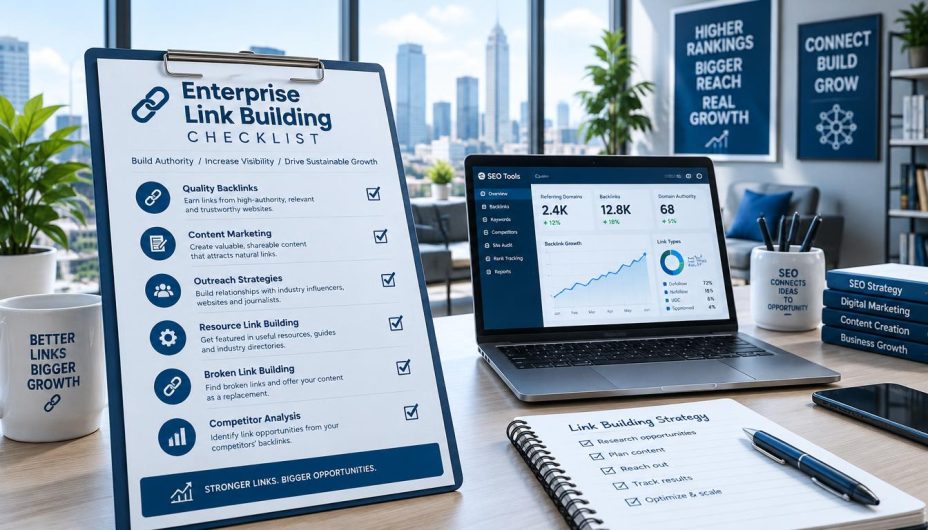
Enterprise Link Building Checklist
- Define one owner for the overall program.
- Create a shared publisher and outreach database.
- Document agency and regional-team permissions.
- Prioritize target pages according to business and search value.
- Identify genuine reasons publishers would reference each asset.
- Invest in original research, useful data, tools and expert insight.
- Separate editorial outreach from paid promotion.
- Use
rel="sponsored"or appropriate qualification for compensated links. - Use
rel="ugc"where user-generated links require it. - Do not force exact-match anchor text.
- Do not buy followed links for ranking purposes.
- Do not require ranking-credit links in commercial contracts.
- Coordinate outreach across brands, regions and vendors.
- Check existing publisher relationships before new outreach.
- Reclaim useful unlinked brand mentions.
- Fix broken linked resources with relevant redirects where appropriate.
- Record publisher, target URL, anchor and link attribute.
- Measure referral traffic and qualified actions.
- Monitor target-page search performance without claiming direct causation.
- Review questionable backlink tactics against Google’s current spam policies.
- Use the Disavow Tool only when Google’s conditions genuinely apply.
- Review strategy periodically when business priorities or markets change.
This checklist keeps enterprise link building focused on editorial value, scalable operations and sustainable risk management.
Frequently Asked Questions
What is enterprise link building?
Enterprise link building is a scalable process for earning and managing legitimate external links for large websites through digital PR, useful resources, publisher relationships, governance, regional coordination and consistent measurement.
How is enterprise link building different from normal link building?
The fundamental goal is similar, but enterprise programs involve more websites, target pages, markets, teams, agencies, approvals and risk controls. Governance and coordination therefore become much more important.
Does enterprise link building guarantee better Google rankings?
No. Relevant editorial links can support discovery, referral traffic and broader search visibility, but no legitimate link-building strategy can guarantee a particular ranking or traffic improvement.
Should enterprise teams buy backlinks?
Buying links for the purpose of manipulating Google rankings violates Google’s link-spam policies. Genuine advertising and sponsorships can exist, but links should be appropriately qualified, such as with rel="sponsored" or an accepted alternative.
Are nofollow links useful for enterprise campaigns?
They can be. A relevant nofollow mention may send referral traffic, build brand visibility, reach a valuable audience or contribute to publisher relationships. It should not be presented as guaranteed ranking credit.
What content earns enterprise backlinks?
Useful original research, first-party data, industry analysis, expert commentary, tools, calculators, reports, templates and timely information can create legitimate reasons for publishers to reference a brand.
Should link building focus on DA or DR?
No single third-party authority metric should determine whether a placement is valuable. Evaluate publisher relevance, editorial standards, audience quality, context, referral potential and business fit alongside any research metrics you use.
When should an enterprise use Google’s Disavow Tool?
Google says most sites do not need it. Consider disavowal when a considerable number of spammy or artificial backlinks have caused, or are likely to cause, a manual action and removal efforts have not solved the problem.
How should enterprise link-building success be measured?
Track editorial placements, publisher relevance, target URLs, referral visits, qualified actions, campaign costs and target-page search trends. Keep correlation and proven causation separate when discussing ranking changes.
Conclusion
Enterprise link building succeeds when scale is controlled by clear governance rather than measured only by backlink volume. Large organizations need shared publisher databases, target-page priorities, outreach standards, agency controls, regional coordination and transparent reporting.
The strongest enterprise link building campaigns create legitimate reasons for coverage through original research, useful resources, expert insight, digital PR and genuine relationships. They also keep paid and sponsored relationships clearly separated from independent editorial links.
Most importantly, enterprise link building should support both people and business goals. Measure whether placements reach the right audiences, send qualified visitors, strengthen visibility and support useful content rather than chasing arbitrary authority scores or guaranteed ranking outcomes.
Continue with our Off-Page SEO & Link Building hub, nofollow links guide, Google disavow guide, B2B SEO guide, Content SEO resources, Technical SEO resources, SEO Tools & Analytics resources, AI Search & SEO resources, full article library, and the Online SEO Blogs homepage.